


When a start date is looming or your current visa is set to expire, the standard USCIS waiting period can feel risky. H-1B Premium Processing is an optional service designed to fast-track your petition to the front of the line.
But with costs rising, is it a necessary investment or an avoidable expense? Here is everything you need to know to make an informed decision.
Key Takeaways
- Cost: Premium processing costs $2,965 and guarantees a USCIS decision within 15 business days.
- Timing is Everything: It is most valuable when facing an approaching start date, expiring status, or an employment gap.
- The Clock Can Restart: If USCIS issues a Request for Evidence (RFE), the 15-day window restarts only after you submit your response.
- Eligibility: Available for H-1B initial petitions, extensions, transfers, and amendments.
- How Ellis Helps: We manage your entire petition and ensure your timeline is protected. Get in touch today.
What is H-1B Premium Processing?
Premium processing is an expedited service offered by USCIS. By filing Form I-907, you move your case into a priority queue.
Important: USCIS guarantees a decision within 15 business days, not an approval. Within this window, you will receive one of the following:
How Much Does It Cost?
As of March 2026, the H-1B premium processing fee is $2,965.
- Who pays? Usually, the employer covers this fee. However, if the employee requests the speed-up for personal reasons (like urgent travel), the employee may be permitted to pay, depending on internal company policy and DOL regulations.
- Payment Method: Paid via check, money order, or credit card (Form G-1450).
How Long Does the Process Take?
The "15-day" guarantee refers specifically to business days. Weekends and federal holidays are excluded.
Important Note on RFE: If USCIS issues an RFE, the 15-day clock stops immediately. Once you file your response, a new 15-business-day window begins from the date USCIS receives your evidence.
Which H-1B Cases are Eligible?
You can use premium processing for most H-1B categories, including:
- Initial Petitions: Both Cap-subject and Cap-exempt.
- Extensions: Continuing employment with the same employer.
- Transfers: Moving to a new employer.
- Amendments: Significant changes to job duties or location.
Note: This service is also available for other visas like L-1, O-1, TN, and certain I-140 petitions.
Premium Processing and International Travel
For most visa types, a pending petition filed under regular processing can significantly limit your ability to travel internationally—and this is often underestimated.
- A pending case and international travel do not mix well. If you travel while an H-1B extension, transfer, or amendment is pending, you may be unable to return until USCIS decides and you obtain a new visa stamp at a consulate. Appointments can take weeks or months.
- This applies to other visa types too. Workers on L-1, O-1, TN, and other employer-sponsored statuses face the same constraint. A pending regular-processing petition can effectively put international travel on hold.
- Premium processing removes that uncertainty. With a decision in 15 business days, you can plan travel around a known timeline rather than an open-ended wait.
- Advance Parole holders should take extra care. If you travel on Advance Parole rather than a visa stamp, any pending petition should generally be resolved before you depart.
If you have international travel planned—for work, family, or any other reason—factor this into your decision.
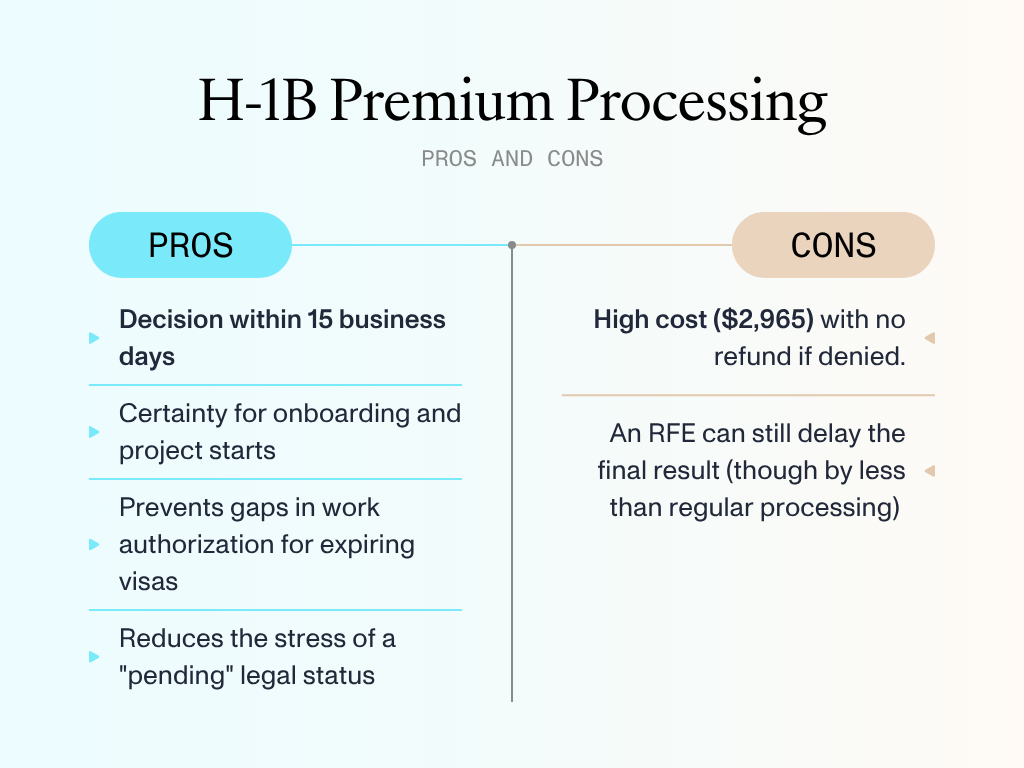
Pros and Cons at a Glance
The main benefit of premium processing is the fact that a decision is guaranteed much faster (in 15 business days), while the main drawback is the hefty price tag of $2,965.
Is it Worth It?
Whether you should pay the fee depends on your specific timeline.
It IS usually worth it if:
- Your current H-1B status or EAD expires in less than 60 days.
- You are transferring to a new company and want to leave your current job safely.
- You have urgent international travel plans that require a valid visa stamp.
It IS NOT usually worth it if:
- You are filing an extension 6 months in advance.
- You have the "240-day rule" protection and don't plan to travel.
- Current USCIS "Regular" processing times for your service center are under 60 days.
How to Apply
- Concurrent Filing: Submit Form I-907 at the same time as your H-1B petition.
- Upgrading a Pending Case: If you already filed via regular processing, you can "upgrade" to premium at any time by mailing Form I-907 and the fee to the service center handling your case.
Expert Guidance for Your H-1B Journey
Navigating USCIS timelines and H-1B petitions is stressful. At Ellis, we streamline the entire process for our clients—from document preparation to tracking the 15-day window.
Schedule a consultation today.
This article is for general informational purposes only and does not constitute legal advice. Immigration laws and USCIS fees are subject to change.