


In short: H-1B portability lets you start working for a new employer as soon as the transfer petition is filed — you don't have to wait for approval. As long as your current H-1B is valid and the new employer files before it expires, your work authorization continues without a gap.
Key Takeaways
- You can change H-1B employers without losing your status, as long as the new employer files a valid H-1B transfer petition while your current status is still valid
- You can start working for the new employer the day the petition is filed — no need to wait for USCIS approval
- The 240-day rule may allow you to keep working even if your H-1B expires while the transfer is pending
- H-1B portability governs your work status — it's separate from AC21 green card portability, which protects your I-140 and priority date
- Get in touch with Ellis today — we handle H-1B transfers end-to-end, from LCA filing to approval
What Is H-1B Portability?
H-1B portability is the rule that lets H-1B workers move to a new employer without losing their work authorization. Under standard immigration rules, a foreign national on an employer-sponsored visa is tied to that specific employer — leaving can mean losing status. H-1B portability removes that constraint for workers in specialty occupations.
The rule comes from the American Competitiveness in the Twenty-First Century Act (AC21) of 2000. It allows an H-1B worker to begin employment with a new employer as soon as the new H-1B petition is filed, rather than waiting months for USCIS to approve it. This protects workers from gaps in employment authorization and gives employers access to H-1B talent without lengthy delays.
H-1B portability applies to your work status only. If you also have a pending green card case, a separate rule — INA §204(j) — governs whether your I-140 and priority date can carry over to the new employer.
Core Eligibility Requirements
To use H-1B portability when changing employers, three conditions must be met:
- Valid H-1B status — Your current H-1B must be valid at the time the new petition is filed. If your status has already expired, portability does not apply.
- New H-1B petition filed — The new employer must file a valid Form I-129 H-1B petition with a certified Labor Condition Application (LCA) before your current status expires.
- Non-frivolous petition — The petition must be filed in good faith for a legitimate specialty occupation role. USCIS may deny portability if the petition is clearly without merit.
H-1B cap-exempt employers — universities, nonprofits affiliated with universities, and certain government research organizations — can file at any time of year. Cap-subject employers must work within the annual H-1B lottery unless the worker is already in H-1B status, in which case a transfer does not require a new cap slot.
How the Transfer Works
Step 1: New employer files LCA Before filing the H-1B petition, the new employer must obtain a certified Labor Condition Application from the Department of Labor. The LCA confirms the prevailing wage for the role and worksite. Standard LCA processing takes 7 business days.
Step 2: File Form I-129 Once the LCA is certified, the new employer files Form I-129 with USCIS. The petition must include the LCA, job offer letter, and supporting documentation for the specialty occupation.
Step 3: Employee starts work The H-1B worker may begin working for the new employer the day USCIS receives the petition — not when it's approved. Keep a copy of the filing receipt as proof of authorized employment.
Step 4: Await approval USCIS processes the petition under standard processing timelines, typically 3–6 months. Premium processing (15 business days) is available for an additional fee — see current USCIS processing times to decide if it's worth it. The worker remains authorized to work throughout.
Note: If USCIS denies the transfer petition, the worker's authorization to work for the new employer ends. The original employer's petition may still be valid depending on timing.
The 240-Day Rule
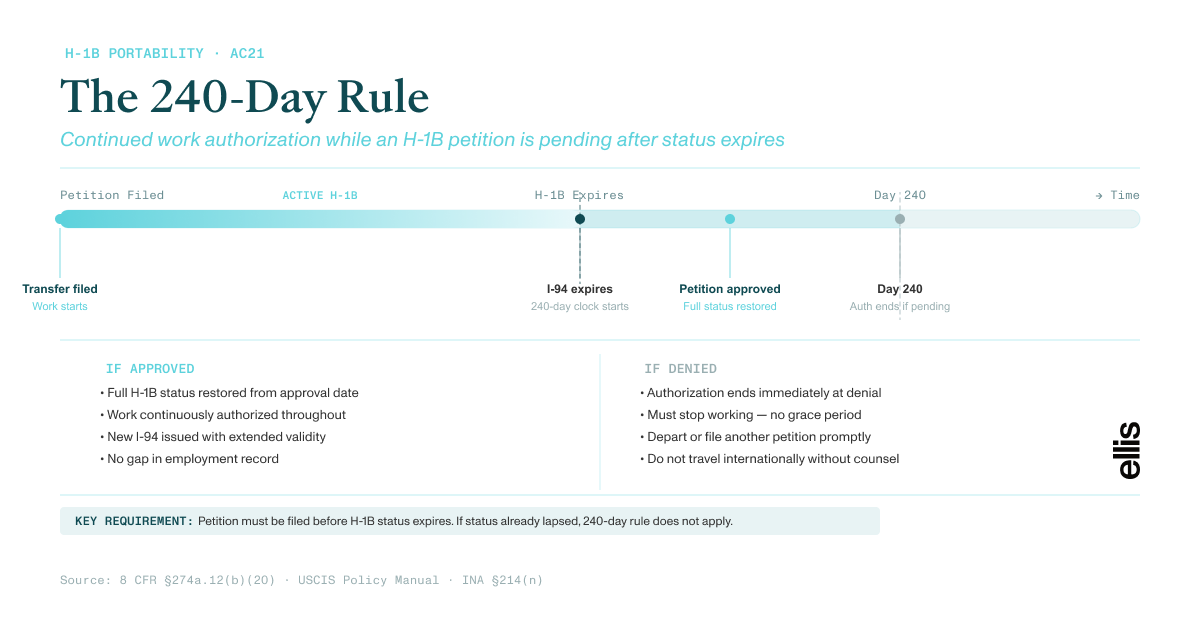
The 240-day rule protects H-1B workers whose status expires while a timely-filed extension or transfer is still pending. If your H-1B expires and a valid petition to extend or transfer it was filed before expiration, you may continue working for up to 240 days while USCIS adjudicates the case.
Requirements:
- The extension or transfer petition must have been filed before the current H-1B expired
- The 240-day period starts the day after the I-94 expiration date
- Work authorization ends if USCIS denies the petition or the 240 days runs out, whichever comes first
The 240-day rule applies to extensions and transfers filed with the same employer or a new one. It does not apply if status expired before any petition was filed. Workers relying on the 240-day rule generally should not travel internationally without counsel's advice — see Ellis's guides on H-1B travel restrictions and advance parole for details.
H-1B Portability and a Pending Green Card
Many H-1B workers are also partway through the employment-based green card process. H-1B portability and green card portability are separate rules — understanding both matters when changing jobs.
H-1B Portability | AC21 Green Card Portability | |
|---|---|---|
What it protects | H-1B work status | Approved I-140 and priority date |
Trigger | New employer files H-1B petition + LCA | 180+ days I-485 pending, same or similar job |
Work authorization | Can start upon filing | Flows from EAD or H-1B status |
180-day rule | No | Yes |
If you have a pending I-485 and want to change jobs, you likely need to assess both: H-1B portability to continue working, and INA §204(j) to protect your green card progress. Maintaining active H-1B status while the I-485 is pending is generally advisable — it enables dual intent, supports international travel, and provides a fallback if the I-485 is denied.
Workers with both a pending I-485 and an active H-1B who change jobs should file both a new H-1B transfer petition and Supplement J (once the I-485 has been pending 180+ days) to protect both tracks.
Common Scenarios
Scenario 1: Straightforward transfer
A software engineer on H-1B accepts an offer at a new company. The new employer files the H-1B petition and LCA before her current status expires. She starts the new job the day the petition is received by USCIS. No cap slot needed — she's already in H-1B status.
Scenario 2: Transfer with pending I-485
An H-1B worker with a pending EB-2 I-485 (pending 210 days) changes employers. His attorney files a new H-1B petition for the new employer and files Supplement J with USCIS to port the green card case. Both tracks — work status and green card — are protected.
Scenario 3: 240-day situation
An H-1B worker's status expires while her extension petition is pending. She continues working under the 240-day rule. The petition is approved at day 150, restoring her full H-1B status. Had it been denied, her authorization would have ended immediately.
Common pitfalls:
- Waiting to file the new H-1B petition until after the current status expires — portability no longer applies
- Assuming there's unlimited time after a layoff — H-1B holders have a 60-day grace period to find a new sponsor and file a transfer petition; see Ellis's guide for workers laid off on H-1B
- Traveling internationally while relying on the 240-day rule without immigration counsel review
- Forgetting to also address green card portability when both an H-1B and I-485 are in play
- Letting the LCA lag behind — the petition cannot be filed without a certified LCA
How Ellis Helps
Ellis is a business immigration law firm and platform built for employers. Ellis handles H-1B transfers end-to-end: LCA filing with the Department of Labor, I-129 petition preparation, 240-day rule tracking, and HRIS integration that flags expiring status before it becomes a problem. For workers with a pending green card, Ellis coordinates H-1B and AC21 portability in parallel.
Get in touch today to keep every H-1B transfer on track.