

In Brief: The Supreme Court ruled 6-3 on June 23, 2026 that CBP can treat any returning green card holder as "seeking admission" with no prior exception required. For any permanent resident ever convicted of a crime, international travel now carries serious risk.
Key Takeaways
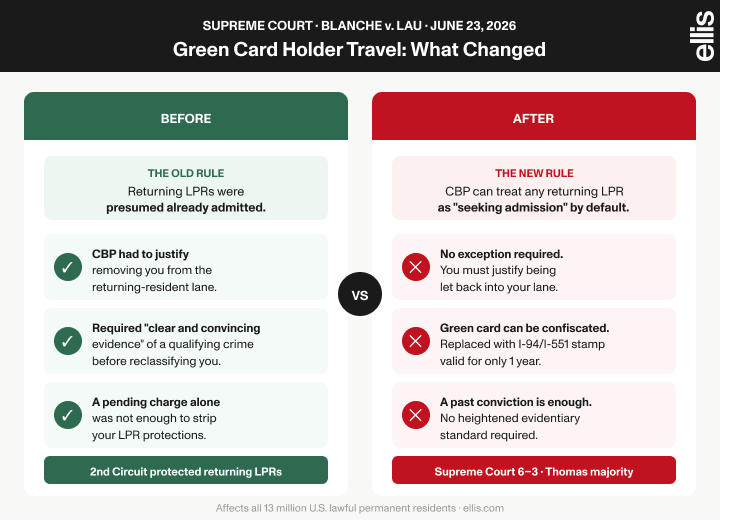
- Before: Returning green card holders were presumed admitted. CBP needed a specific legal exception to treat you otherwise.
- After: CBP can now treat any returning green card holder as seeking admission by default. No exception needed.
- What that means: CBP can confiscate your green card and issue a 1-year temporary document (I-94/I-551 stamp) instead, which causes problems with jobs, banks, housing, insurance, and schools.
- Worst case: You could end up in removal proceedings and lose your green card permanently.
- Who's most at risk: Anyone ever convicted of a crime who travels internationally.
What Are the New Green Card Holder Travel Restrictions?
The Supreme Court's ruling in Blanche v. Muk Choi Lau introduced new travel rules for green card holders that overturn the legal framework governing reentry to the U.S. for decades.
The case started in 2012. Muk Choi Lau had been a lawful permanent resident since 2007. After being charged with trademark counterfeiting in New Jersey, he briefly left the U.S. When he returned, CBP treated him as someone seeking admission for the first time rather than as a returning resident. He had not been convicted of anything at that point.
The Second Circuit Court of Appeals said CBP was wrong. It required "clear and convincing evidence" of a qualifying crime before CBP could treat a returning green card holder that way. The Supreme Court reversed that 6-3. Justice Clarence Thomas wrote that no such evidentiary standard exists in the Immigration and Nationality Act.
"We decline to read into the INA an additional clear-and-convincing-evidence burden on border officers entrusted with making 'quick judgments on the spot' when that burden is nowhere in the statute," Thomas wrote.
The short version: Before this ruling, CBP had to justify pulling you out of the returning-resident lane. Now, you have to justify being let in.
What Does "Seeking Admission" Mean for Your Green Card?
Being classified as "seeking admission" instead of "returning resident" is a big deal. Here's the difference.
As a returning resident, you have the full rights of a lawful permanent resident. CBP processes you and you leave with your green card.
As an applicant for admission, you have the same legal standing as someone entering the U.S. for the first time. CBP can take your green card and give you an I-94 document with an I-551 stamp instead. That stamp is only valid for one year.
A 1-year I-551 stamp can cause real problems in daily life:
- Work: Employers may reject it during I-9 employment verification.
- Banking: Financial institutions may not accept it as proof of status.
- Housing: Landlords may question or refuse it.
- Insurance: Providers may flag or cancel coverage.
- Schools: Educational institutions may ask for additional documentation.
From there, you may be placed in removal proceedings and face deportation. If removal is ordered, or if you miss a legal notice, you can lose your green card entirely. Understanding your green card holder rights before you travel is the only way to protect against this outcome. Some people end up stuck with only temporary documents for months or years with no clear path back.
Can Green Card Holders Travel Internationally Right Now?
Green card holders can legally travel internationally; this ruling does not ban travel. What it changes is what can happen when you come back.
For green card holders with no criminal history, the practical risk is lower, though the ruling gives CBP broader power than before.
For anyone with a criminal history, the risk at reentry is much higher now. Before you travel, talk to an immigration attorney if any of these apply to you:
- You have ever been convicted of a crime, even a minor one
- You have a pending charge, even one that seems resolved
- A charge was dismissed or reduced in criminal court (that does not clear it for immigration purposes)
- You had an arrest that never led to a conviction
- You have prior law enforcement interactions involving fraud, dishonesty, theft, or drug offenses
What Is the New Warning for Green Card Holders?
The Blanche v. Lau ruling is the most significant change for green card holders in 2026. It combines with a May 2026 USCIS memo restricting adjustment of status and ongoing federal court battles over immigration processing. Green card holders are navigating the most uncertain legal environment in recent memory.
The clear warning from immigration attorneys after today: do not travel internationally if you have ever been convicted of a crime without first speaking to an immigration lawyer. A plea deal, a reduced charge, a dismissed case: none of these automatically protect you at the border anymore. Criminal court outcomes and immigration law use different standards.
Are Green Card Holders Being Detained at Airports?
Reports of green card holders being stopped, questioned, and detained at U.S. airports increased significantly in 2025 and 2026. Before today, some of those detentions were legally contested. After Blanche v. Lau, CBP has broader legal authority to detain and reclassify returning green card holders with fewer procedural requirements.
In the worst-case scenario, CBP could use this ruling to reclassify large numbers of returning green card holders at once, funneling them into removal proceedings. Those who cannot afford legal help or who miss official notices could lose their green card status by default.
What Green Card Holders Should Do Now
If you have any criminal history and plan to travel, talk to an immigration attorney before your trip. This includes past convictions, pending charges, dismissed cases, reduced charges, and old arrests. The immigration standard is different from the criminal one.
If you are reclassified at the border, do not sign anything and do not agree to voluntary departure without speaking to an attorney first. Voluntary departure gives up important rights. The temporary I-94/I-551 stamp you receive has real consequences for employment, housing, and status.
If your record is clean, review your full history with an attorney if you travel often. Government data errors and changing enforcement policy create risks that a clean record alone does not fully eliminate.
Questions about how Blanche v. Lau affects your green card or travel plans? Contact Ellis for a free consultation.
The information on this page is for general informational purposes only and does not constitute legal advice.