In Brief: USCIS recently issued Policy Memorandum PM-602-0199, reframing adjustment of status (AOS) as an "extraordinary form of relief." While media headlines suggest this ends the green card process for internal applicants, a legal analysis reveals the core statutory rules remain unchanged. This guide breaks down what the memo actually says, its historical flaws, and how to respond to subsequent discretionary Requests for Evidence (RFEs).
On May 21, 2026, U.S. Citizenship and Immigration Services issued Policy Memorandum PM-602-0199 reframing adjustment of status under section 245 of the Immigration and Nationality Act as "an extraordinary form of relief" and "a matter of administrative grace." A press release the following day went further, declaring that, from now on, "an alien who is in the U.S. temporarily and wants a Green Card must return to their home country to apply, except in extraordinary circumstances."
The widespread interpretation — picked up by the New York Times the same day under the headline "Green Card Seekers Must Leave U.S. to Apply, Trump Administration Says" — has been that USCIS is effectively ending adjustment of status as we know it and will force the vast majority of applicants to pursue consular processing abroad.
If that interpretation is right, it is a problem for a great many people.
Why This Matters for Green Card Applicants
- Consular processing is incredibly time-consuming right now. Processing times still have not recovered from COVID. For most categories at most consulates, the wait is well over a year, often closer to two. That remains true even for spouses of U.S. citizens, who have historically been given priority under U.S. immigration law.
- Many adjustment applicants have lives already established in the United States. They are working, studying, raising children, building businesses. A huge number of them are doing so lawfully on valid nonimmigrant statuses. Asking them to uproot for a year or more of consular processing, leaving employers, schools, mortgages, and family ties behind, is not a minor inconvenience.
- For out-of-status applicants, leaving the country can trigger a 3-year, 10-year, or even permanent bar to reentry, depending on their accrued unlawful presence and prior immigration history. Provisional waivers exist for some of these bars, but the I-601A is itself taking years to adjudicate.
Putting this together, if USCIS is in fact ending adjustment of status, this would be a watershed moment in U.S. immigration policy, somewhere between an inconvenience and a devastation for would-be green card applicants.
This post explores three questions:
- What does the memo actually say — and what does it not say? Is the administration truly ending adjustment of status, as the headlines suggest?
- What is the administration right about, and what is it wrong about? The memo offers a potted history of adjustment of status and concludes that AOS was always disfavored relative to consular processing. Is that true? Is it what Congress intended? And to the extent it once was, is it still?
- What does this mean in practice — both worst case and best case? How will USCIS actually implement this? What options do applicants have? For those who are denied, is there a way to fight it? And what do Supreme Court decisions like Patel v. Garland mean for them?
Before getting to any of that, a primer on what adjustment of status actually is.
What Is Adjustment of Status?
Section 245 of the Immigration and Nationality Act (INA) allows certain people to obtain lawful permanent resident status (a green card) from within the United States, rather than having to apply for an immigrant visa at a U.S. consulate abroad. To qualify under §245(a), the applicant generally has to have been lawfully admitted or paroled into the country and to have maintained that status.
Congress carved out exceptions. Immediate relatives of U.S. citizens are forgiven post-entry status violations and unauthorized employment — though they still must have been inspected and admitted or paroled to qualify. Most employment-based applicants are allowed up to 180 days aggregate out of status under §245(k). VAWA self-petitioners get their own carve-outs. And §245(i) — though the filing deadline to grandfather a qualifying petition or labor certification was April 30, 2001 — still allows certain grandfathered individuals to adjust despite unlawful entry or out-of-status work.
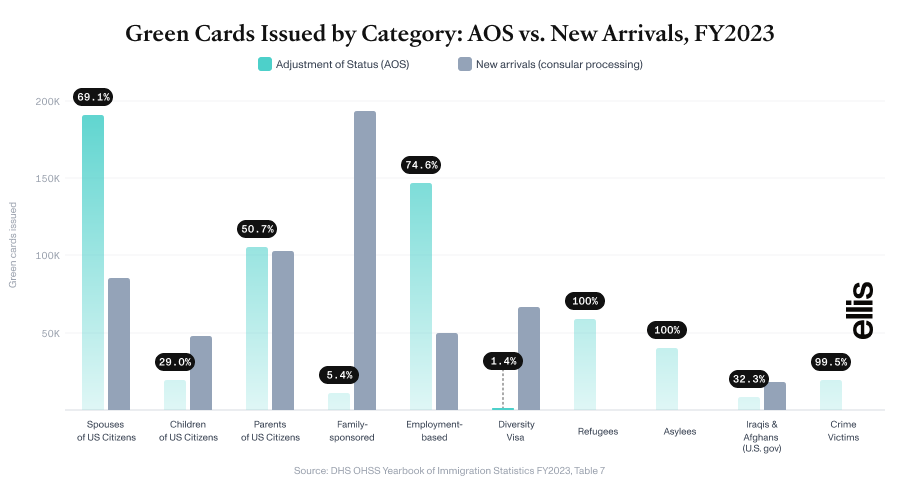
Roughly half of all new green cards each year are issued through adjustment of status — 52% in FY 2023, and the AOS share has been higher in some recent years. The other half come from consular processing abroad. For many applicants, AOS is strongly preferred. The consular alternative is slow, forces departure from the United States, and for those with any unlawful presence it triggers the 3- and 10-year bars at the moment of departure.
The discretionary element
Beyond the basic eligibility requirements, adjustment of status carries what is known as a discretionary element. That extra requirement comes from ten words buried in section 245: an applicant's status "may be adjusted by the Attorney General, in his discretion."
Those six words drop adjustment of status into an entirely different category of immigration benefits: the discretionary ones. Other examples include hardship waivers under §212(h), some inadmissibility waivers, and several forms of relief from removal such as cancellation of removal. For each of these, meeting the bare statutory requirements is not enough. The applicant must also show, based on the totality of the circumstances, that they warrant a favorable exercise of discretion.
That extra step is one most adjustment applicants never think about. There are two reasons for that.
The first is doctrinal. For decades, the Board of Immigration Appeals has held that, in the absence of adverse factors, adjustment of status will ordinarily be granted. Matter of Arai, 13 I&N Dec. 494, 496 (BIA 1970). Discretion is built in, but the thumb is on the scale toward approval for the applicant with a clean record.
The second is practical. In my experience (much of which has been spent handling complex deportation cases, many of them involving criminality and almost all involving immigration violations), I have seen exactly one discretionary adjustment denial in my entire career. The applicant in that case was lawfully present on a valid work visa and had no criminal convictions that would have rendered him strictly ineligible. What he did have was a string of civil complaints filed against him by the Securities and Exchange Commission, all of which came to light during his adjustment process. Strictly speaking, those SEC complaints did not make him inadmissible or render him ineligible for adjustment. But the adjudicating officer concluded that the seriousness of civil enforcement actions filed against a green card applicant by a federal body was enough to find that he did not warrant the privilege of adjusting within the United States.
That is how rare these denials have been. Discretion is a real legal element of every adjustment case, but it has historically been a vanishingly small operational factor.
Patel v. Garland and the reviewability problem
One last thing to know about discretionary relief: federal court review of these decisions is sharply limited. Congress in IIRIRA (1996), refined by the REAL ID Act in 2005, stripped the courts of general jurisdiction to review discretionary immigration decisions, with a carve-out for legal and constitutional claims.
The Supreme Court's 2022 decision in Patel v. Garland made the picture even harder. Patel held that federal courts may not review factual findings that underlie discretionary denials under §1255 and the other enumerated forms of discretionary relief. Courts can still review the legal and constitutional framework — whether the officer used the right legal test, whether the procedure was fair — but they cannot revisit, say, an officer's finding that an applicant lied to a consular officer about their intent to stay temporarily.
This matters for the new memo because the more USCIS adjudicators are encouraged to convert adverse facts into discretionary denials, the more they are operating in an area of limited judicial oversight. There is a real risk that officers will feel emboldened by Patel to treat discretionary denial as a kind of loophole: a way to deny applications based on findings the courts cannot revisit. Whether that is actually how this will play out is something we will return to below.
What Does USCIS Policy Memorandum PM-602-0199 Actually Say?
Critical to this analysis is the fact that USCIS released two documents on May 22.
The first is the policy memorandum itself, PM-602-0199, which instructs officers on how to conduct the discretionary analysis for adjustment applications.
The second is a press release announcing the memo. And it is the press release, not the memo, that contains the most inflammatory language. USCIS Spokesman Zach Kahler is quoted as saying:: "From now on, an alien who is in the U.S. temporarily and wants a Green Card must return to their home country to apply, except in extraordinary circumstances."
A plain reading of that statement would suggest that USCIS is now instructing officers to look for "extraordinary circumstances" before approving any adjustment application.
The problem is that the phrase "extraordinary circumstances" appears nowhere in the actual memo. Officers are not instructed to evaluate whether extraordinary circumstances exist. The memo does not define what such circumstances would be. The standard simply does not appear.
Three Standards, None of Them Consistent
After backlash to the initial announcement, USCIS Spokesman Kahler released yet another statement — this one picked up by TIME magazine the following day — saying that "people who present applications that provide an economic benefit or otherwise are in the national interest will likely be able to continue on their current path while others may be asked to apply abroad depending on individualized circumstances." So in 48 hours, USCIS had articulated three different standards for who can adjust:
- Standard 1 (The Memo): A totality-of-the-circumstances weighing of equities against adverse factors, with "unusual or even outstanding equities" required only when adverse factors are present. This is the only standard in the binding document.
- Standard 2 (The Press Release):Adjustment only in "extraordinary circumstances" — a phrase that appears nowhere in the actual memo.
- Standard 3 (Statement to TIME): Applicants who offer "an economic benefit or otherwise are in the national interest" — also absent from the memo.
None of these are reconcilable with each other. Only the first purports to bind the agency. When officers eventually deny cases, they will have to use the standard in the memo — the other two were press-release sound bites.
So what does the memorandum actually say? In bullet form:
- It provides a legal history, citing a curated selection of administrative and judicial decisions characterizing adjustment of status as "extraordinary," a "matter of administrative grace," and "not designed to supersede the regular consular visa-issuing processes." This language has indeed appeared in various forms in immigration decisions for the better part of 70 years.
- It asserts that Congress did not intend AOS to supplant or supersede consular processing as the mechanism for obtaining lawful permanent residence.
- It reviews the eligibility limits Congress placed in §245, noting that status violations and lack of lawful entry bar most applicants from §245(a).
- It reviews the discretionary analysis required for every adjustment case. Here the memo leans heavily on Matter of Blas, 15 I&N Dec. 626 (BIA 1974; A.G. 1976), and the line that adverse factors may need to be offset by "a showing of unusual or even outstanding equities."
- It instructs officers to consider violations of immigration law, conditions of any status held, fraud, and other misconduct as relevant to the discretionary analysis — while reminding officers that they must still weigh all the circumstances and issue a denial notice explaining the specific reasons for denial.
To repeat the question: what does it actually say?
In this practitioner's view, not actually that much. But to see why, you have to understand how AOS got to where it is now — because the memo's central rhetorical move is to anchor itself in a world that no longer exists.
From Exception to Default: The Adjustment of Status Story
The memo's foundational claim is that adjustment of status is "extraordinary" relief that "was not designed to supersede the regular consular visa-issuing processes." That was a defensible claim in 1965. It is an extremely difficult claim to make in 2026, because Congress has spent the intervening 60 years systematically converting AOS from a narrow exception into the default route to permanent residence for huge categories of immigrants.
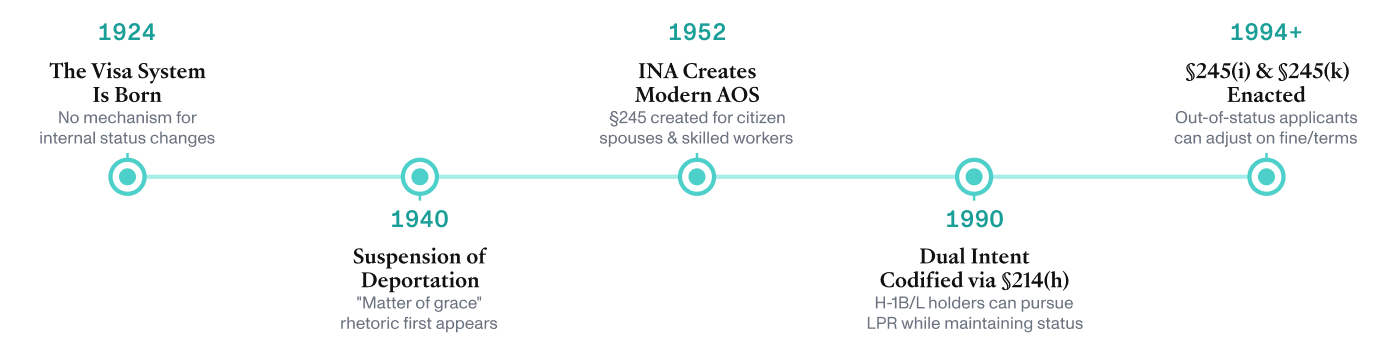
1924 — The visa system is born, with no AOS. The Immigration Act of 1924 created the consular visa-issuing system, drew the line between immigrants and nonimmigrants, established the first nonimmigrant visa categories, and formalized exclusion and deportation. It provided no mechanism to change one's status from within the United States. Immigration officials at the time complained that even judges had no tool to help a deserving deportee other than to recommend voluntary departure.
1929 — Registry. The Registry Act of 1929 allowed long-resident noncitizens who could prove continuous residence since a fixed date to obtain lawful permanent resident status. This was a narrow remedy for an entrenched problem, not a general route to LPR.
1940 — Suspension of deportation. As part of the Alien Registration Act, Congress added suspension of deportation as a form of relief from deportation, authorizing the Attorney General to suspend deportation of certain deportable noncitizens with good moral character who could make certain showings, such as that their removal would cause "serious economic detriment" to a U.S. citizen or LPR spouse, parent, or child. This is the statutory ancestor of the "matter of grace" rhetoric the memo now invokes. It was a form of relief from deportation, available to people who were already adjudicated removable. The Supreme Court's seminal "matter of grace" decision — Jay v. Boyd, 351 U.S. 345 (1956) — was a suspension case, decided 5-4 in the McCarthy era. So was U.S. ex rel. Kaloudis v. Shaughnessy, 180 F.2d 489 (2d Cir. 1950), the Learned Hand decision that first compared this discretionary relief to "a judge's power to suspend the execution of a sentence, or the President's [power] to pardon a convict." The framing presupposed a noncitizen already adjudicated removable. In Hand's words, this was the equivalent of "a convict."
1952 — The INA creates modern AOS (nonimmigrant->immigrant). The Immigration and Nationality Act of 1952 (the McCarran-Walter Act) did two foundational things. First, it created the petition-based immigration system: most prospective immigrants now needed a U.S. citizen or LPR relative or a U.S. employer to file a petition on their behalf. Second, and critically, it created section 245 — adjustment of status as we use the term today, allowing a nonimmigrant to convert to immigrant status from within the United States, without first being placed in deportation. The 1952 House and Senate Reports identified two groups Congress specifically intended to benefit: spouses of U.S. citizens, and individuals with valued skills. Those are precisely the populations now most exposed to the memo. The doctrine the memo invokes was developed for deportation proceedings; the population the memo applies it to was the population Congress was actually trying to help.
1965 — Hart-Celler ends the national-origins quotas. The 1965 Amendments dismantled the country-of-origin quota system, replaced it with the modern preference categories, and set the stage for the family-and-employment-based system we have today. AOS volume began to climb. (Notably, the petition system did not yet apply to Western Hemisphere immigrants — until the 1976 Amendments took effect on January 1, 1977, a Brazilian could essentially walk into the U.S. consulate and apply for an immigrant visa with no I-130 having been filed. The new 120,000-person Western Hemisphere annual cap and the labor certification requirement Congress had imposed in 1965 applied; the preference system did not.)
1990 — Dual intent is codified. The Immigration Act of 1990 created the modern nonimmigrant visa landscape, including several dual intent categories. Through INA §214(h), Congress explicitly provided that the filing of an immigrant petition is not evidence of intent to abandon a foreign residence for H-1B(b) and L visa holders. (The O visa, also created by the 1990 Act, is treated as functionally dual intent through agency policy.) This is the single most important fact for evaluating the memo's "Congress expects them to depart" framing. For huge categories of working professionals, Congress did not expect them to depart. Congress designed visa categories specifically to permit applicants to maintain temporary status while simultaneously pursuing permanent residence. The memo's framing simply does not describe these statutes.
1994 and after — §245(i) and §245(k). Section 245(i), enacted in 1994 and extended multiple times before the LIFE Act fixed a final filing deadline of April 30, 2001, allowed many out-of-status and even EWI applicants to adjust on payment of a fine — expressly contemplating that AOS would be used by people who had violated immigration laws. Section 245(k), enacted in 1997, allows employment-based applicants up to 180 aggregate days out of status. These provisions are direct congressional answers to the very rhetoric the memo now revives. Congress, repeatedly and explicitly, has chosen to expand AOS to populations that the "extraordinary grace" doctrine would treat as undeserving.
1996 — IIRIRA's bars. And then, in a twist often overlooked, IIRIRA's 3- and 10-year unlawful-presence bars made consular processing actively punitive for many noncitizens. If an out-of-status applicant departs to attend a consular interview, they may trigger a bar at the moment of departure that they would not have triggered by remaining and adjusting. The "regular consular visa-issuing process" the memo invokes is, for a substantial slice of the AOS population, no longer a benign alternative. It is a trap. Congress was aware of this — and the response, in the I-601A provisional waiver and elsewhere, has been to ease the path, not to entrench the trap.
What the trajectory shows is this: every congressional intervention since 1952 has moved AOS in one direction: toward making it broader, easier, and more accommodating of past noncompliance. The "extraordinary grace" cases, the "not designed to supersede consular processing" rhetoric, the "matter of administrative grace" framing — all of that doctrine reflects an era when AOS was novel, narrow, and applied mostly in deportation contexts to people who were already on the brink of removal. None of it reflects the law Congress has actually built.
This is what makes the memo's appeal to "longstanding" doctrine so misleading. The doctrine isn't false. It's anachronistic. It's quoting Congress's first attempt at a tool from 1952 and ignoring the next seventy years of Congress's revisions.
What the Memo Gets Right
With that history in mind, here is what is actually defensible in the memo.
- Adjustment of status is, in fact, discretionary. Section 245(a) says so on its face. Not every eligible applicant is entitled to a grant.
- Adverse immigration history can and should be considered. Officers have arguably been instructed to look the other way on some of these things for too long. Re-emphasizing that adverse factors actually count is not an outrageous policy position on its own.
- Officers need to take a totality-of-the-circumstances view. True, and not new. Matter of Mendez-Moralez, 21 I&N Dec. 296 (BIA 1996), Matter of Marin, 16 I&N Dec. 581 (BIA 1978), and Matter of Arai all already require this.
All of this is correct and defensible. What's left, when you strip the memo down to its defensible core, is essentially a reminder that adjustment is discretionary and adverse factors matter. That is unremarkable. The loaded rhetoric — extraordinary, grace, supersede, circumvent — is doing something else.
What the Memo Gets Wrong
The "Matter of Grace" Doctrine Grew Up in Deportation — Not Adjustment of Status
The "extraordinary form of relief / matter of grace" framing comes overwhelmingly from decisions arising out of deportation proceedings. There is good reason for this -- before the INA was passed in 1952, there was no "legal" adjustment of status. The phrase exclusively referred to people requesting adjustment in response to deportation proceedings.
Even after the INA came into law, thus allowing nonimmigrants to applying for adjustment for the first time, the process remained heavily restricted for the next several decades. That's why nearly all court decisions analyzing adjustment during this period involved its use as a form of relief and not as a commonly used procedural mechanism it has become today.
To illustrate, the chain of those cases runs Kaloudis (1950, suspension/habeas) → Jay v. Boyd (1956, suspension/habeas) → Hintopoulos (1957, suspension) → Ortiz-Prieto (1965, the first BIA decision to apply "administrative grace" to AOS, in a deportation posture) → Chen v. Foley (1967, the Sixth Circuit, importing the Hintopoulos suspension language wholesale into the AOS context). Every later case (Kim, Jain, Rashtabadi, Howell, Eide-Kahayon, Ayanian) is just a quotation chain back to Chen v. Foley.
The doctrine grew up in deportation, was grafted onto AOS by analogy without analysis, and has been recycled as boilerplate for nearly 60 years.
The Matter of Blas Error: The Memo Quotes a Superseded BIA Opinion
The memo seriously misreads Matter of Blas. Blas is the spine of the memo's discretionary analysis, and the memo's most aggressive quotations ("not designed to supersede the regular consular visa-issuing processes") come from the BIA majority's 1974 opinion. But the BIA panel deadlocked on rehearing and the Chairman referred the case to Attorney General Edward H. Levi, who issued the final decision in 1976. Under the governing regulations, the A.G.'s decision is the binding final agency decision; the BIA majority opinion was superseded. The memo's most aggressive quotations come from a superseded BIA opinion that the binding A.G. decision did not adopt.
What A.G. Levi actually held was much more friendly to the applicant. He expressly reaffirmed Matter of Arai's presumption that "in the absence of adverse factors, adjustment will ordinarily be granted." He held that immediate-relative status carries "its own strong equities" and that, in the absence of adverse circumstances, that showing "should prevail." He invoked Griswold v. Connecticut and Loving v. Virginia for the proposition that marital relationships warrant "special solicitude." And he denied Blas himself only because the applicant had made misrepresentations to the consular officer "in furtherance of a concerted plan calculated to produce the equity" he was now asserting — a narrow fraud-adjacent rationale, not a broad statement that AOS is grace.
The Arai Presumption: No Adverse Factors Means Adjustment Is Ordinarily Granted
The memo claims "the absence of adverse factors, by itself, does not demonstrate such unusual or outstanding equities." Technically true, but rhetorically misleading. The Arai framework does not require that an applicant with no adverse factors demonstrate "unusual or outstanding equities." It requires nothing of the kind. The "unusual or outstanding equities" test is a tiebreaker for cases where adverse factors are present. In their absence, adjustment is ordinarily granted. The memo's framing turns the two-track Arai framework into a single demanding standard for everyone — exactly what A.G. Levi rejected in Blas.
It also bears mentioning that Blas did not overrule Arai and that the latter remains binding precedent. In fact, a search of appellate decisions by USCIS's Administrative Appeals Office shows that Arai's most famous sentence, that "a grant an applicant adjustment of status to that of an LPR is generally warranted in the absence of adverse," has been quoted more than 100 times in the past 5 years. Clearly, the AAO still thinks of it as binding.
The Dual-Intent Problem: Congress Designed These Visas for This Exact Purpose
The memo states that "maintaining lawful status in a dual intent nonimmigrant category is not sufficient, on its own, to warrant a favorable exercise of discretion." This is technically correct under existing case law. It is also in tension with everything else the memo says about consular processing being the preferred path. If a dual intent visa holder (by statutory design permitted to simultaneously hold temporary status and pursue immigrant status) is told that maintaining status is "not sufficient" to warrant a grant, the memo owes an explanation of what would be sufficient for the population Congress specifically designed dual intent to accommodate. The memo does not provide one.
"Extraordinary Circumstances" Is Not in the Memo
This is my biggest problem with the memo: it does not actually require "extraordinary circumstances." That phrase is in the press release, not in the memo. We have seen this pattern in other areas where the administration says one thing publicly and something legally narrower in the paperwork. This looks like another example. It sounds good to say that adjustment will only be approved in extraordinary circumstances. But there is no legal authority requiring that, and the memo itself does not impose it. Officers are still required to perform a totality-of-the-circumstances analysis. At most, the memo is a historical and legal reframing of that analysis, and a re-emphasis on adverse factors that probably should have been getting more weight all along.
What to Expect in Practice — and How to Respond to the RFEs
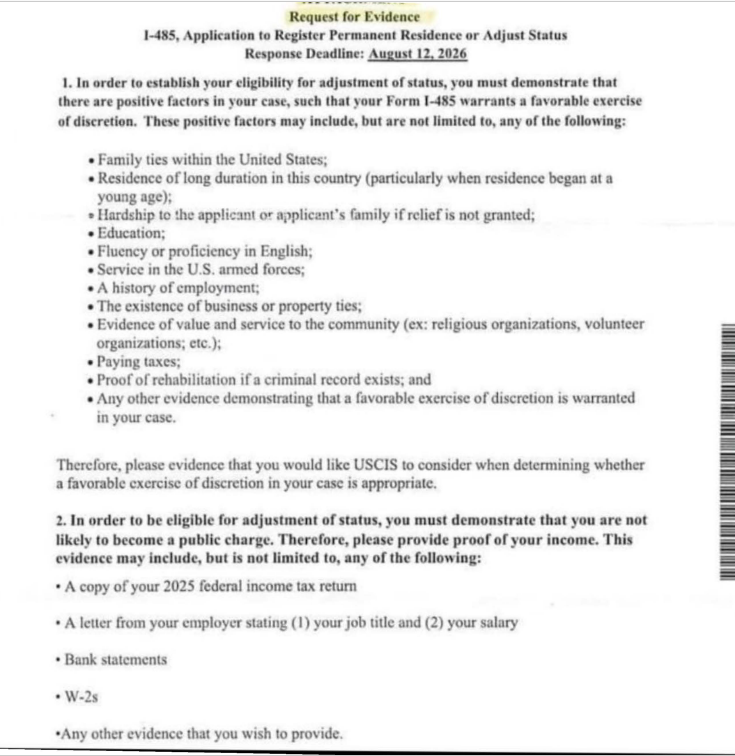
Already we are hearing reports of USCIS issuing requests for evidence asking applicants to justify a favorable exercise of discretion. To this practitioner, it feels very much like the I-944 from the first Trump administration on public charge — a lot of extra paperwork, a lot of extra documentation, but ultimately not a sea change in outcomes.
An example of one such RFE has been circulating on AILA practitioner listservs and is reproduced as Appendix B below. It asks the applicant to provide evidence of the positive factors that would warrant a favorable exercise of discretion, listing the Matter of Marin / Matter of Mendez-Moralez factors: family ties, length of residence, hardship, education, English fluency, U.S. military service, employment history, business or property ties, community service, tax payments, and rehabilitation evidence where there is a criminal record. So far, so unobjectionable: these are the standard discretionary balancing factors. Notable, however, is the second request: the same RFE asks for proof that the applicant "is not likely to become a public charge," including the 2025 federal tax return, an employer letter stating job title and salary, bank statements, and W-2s. The May 21 memo does not mention public charge. The RFE is silently bolting a revived public-charge analysis onto the discretionary inquiry — and there are echoes here of the I-944 era. Practitioners should be ready to respond to both fronts at once.
I think these cases will fall into three rough buckets.
Bucket 1: Dual-Intent Visa Holders with Clean Records (H-1B, L-1, O-1)
This is the H-1B engineer, or the L-1 transferee, or the O-1 — someone here in valid dual intent status, sponsored by an employer, no criminal history, no immigration violations. My sense is that there is still no legal justification to deny these cases. Congress created dual intent precisely for these applicants; the Arai presumption applies; Blas (properly read) confirms that immediate-relative-like equities should prevail in the absence of adverse circumstances. Expect more RFEs asking applicants to articulate their equities. Those equities will largely be employment-based: the employer's sponsorship, the value of the position, contributions to the U.S. economy, family ties if any. The right answer should still be approval.
Bucket 2: Applicants with a Prior Immigration or Criminal "Blip"
This is the dual intent visa holder, or the family-based applicant, with a DUI arrest, a minor lapse in status, an old misrepresentation issue — something less than the kind of misconduct that triggered the historical "extraordinary grace" denials, but more than a clean record. This is a zone of twilight. It is unclear how aggressively USCIS will deploy discretion in these cases. My guess is that the strength of the equities will matter more than ever, and that practitioners will need to front-load equity evidence: family ties, length of residence, employment, community involvement, evidence of rehabilitation where relevant. Matter of Segura Romero, an unpublished 2019 BIA decision affirming an AOS grant on a five-DUI record, is a useful reference point for what serious rehabilitation evidence can carry.
Bucket 3: Overstays Married to U.S. Citizens
This is where applicants need to worry most. The most charitable version of this case is the sympathetic visitor who came, fell in love, married a U.S. citizen, and is now adjusting. The less charitable version is the person who entered the United States, violated their status, committed crimes, and flouted immigration law along the way. For the latter, there is almost no hope under this memo; their time is up, and they need to seriously consider whether they can — or should — remain.
For the more sympathetic overstays, the question is whether the equities are truly outstanding. Children in the United States. A long-married U.S. citizen spouse. Positive contributions to the community. Evidence that the noncompliance was bounded and not part of a broader pattern of misconduct. Practitioners will need to build these cases like cancellation-of-removal cases, with more evidence, more declarations, more documentation than they have been used to filing.
What denial means
If someone is denied and they are out of status, the administration will likely issue a Notice to Appear and place them in removal proceedings. There, they can renew their adjustment application before an immigration judge.
Historically, immigration judges have tended to be relatively fair on adjustment cases. In this practitioner's experience, judges generally welcomed adjustment cases on the docket, as a break from the relentless flow of weak asylum claims. That said, the composition of the immigration courts has shifted significantly in recent years, and judges are operating under increased pressure. Even though this memo does not formally apply to immigration judges, they may feel pressure to read it as binding in spirit.
The bigger question for out-of-status denials is detention. ICE has the authority to detain people upon issuing an NTA. Going to immigration court is bad enough on a non-detained docket. Being detained while going through immigration court proceedings is a living hell. The open question is whether we will see an uptick not just in denials but in detentions of relatively minor cases denied purely on discretion. Will the administration really push tens of thousands of otherwise low-priority noncitizens into detention beds while they litigate adjustment denials? Operationally, probably not. But the threat alone will reshape decision-making.
Facing an RFE regarding the May 2026 USCIS policy memorandum? Schedule a consultation with our immigration experts.
What denial means if you're still in status
If a denied applicant is still in valid nonimmigrant status, the denial does not automatically trigger an NTA. They can technically challenge the denial, but the avenues are narrow.
A motion to reopen before USCIS is one option (the AAO does not have jurisdiction over most AOS applications). Federal court review is another, though Patel v. Garland sharply limits what the courts can do: legal and constitutional claims are reviewable, but factual findings underlying a discretionary denial are not. The strategic question for federal litigation is whether the denial can be reframed as resting on a legal error: the use of the wrong discretionary standard, the failure to apply Arai's "absence of adverse factors" presumption, due process problems with the reasoning — rather than on a factual finding.
For most denied applicants who remain in status, the practical reality is that they will need to pivot to consular processing. The mechanical problem is that switching from an AOS case to a consular case requires filing an I-824 to transfer the underlying petition to the National Visa Center, and the I-824 itself is currently taking well over a year to adjudicate. When responding to discretionary RFEs, applicants should try to convince USCIS that, if they do decide to deny, please go ahead and transfer the I-140 or I-130 to NVC directly, saving the months that would otherwise be lost to the I-824 queue.
For out-of-status applicants, the pivot is harder still. They need to reconsider their eligibility for provisional waivers, particularly the I-601A unlawful-presence waiver, which is itself currently running multiple years. The sooner they file, the sooner they can complete consular processing if AOS is no longer realistic.
A Closing Thought
The legal architecture of adjustment of status has not changed. Section 245 still gives the Attorney General (now the Secretary of Homeland Security) discretion. Matter of Arai's presumption that adjustment will ordinarily be granted in the absence of adverse factors remains the binding standard, reaffirmed by A.G. Levi in Blas and as recently as 2019 by the BIA in cases applying the same balancing test to applicants with substantial criminal history.
What changes is the cultural framing inside USCIS: the signal to adjudicators that discretion is a tool they should use more often, that adverse factors should weigh more heavily, that an overstay or a lapse should not be brushed aside. That is a real shift, and practitioners need to take it seriously. But it is a long way from ending adjustment of status. And it is a long way from the law actually requiring "extraordinary circumstances," a phrase Congress has never used, USCIS's own memo does not adopt, and that, for the populations Congress designed AOS to serve, has no home in the statute.
The fights ahead will mostly be in the RFE responses. The fights after that will be in the immigration courts. The fights after that, for the cases that survive, will be in federal district court, on the narrow questions Patel still permits.
Appendix A: The People Behind the Citations
For those worried about what PM-602-0199 means in practice, it is worth looking at the actual people whose cases USCIS is citing to support the "extraordinary act of administrative grace" and "not designed to supersede the regular consular visa-issuing process" framing. The table below summarizes the equities — and the conduct — of the applicant in every such case cited in the memo's text and in footnotes 3, 4, and 5.
The pattern is hard to miss. Almost every one of these cases involves consular fraud, identity fraud, a paper marriage, abandonment of a foreign family, a serious criminal record, or some combination of those. Several of the cases the memo cites for its restrictive proposition actually resulted in the noncitizen winning, or were dismissed without any merits ruling. None of them involves the clean affirmative applicant the memo's framing is now being applied to.
Case Citation | Year | Posture | Positive Equities | Adverse Facts / Negative Factors | Final Outcome & Relevance |
|---|---|---|---|---|---|
1967 | Judicial review of BIA denial in deportation | M.D. and Ph.D.; employed at HBCUs at modest salary | Preconceived intent (had an unused approved 1st-preference petition); entered as B-2 to "sight-see" Honolulu; unauthorized employment; married a USC within 7 months on false news of his Philippine wife's death (never cohabited; marriage annulled); wife and multiple children abandoned in Philippines; lack of candor | AOS denied | |
Matter of Blas, 15 I&N Dec. 626 | 1974 / 1976 | Deportation; 3-2 BIA majority, then certified to A.G. Levi | Bona fide marriage to a USC (immediate-relative I-130 approved); supports wife financially; pays child support to Philippines | Pre-arrival plan to divorce Philippine wife, remarry, and stay; concealed USC adoptive parents from the consul; mischaracterized his employment; claimed a 35-day pleasure trip while planning to remain | AOS denied (A.G. final decision; BIA majority opinion superseded). The "not designed to supersede" line USCIS quotes is from the superseded BIA majority — not from A.G. Levi. |
1979 | Deportation; conceded deportable | Investment in a U.S. company | Liquidated Indian business before entering on B-1; preconceived intent; misrepresentation to officers about intentions; the investor enterprise failed to create any U.S. jobs; no close family ties in U.S. | AOS denied | |
Matter of Tanahan, 18 I&N Dec. 339 | 1981 | Affirmative §245; certified to Regional Commissioner | Approved 6th-preference labor certification | Refused admission at Boston in 1979; absconded from TWA after being paroled for departure to London; wife and children in London; deliberate evasion of removal | AOS denied |
Kim v. Meese, 810 F.2d 1494 (9th Cir.) | 1987 | §246 rescission (not an initial denial) | In U.S. since 1972; previously granted LPR | Sold his qualifying investor business in January 1978 — two months before his March 1978 AOS grant. He was ineligible on the asserted investor ground at the time AOS was granted | LPR status rescinded |
Sanchez-Trujillo v. INS, 632 F. Supp. 1546 (W.D.N.C.) | 1986 | APA action challenging an I-130 denial | Legitimated under both California and Colombian law; father took her into his home and held her out as his daughter; INS had abused discretion by misstating the law; father had committed suicide before the error could be corrected | Overstayed tourist visa; had been granted voluntary departure | Plaintiff WON. I-130 retroactively approved with original 1977 priority date; permitted to apply for AOS. USCIS cites this case for the proposition the plaintiff defeated. |
1988 | Affirmative AOS denied; constitutional challenge in district court | USC parents (elderly, in Albuquerque); four USC children; USC son filed the I-130; long historical and family connection to the U.S.; home ownership; IJ found discretion would be warranted but for the statutory exclusion | Expatriated to Mexico in 1966; admitted speeches "for the Communist Party"; writings advocating communism — then a statutory exclusion ground under §1182(a)(28)(G)(v), since repealed | Procedurally dismissed on ripeness. Underlying exclusion ground later repealed in her favor. No merits ruling. | |
1994 | Deportation; petition for review | USC spouse; rehabilitation evidence (G.E.D., vocational classes, positive instructor evaluations); no post-release criminal conduct; 7+ years residence | Iranian; entered without valid documents in 1980; armed hostage/fraud scheme; nearly $1 million theft plot; 7-year sentence; spent more than half his U.S. residence incarcerated | 9th Cir. GRANTED petition in part and remanded — the BIA had abused its discretion by failing to weigh rehabilitation evidence | |
1995 | Jurisdictional / exhaustion case | USC husband; approved I-130 | Entered the U.S. using another person's passport and identity ("Sadie Dennis"); failed to respond to INS interview notices; failed to cooperate | Dismissed on exhaustion grounds. No merits ruling. | |
1996 | Motion to reopen in deportation | New USC spouse (Simmons; approved I-130); two children with §212(k) waivers | Submitted a fraudulent death certificate for her then-living Philippine first husband to obtain LPR through a prior USC marriage; LPR rescinded; gave false testimony during the 1986 rescission proceedings; serial marriages | MTR denied | |
Lee v. USCIS, 592 F.3d 612 (4th Cir.) | 2010 | APA in district court — §245(i) AOS | None weighed (pure legal challenge) | Korean visa overstay; filed §245(i) based on a substituted labor certification originally filed for a different worker; employer later withdrew the petition | Dismissed on §1252(a)(2)(B)(i) jurisdictional grounds. No merits ruling. |
Castro-Soto v. Holder, 596 F.3d 68 (1st Cir.) | 2010 | Deportation; §245(i) AOS pretermitted | None significantly weighed | Dominican; first marriage bona fides questioned and removal of conditional residence denied; voluntarily departed in January 2005; EWI re-entered 8 days later; tried to use the 1992 petition to grandfather a new §245(i) application | §245(i) AOS denied |
Baez v. United States, 715 F. Supp. 2d 1165 (D. Or.) | 2010 | District court APA — Cuban Adjustment Act (not §245) | 47 years U.S. residence (since age 3); family ties | 1980 conviction for "accessory" tied to a marijuana arrest; 1980 grand theft; 1995 concealed firearm / menacing / reckless endangerment; 1998 contempt; USCIS "reason to believe" drug trafficker finding under §1182(a)(2)(C)(i) | CAA denial upheld. Case applies the CAA, not §245(a). |
Singh v. DHS, 2013 WL 1246814 (C.D. Cal.), aff'd sub nom. Vukov, 561 F. App'x 648 (9th Cir.) | 2013 / 2014 | Mandamus/APA in district court — jurisdictional | USC spouse; approved I-130; conditionally approved I-212 | Repeatedly sworn under oath in 1994 and 1996 that he arrived in November 1994; later asserted in 2006 and 2010 that he had actually been paroled at JFK in August 1992 as a different person ("Tarsem Singh") to claim "arriving alien" jurisdiction | Dismissed on jurisdictional grounds. No merits ruling. |
Matter of Benitez (BIA, unpublished) | 2018 | Deportation; §245(i) AOS | 25 years in U.S. (since 1992); six USC children; work history; church attendance | Four DUI convictions, including in 2015 and 2016; lack of established rehabilitation | §245(i) AOS denied |
2023 | Second motion to reopen a final removal order | USC mother and sister; approved I-130s with a June 2007 priority date about to become current; long residence | Overstayed visa in 1996; 15-year-old final order of removal; adverse credibility finding; multiple unsuccessful asylum, withholding, and CAT claims | Second MTR denied; mediation request denied. Judge Wardlaw partially dissented. | |
Abdullaeva v. Garland, 2023 WL 7221935 (N.D. Ohio) | 2023 | APA/mandamus delay suit | USC husband (naturalized 2019); approved I-130; F-1 student since 2005 | Removal proceedings open from 2010 to 2022; sued for delay 11 months into USCIS review (field office average: 14.5 months) | Mandamus complaint dismissed for failure to state a claim. The underlying AOS adjudication continues at USCIS. |
Appendix B: An Example Discretionary RFE
Reproduced below is an example of a Request for Evidence that has been circulating on AILA practitioner listservs in the days immediately following PM-602-0199. The first request — for evidence of positive discretionary factors — is the kind of thing the memo invites. The second request — for public-charge documentation that the memo does not mention — is not. Both are now being asked for in the same RFE.