


Key Takeaways
- Who needs it: Anyone with a pending Form I-485, some DACA recipients, Temporary Protected Status (TPS) beneficiaries, asylum applicants, refugees, and asylees who plan to travel abroad.
- Cost: $630 paper / $580 online for the Form I-131 filing fee. As of October 16, 2025, an additional $1,000 parole fee applies in most cases.
- Timing: 90 to 120 days is the standard, but many cases stretch to several months or longer. Apply with refundable travel plans.
- Get help fast: Ellis can review your case, file Form I-131, and flag re-entry risks before you book. Book a consultation to talk through your situation.
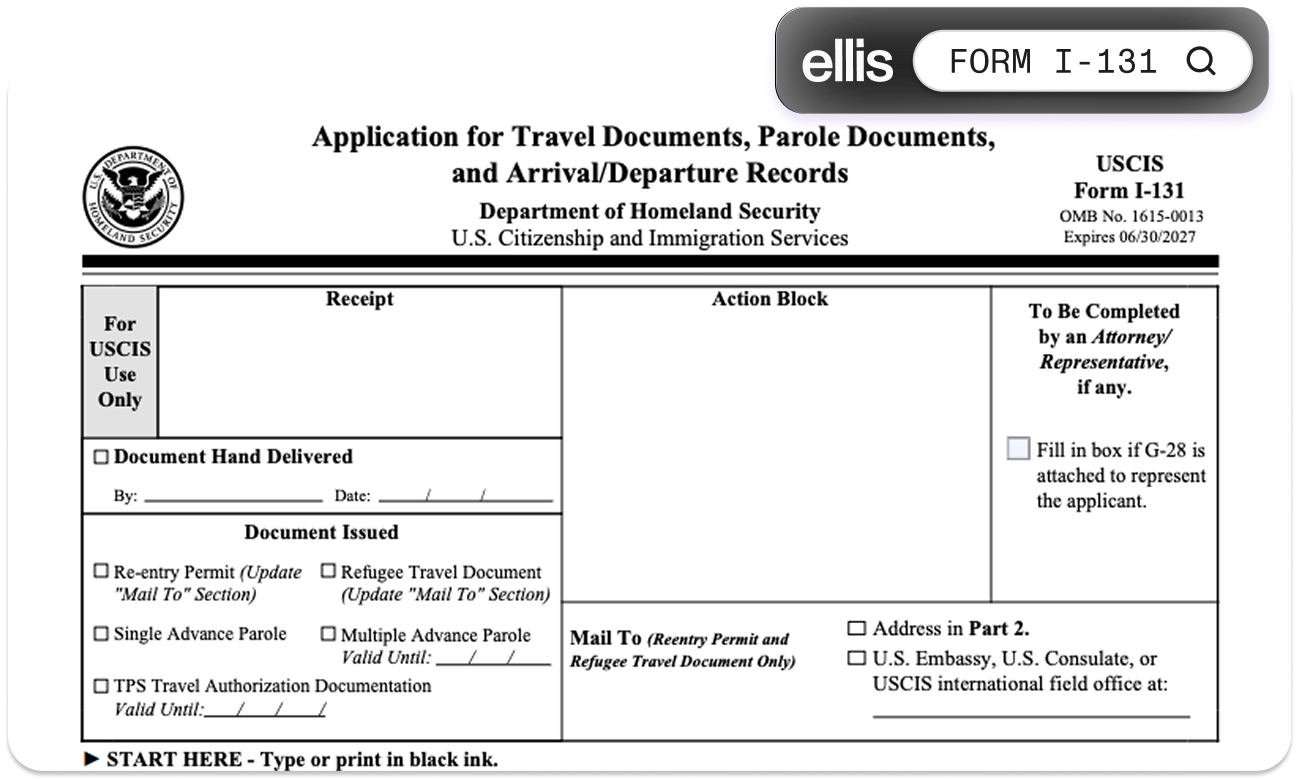
If you have a pending green card or other immigration case in the U.S., leaving the country without the right travel document can sink your application. Advance Parole is the document that lets you travel safely. It is issued by U.S. Citizenship and Immigration Services (USCIS) and lets certain noncitizens travel abroad and return without giving up a pending application.
The basics: you file Form I-131. USCIS then issues Form I-512L (the paper Advance Parole document) or a combo card that also works as an Employment Authorization Document (EAD). You travel with both your passport and the document. It does not replace the visa you need to enter other countries, and it does not guarantee you can re-enter the U.S. Customs and Border Protection (CBP) makes that call at the port of entry.
What is Advance Parole?
Advance Parole is permission from the Department of Homeland Security (DHS), usually through USCIS, to seek entry into the U.S. after traveling abroad without a visa stamp in your passport. It lets certain immigrants leave the United States and return lawfully.
The document is issued as a standalone paper Form I-512L or as part of an EAD "combo card" that says it serves as Advance Parole. It is usually valid for one year and allows single or multiple entries, depending on what USCIS grants.
It is different from a visa. A visa is issued abroad by the Department of State. Parole is a one-time permission from DHS, decided at the U.S. port of entry. A person granted parole is "paroled in" rather than admitted in a status, which has its own legal consequences.
Common reasons to use Advance Parole include a pending green card applicant who needs business travel, an overseas work assignment, a family funeral abroad, or a visit to a sick relative. Advance Parole is built for urgent humanitarian reasons or a significant public benefit.
Who is eligible for Advance Parole?
Eligibility depends on your current status, your pending applications, why you're traveling, and whether anything in your record could block re-entry. Common eligible groups:
- Adjustment of Status applicants with a pending Form I-485 green card case
- DACA recipients with deferred action who need to travel for humanitarian, educational, or work purposes
- TPS beneficiaries with Temporary Protected Status
- Asylum applicants and certain refugee applicants
- Certain immigrants with pending humanitarian applications, including some U visa holders
- Certain noncitizens requesting parole for humanitarian purposes or a significant public benefit
Most often, people with a pending Adjustment of Status (Form I-485) must get Advance Parole before leaving the U.S. or risk abandoning their application. People in valid H-1B or L-1 status who apply to adjust status usually don't need Advance Parole to travel, as long as they keep that nonimmigrant status and return with valid documents.
Eligibility can be affected by removal orders and unlawful presence, which make re-entry harder. HR and global mobility teams should check eligibility with an immigration attorney before approving international travel.
What does Advance Parole cost in 2026?
USCIS fees and broader DHS parole costs are now a bigger planning issue for employers and employees.
Cost item | Amount |
|---|---|
Form I-131 filing fee (paper) | $630 |
Form I-131 filing fee (online) | $580 |
Additional DHS parole fee (effective Oct 16, 2025) | $1,000 |
Total potential cost | $1,580 – $1,630 |
USCIS no longer accepts personal or business checks for paper filings of Form I-131. Pay by credit card, debit card, or prepaid card. Always check current fees on the USCIS fee schedule.
The $1,000 parole fee may be collected when CBP processes the traveler at a U.S. port of entry, by USCIS for some in-country requests, or by another DHS agency, depending on the case. Some humanitarian cases and low-income applicants may qualify for exceptions or a fee waiver on the I-131 filing fee, but the rules are narrow.
How long does Advance Parole take to process?
Standard processing runs 90 to 120 days from the date Form I-131 is filed. In practice, many applicants wait several months or longer than a year, especially green card applicants waiting on combo cards (4-6 months average). Check current USCIS processing times for your service center before you count on a date. You can also check the official USCIS processing times tool and your case status directly with USCIS.
Approval is not guaranteed. Book travel with refundable tickets in case of delays or a denial.
What are the risks of applying for Advance Parole?
The most important step is not the form. It is deciding whether to travel at all.
Past unlawful presence, old deportation or removal orders, criminal history, misrepresentation, or other immigration violations can create serious problems even with an approved Advance Parole document. If you have any of these in your history, or you're subject to a bar that blocks re-entry, you could be denied entry at the border.
DACA, TPS, and asylum programs can also be affected by litigation or policy changes while you're abroad. DACA recipients can apply for Advance Parole under three categories (humanitarian, educational, or work purposes), including academic research, employment meetings, or urgent family needs. Even so, those categories do not remove every risk.
Companies should require legal review before any employee with a pending green card, pending application, or humanitarian case takes international business travel. Ellis centralizes employee records, approvals, passport details, and travel history so attorneys and HR can spot risk factors before a trip is approved.
How do you apply for Advance Parole?
To get Advance Parole, you must meet specific immigration status requirements, have a valid reason for travel, and file Form I-131 (Application for Travel Documents) with USCIS. The form can be filed online or by mail.
Your application should clearly explain why you're traveling: urgent need, immediate family abroad, business meetings, educational travel, or humanitarian reasons. Online filing is available for some applicants through a USCIS account. Others must file on paper. Picking the wrong category can lead to a rejection.
A complete package usually includes:
- Signed Form I-131
- Filing fee or fee waiver request
- Copy of a government ID and valid passport
- Evidence of current status or pending green card case
- Receipt notice for Form I-485 or another pending immigration benefit
- Evidence supporting travel, such as employer letters, medical records, school documents, or proof of funeral services
- Copies of any prior travel document issued by USCIS
- Additional supporting documents as needed
Make at least two copies of the full package: one for the applicant and one for a trusted contact or HR file. After you file, USCIS issues Form I-797C, a receipt notice with your case number. You can use it to track your Advance Parole application online.
Can you get emergency Advance Parole?
In urgent situations, you can request emergency Advance Parole or ask USCIS to expedite a pending request. Emergency requests are reserved for serious situations, not routine travel.
Examples include a critically ill loved one, the death of a close family member, urgent medical treatment you can't get in the U.S., or another urgent humanitarian reason. You will usually need hospital records, doctor's letters, death certificates, travel itinerary details, ID, and proof of your pending immigration case. In some cases, USCIS may send you to a local USCIS field office for emergency processing.
Emergency Advance Parole is decided case by case. Strong documentation helps, but approval is never guaranteed.
How should you prepare to travel on Advance Parole?
Do not leave the U.S. until the original Advance Parole document is approved and in your hands. If you travel before it's issued, your pending immigration case can be denied automatically, and you may be barred from re-entry.
An Advance Parole document does not replace a passport or the visas you need for other countries. Carry both when you travel. Bring the original Advance Parole document, a valid passport, and any unexpired EAD that serves as a combo travel document. If you have H-1B, L-1, I-140, or I-485 records, carry copies too.
Check destination and transit rules before booking. A connecting flight may require a transit visa, vaccination record, or electronic authorization even if you never leave the airport. HR teams should track dates, flight details, return plans, and whether the Advance Parole document will still be valid on the planned re-entry date. Our guide on H-1B travel restrictions covers some related rules worth knowing.
How long can you stay abroad on Advance Parole?
A few different time limits matter here, and they're easy to mix up.
Document validity (1 to 2 years). An Advance Parole document is usually valid for 1 year, sometimes 2 years for Adjustment of Status applicants under recent USCIS practice. You must re-enter the U.S. before the document expires. Once it expires, it can't be used to come back, even if you're already abroad.
Per-trip duration (no hard max, but watch 180 days). USCIS doesn't set a strict maximum for any single trip. In practice, most attorneys recommend keeping each trip under 6 months. Trips longer than 180 days raise two related risks:
- Abandonment of your I-485. USCIS can argue you gave up your green card application by spending too much time outside the U.S.
- Unlawful presence on future trips. If something goes wrong with your case while you're abroad and you later accrue 180+ days of unlawful presence, you can trigger a 3-year or 10-year bar on re-entry.
Number of trips. If USCIS grants a multiple-entry Advance Parole, you can make as many trips as you want during the validity period. A single-entry document is one trip only.
Quick rule of thumb:
Length of trip | Risk level |
|---|---|
Under 30 days | Low. Typical business or family travel. |
30 to 90 days | Low to moderate. Keep documentation of your ties to the U.S. |
90 to 180 days | Moderate. Talk to an attorney. Explain the trip purpose at the border. |
180+ days | High. Abandonment risk, possible bar issues. Attorney review is essential. |
Over 1 year | Very high. Almost always treated as abandonment unless you have a strong reason and prior planning. |
If you know ahead of time that you'll be gone more than 6 months, talk to an immigration attorney before you leave. There are sometimes other filings (like a re-entry permit for green card holders, or specific documentation for long absences) that can protect your case.
What happens when you re-enter the U.S. on Advance Parole?
When you return, show your passport and Advance Parole document to CBP at the port of entry. The officer may process you quickly, send you to secondary inspection, or refuse parole if there's an inadmissibility concern.
Even with an approved Advance Parole document, re-entry is not guaranteed. CBP officers can still deny entry.
If you get through, CBP usually creates an I-94 record that shows parole as the class of admission and your authorized stay. Download the I-94 from the CBP I-94 website and save it with your other immigration records. If something goes wrong at the border, call an immigration attorney as soon as you can.
How does Advance Parole interact with green cards and work authorization?
Advance Parole is closely tied to employment-based green card and work authorization planning. Many Adjustment of Status applicants file Form I-131 for travel, Form I-765 for employment authorization, and Form I-485 all together. USCIS may issue a combo card that works as both an EAD and a travel document.
Traveling abroad while an I-485 is pending, without Advance Parole, can lead USCIS to treat the green card case as abandoned. Narrow exceptions may apply for some H-1B and L-1 workers who keep their status and return with valid visa documents.
For employment-based cases, HR should decide with counsel whether the employee should rely on nonimmigrant status or on parole for re-entry. Ellis helps track employment authorization, Advance Parole document expiration dates, passport validity, and renewal timing before any travel or work authorization gaps come up.
What are common pitfalls when traveling on Advance Parole?
Advance Parole is useful, but it is not risk-free. The biggest mistake is thinking an approval notice means you're guaranteed back in.
Common pitfalls include:
- Booking nonrefundable flights before approval
- Departing before the Advance Parole document is physically issued
- Losing or damaging travel documents abroad
- Returning after the document expires
- Ignoring DACA, TPS, or asylum policy changes during travel
- Failing to disclose prior arrests, removals, or status violations before applying for Advance Parole
A Refugee Travel Document is different from Advance Parole, even though both are travel benefits. Employers and individuals should avoid non-urgent trips during critical green card or humanitarian case stages unless an experienced attorney has reviewed the full immigration history.
Final tips
A few things to do before you fly:
- Wait for the physical document. Do not depart before Advance Parole is approved and in hand.
- Carry a complete document set. Passport, original Advance Parole document, EAD (if any), and copies of your I-485 receipt or I-797C.
- Book refundable tickets. Approval timing is unpredictable. So is CBP discretion.
- Confirm transit visa rules. A connecting country may require its own paperwork.
- Save your I-94 after re-entry. Download it from the CBP site and store it with your immigration records.
- Talk to an attorney first if you have any unlawful presence, removal orders, or criminal history. Approval of Advance Parole does not eliminate inadmissibility risk at the border.
- Avoid non-urgent travel during critical case stages. Wait until your case is at a more stable point if you can.
Planning travel on a pending case?
Ellis can review your status, file Form I-131, and flag re-entry risks before you book. We help HR and global mobility teams centralize records and track expiring documents. Book a consultation to talk through your case.
The information in this article is for general guidance only and is not legal advice.