

Key Takeaways
- Who files? Anyone seeking U.S. work authorization who isn't a citizen or Lawful Permanent Resident (LPR). F-1 OPT students, H-4 and L-2 spouses, adjustment of status applicants, asylees, DACA recipients, and dozens of other categories.
- How much? $470 online or $520 by paper. Free when filed concurrently with Form I-485.
- How long is the EAD valid? Typically 1 to 2 years, depending on category. Renewable while your underlying status is pending.
- Should I use an attorney? Strongly recommended for anything beyond a simple F-1 OPT case. Eligibility category selection is complicated, and the wrong code is the #1 reason applications get rejected. Schedule a free consultation with Ellis.
If you're not a U.S. citizen or green card holder but you need to work in the United States, the path runs through one form: Form I-765. Officially called the Application for Employment Authorization, it's how you request and receive an Employment Authorization Document (EAD), also known as a U.S. work permit.
This guide covers what the I-765 is, who can file it, how much it costs, and what to expect after you submit.
What is Form I-765?
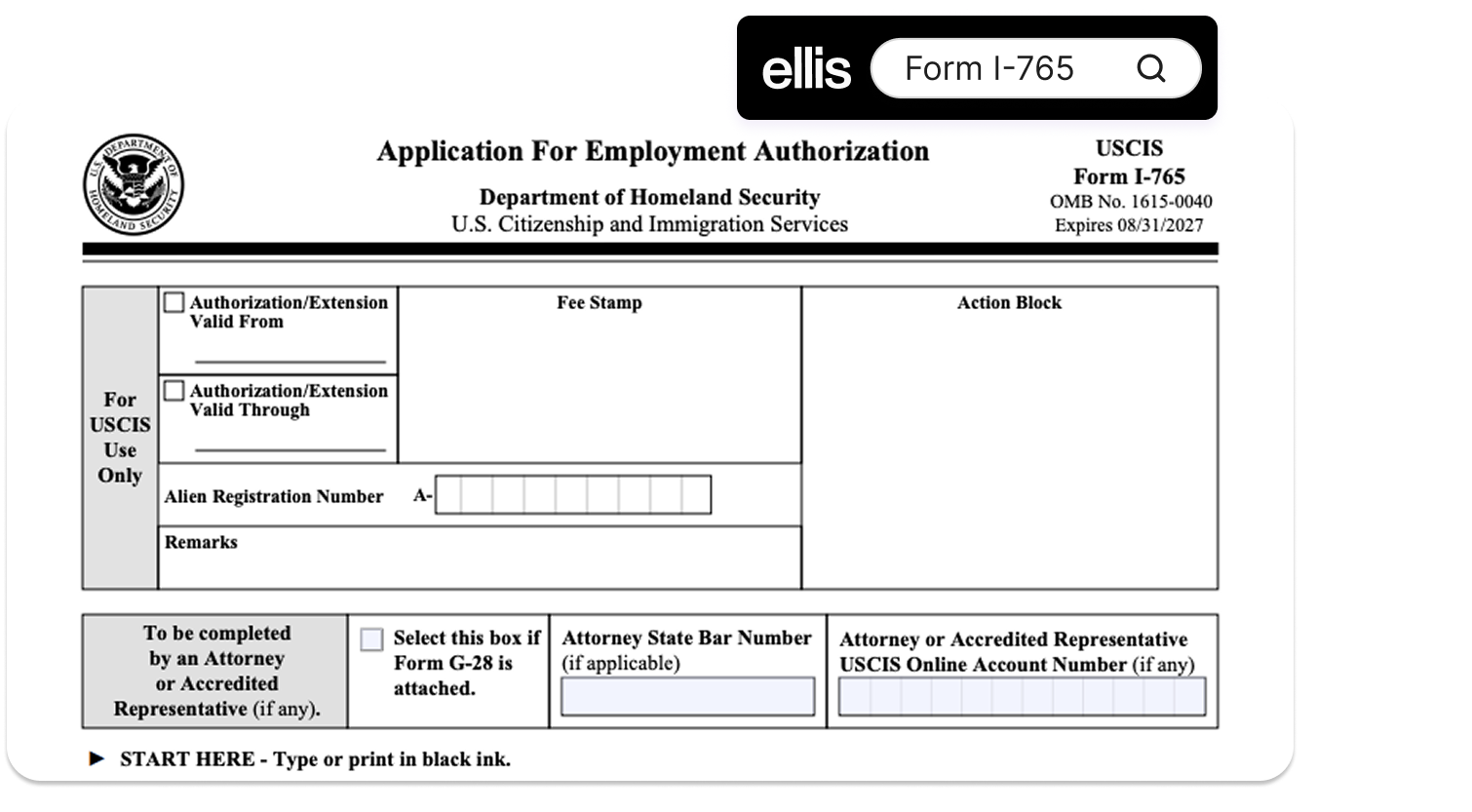
Form I-765 is the USCIS application for an Employment Authorization Document (EAD), also called a "work permit." It's the legal authorization that lets U.S. employers hire someone who isn't a citizen or lawful permanent resident.
The form is 7 pages and asks about your immigration history, current status, eligibility category, and biographic information. You file the I-765 with USCIS, either online or by mail. If approved, USCIS mails you a physical EAD card showing your name, photo, A-Number, eligibility category, and validity dates.
Without an EAD or another work-authorized status, you can't legally work in the U.S. and no employer can legally hire you.
Who Can File Form I-765?
The I-765 is one of the most-used USCIS forms because the list of eligible categories is long. Common applicants include:
- F-1 students transitioning to OPT (Optional Practical Training) or STEM OPT extension
- H-4 spouses of certain H-1B visa holders
- L-2 spouses of L-1 visa holders
- Adjustment of status applicants filing concurrently with Form I-485
- Asylum applicants with a pending Form I-589
- DACA recipients
- Refugees and asylees
- U visa and T visa holders
- VAWA self-petitioners
- K-1 fiancé visa holders
- People with TPS (Temporary Protected Status)
The form requires you to identify your eligibility category with a specific code. There are over 60 categories. The most common ones:
Category | Description |
|---|---|
(c)(3)(B) | F-1 student, post-completion OPT |
(c)(3)(C) | F-1 student, STEM OPT extension |
(c)(8) | Asylum applicant with pending I-589 |
(c)(9) | Adjustment of status applicant (I-485 pending) |
(c)(26) | H-4 spouse with H-1B principal who has approved I-140 |
(a)(18) | L-2 spouse |
(c)(33) | DACA recipient |
(c)(35) | EB-1, EB-2, or EB-3 derivative with approved I-140 awaiting green card |
The form fields differ by category, and the wrong code triggers an automatic rejection. Get attorney advice before filing if you're not 100% certain of your category.
What Does the I-765 Cost in 2026?
The 2026 filing fee structure for Form I-765:
Filing method | Fee | Notes |
|---|---|---|
Online | $470 | Slightly cheaper, faster receipt |
Paper | $520 | Mail to a USCIS lockbox |
Filed with Form I-485 | $0 | Free when filed concurrently |
A fee waiver (Form I-912) is available for limited humanitarian categories like asylees, refugees, certain T and U visa holders, and VAWA self-petitioners.
Eligibility Categories Worth Knowing
Three categories trip up a lot of applicants. A quick orientation:
F-1 OPT and STEM OPT. Post-completion OPT (12 months after graduation) uses (c)(3)(B). STEM OPT extension (an additional 24 months for STEM graduates) uses (c)(3)(C). The F-1 student must have a Form I-20 with the OPT recommendation from the school's DSO. Filing windows are strict, and late filings get rejected. See our OPT and STEM OPT guide for details.
H-4 spouse EAD. Only certain H-4 spouses are eligible, specifically those whose H-1B principal has an approved Form I-140 or who are in the 7th year or later of H-1B status. Use category (c)(26).
L-2 spouse. Since the 2022 USCIS policy update, L-2 spouses are work-authorized incident to status. They don't technically need an EAD to work, but many apply anyway because employers prefer the physical EAD card for I-9 verification. Use category (a)(18).
How Long Is the EAD Valid?
Validity varies by category:
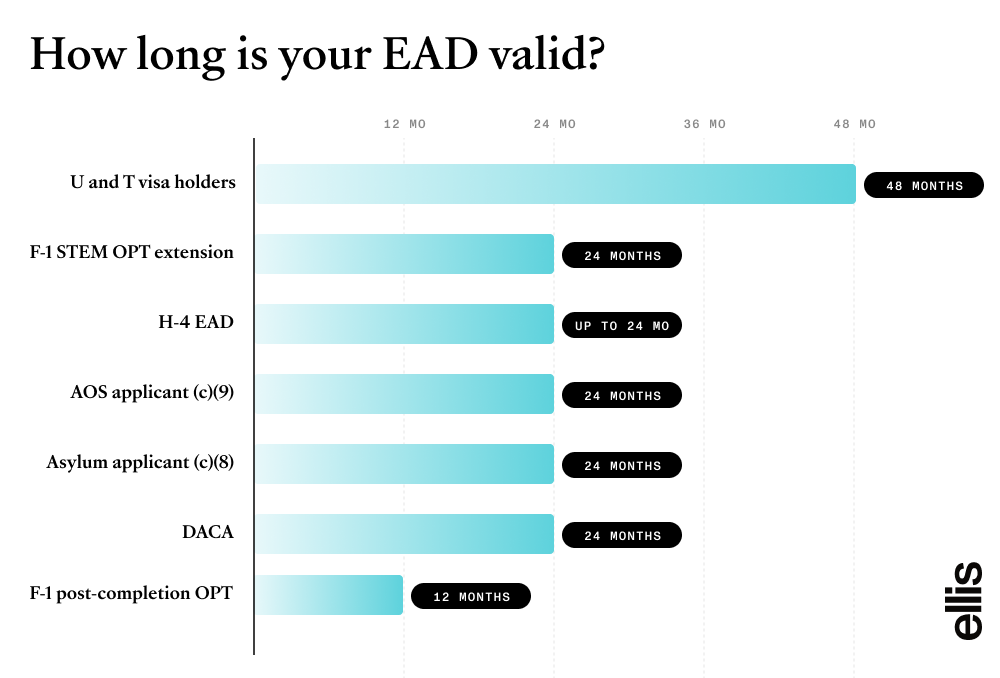
- F-1 post-completion OPT: 12 months
- F-1 STEM OPT extension: 24 months
- H-4 EAD: Up to 2 years (limited by H-1B status validity)
- AOS applicant (c)(9): 2 years, renewable while I-485 is pending
- Asylum applicant (c)(8): 2 years, renewable while I-589 is pending
- DACA: 2 years
- U and T visa holders: 4 years
To renew, file a new I-765. There's no separate renewal form. USCIS recommends filing 180 days before your current EAD expires. Some categories qualify for an automatic extension of work authorization for up to 540 days while the renewal is pending, but only if you file before the current EAD expires.
Can I speed it up? Premium processing for I-765
Some I-765 categories qualify for premium processing, which guarantees a decision in 30 business days (about 6 weeks) instead of the standard 3 to 5+ months. As of 2026, premium processing is available for these F-1 student categories:
Category | Description |
|---|---|
(c)(3)(A) | F-1 student, pre-completion OPT |
(c)(3)(B) | F-1 student, post-completion OPT |
(c)(3)(C) | F-1 student, STEM OPT extension |
The fee is $1,685 on top of the regular I-765 filing fee, paid using Form I-907. File the I-907 with your I-765, or upgrade an already-pending case by filing the I-907 separately.
Premium processing is not available for the other major I-765 categories. AOS-based EADs (c)(9), asylum-based EADs (c)(8), H-4 spouses (c)(26), L-2 spouses (a)(18), DACA (c)(33), and others all run on standard processing times. USCIS has hinted at expanding premium processing to more categories, but nothing is finalized.
A few practical notes:
- Time-sensitive OPT cases. Premium processing is most useful for graduating F-1 students whose employment start date is close. The 30-business-day clock usually beats the OPT start window.
- Premium processing doesn't change your EAD start date. It only changes when USCIS makes the decision. Coordinate filing timing with your DSO.
- Upgrading a pending case. If you've already filed and want to switch to PP, file Form I-907 separately. USCIS processes the upgrade once it receives the I-907.
The I-765 Filing Process
- Confirm your eligibility category. Check the I-765 instructions on uscis.gov for the full list.
- Gather supporting documents. Each category requires specific evidence. For OPT, your Form I-20. For H-4 EAD, proof of the H-1B principal's I-140. For AOS-based, your Form I-485 receipt notice.
- Choose online or paper filing. Online is faster and $50 cheaper. Paper is required for some categories.
- Pay the fee. $470 online or $520 paper. Free if filed with I-485.
- Wait for the receipt notice (Form I-797C), typically 2 to 4 weeks.
- Wait for biometrics if your category requires it, typically 6 to 10 weeks.
- Receive your EAD in the mail, typically 3 to 12 months total depending on category and service center.
For current wait times, check the USCIS processing times tool on uscis.gov.
Final Takeaway
The I-765 is the U.S. work permit. The form itself is short, but your eligibility category, supporting evidence, and timing are where things can get complicated.
A few clear rules:
- File the right category code. Wrong code equals rejection.
- File at the right time. F-1 OPT in particular has strict windows.
- Renew early. Start the renewal 180 days before expiration when possible.
- Don't work without authorization. Working before USCIS approves the EAD has serious immigration consequences.
- Get attorney review beyond simpler F-1 OPT cases. H-4 EADs, deferred action, and asylum-based applications regularly need legal guidance.
Need help filing your I-765?
Ellis combines experienced immigration attorneys with a modern case management platform. Every I-765 we handle goes through structured workflows, automated checks, and full attorney review.
Schedule a free consult today.