

Key Takeaways
- Who files? The U.S. citizen or lawful permanent resident petitioner sponsoring a family-based green card applicant. Some employment-based cases also require an I-864.
- What's the income rule? Sponsors must show income at or above 125% of the Federal Poverty Guidelines for their household size (100% for active-duty military sponsoring a spouse or child).
- How much does the form cost? $0. The I-864 itself has no filing fee. It accompanies the I-485 or the NVC immigrant visa packet, both of which have their own fees.
- Should I use an attorney? Strongly recommended. Income calculations, household size, joint sponsors, and asset substitutions are all common rejection points. Free Ellis consult →
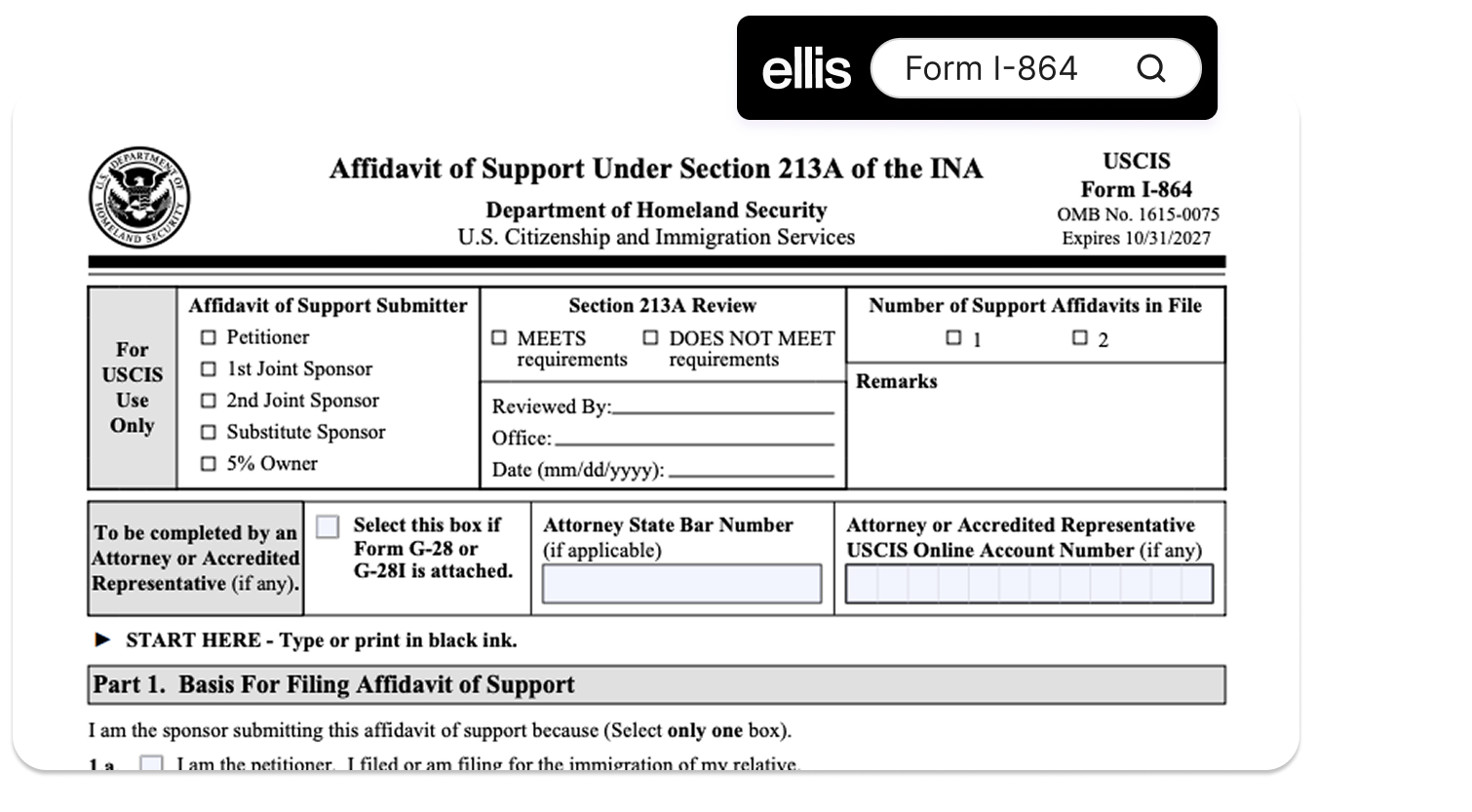
Every family-based green card needs a financial sponsor. Form I-864 is how that sponsor goes on the record. Officially called the Affidavit of Support Under Section 213A of the INA, it's the legally binding promise that the immigrant won't become a "public charge" — that the sponsor will financially support the immigrant if needed.
This guide covers what the I-864 is, who has to file it, the income requirements, and what sponsoring really commits you to.
What is Form I-864?
Form I-864, the Affidavit of Support Under Section 213A of the INA, is the form a sponsor signs to legally promise that the immigrating relative they're sponsoring will not rely on certain federal means-tested public benefits. The sponsor commits to maintaining the immigrant at an income level of at least 125% of the Federal Poverty Guidelines until specific termination events occur.
It's required in nearly every family-based immigrant visa or adjustment of status (Form I-485) case, plus a small subset of employment-based cases.
The I-864 isn't filed by itself. It accompanies the immigrant's underlying petition or AOS application— typically Form I-485 (for adjustment of status inside the U.S.) or the National Visa Center packet (for consular processing abroad).
Who Needs to File Form I-864?
You need an I-864 if you're sponsoring:
- Most family-based immigrants: spouses, parents, unmarried minor children, married children, and siblings of U.S. citizens, plus spouses and unmarried children of legal permanent residents (LPRs)
- Employment-based immigrants when a U.S. citizen or LPR relative has 5%+ ownership in the petitioning employer
The petitioner who filed Form I-130 (or the relevant employment-based petition) is automatically the primary sponsor and must file an I-864.
You do not need an I-864 for:
- Immediate relatives of U.S. citizens applying for a green card based on a self-petition (e.g., VAWA, widows/widowers)
- Children acquiring citizenship automatically under the Child Citizenship Act
- Immigrants who can be credited with 40 qualifying quarters of work (often via spouse) — these use Form I-864W (Request for Exemption)
Who Can Be a Sponsor?
To be eligible to sponsor, you must:
- Be at least 18 years old
- Be a U.S. citizen or lawful permanent resident
- Be domiciled in the United States (or actively planning to re-establish domicile)
- Have income (and/or assets) meeting the 125% FPG threshold for your household size
If the primary sponsor's income doesn't meet the threshold, three options exist:
Joint sponsor. A second person (not in the petitioner's household) can sign their own I-864, accepting the same legal obligations as the primary sponsor. The joint sponsor's income alone must meet the 125% threshold.
Household member income. The primary sponsor can include income from a household member (spouse, adult child, or other dependent listed on tax returns) by having them sign Form I-864A.
Assets. Assets like savings, real estate equity, and investments can substitute for missing income, generally at a 5:1 ratio (5x the income shortfall in assets, 3:1 for spouses of U.S. citizens).
The Income Requirement: 125% of the Federal Poverty Guidelines
The income threshold updates annually (typically in March) when HHS publishes new Federal Poverty Guidelines. Approximate 2026 thresholds at 125% FPG:
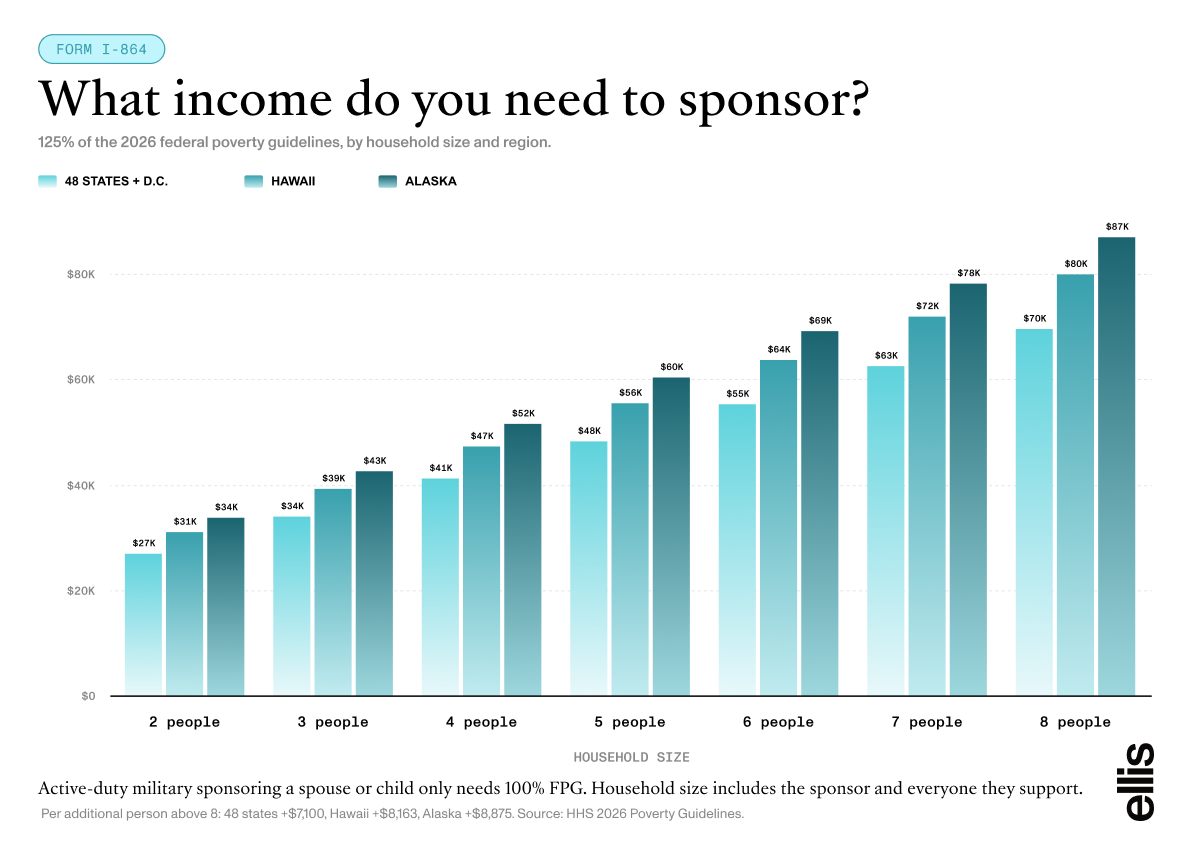
Household size | 125% FPG annual income (approx 2026) |
|---|---|
2 | ~$26,400 |
3 | ~$33,500 |
4 | ~$40,500 |
5 | ~$47,500 |
6 | ~$54,500 |
Each additional person | + ~$7,000 |
Household size for I-864 purposes includes:
- The sponsor
- The sponsor's spouse
- The sponsor's dependent children
- Any other dependents listed on the sponsor's tax return
- The intending immigrant (and any derivative beneficiaries)
- Any immigrants the sponsor has previously sponsored under an I-864 still in force
Active-duty U.S. military sponsoring a spouse or child use 100% FPG instead of 125%.
What Does the I-864 Cost?
$0 for the I-864 itself. There's no separate filing fee. The form is submitted with the I-485 or NVC packet, both of which carry their own fees. For 2026, the I-485 filing fee is $1,440 for adults.
What You'll Need to File
A complete I-864 filing typically includes:
- Form I-864 (10 pages)
- Most recent federal tax return (Form 1040 with schedules) or, preferred by USCIS, an IRS tax return transcript
- W-2s and 1099s from the most recent tax year
- Recent paystubs (typically last 6 months) if available
- Employer letter confirming current employment, salary, and start date
- Proof of U.S. citizenship or LPR status for the sponsor
- Form I-864A if a household member's income is being included
- Asset documentation if assets are being used to meet the threshold (bank statements, property valuations, etc.)
- Joint sponsor's separate I-864 and supporting documents if a joint sponsor is needed
USCIS strongly prefers IRS tax transcripts over copies of tax returns. You can order them free at IRS.gov/transcripts.
Missing or unclear tax documentation is the #1 reason an I-864 hits a Request for Evidence (RFE). Our guide to gathering supporting documents covers what USCIS expects.
The I-864 vs Other Forms in the Family
The I-864 has several variants and a confusingly similar form (I-134) used in different contexts:
Form | Used for | Who signs |
|---|---|---|
Family-based green cards (most common); some employment-based | Petitioner (primary sponsor) | |
Contract to add a household member's income to the sponsor's | Household member | |
Simplified version when sponsor's W-2 income alone meets the threshold | Petitioner | |
Request for exemption (e.g., 40 qualifying quarters of work) | Sponsored immigrant | |
I-134 | Nonimmigrant visa cases (visitors, fiancés, K-1) — NOT for green cards | Sponsor (less binding obligations) |
Confusing the I-864 with the I-134 is a common error. The I-134 is for nonimmigrant cases (B-2 visitor sponsors, K-1 fiancé visas, parole programs). The I-864 is for green card cases and creates a long-term, legally enforceable financial obligation.
What Sponsoring Really Commits You To
The I-864 is a legally enforceable contract between the sponsor and the U.S. government, with the sponsored immigrant as a third-party beneficiary. The obligation lasts until one of these events:
- The sponsored immigrant becomes a U.S. citizen
- The immigrant accumulates 40 qualifying quarters of work (about 10 years)
- The immigrant leaves the U.S. permanently
- The immigrant dies
- The sponsor dies (the obligation does not pass to the estate, but past benefits already received can still be recovered)
Divorce does not terminate the obligation. Even if a sponsor and the sponsored immigrant divorce, the sponsor remains responsible. This is one of the most-misunderstood aspects of the I-864.
If the sponsored immigrant uses certain federal means-tested benefits (TANF, SSI, SNAP, Medicaid for non-emergency services, CHIP), the agency providing those benefits can sue the sponsor for reimbursement. The sponsored immigrant can also sue the sponsor directly for support.
Final Tips
The I-864 is a multi-year legal commitment. The form itself is straightforward, but the income calculation, household size analysis, and long-term obligations are where most sponsors stumble.
A few clear rules:
- Use IRS transcripts, not photocopied returns. USCIS strongly prefers them.
- Calculate household size correctly. Include the immigrant and any prior I-864 obligations still in force.
- Use a joint sponsor early if your income is borderline, rather than risking an RFE.
- Understand what you're signing. Divorce doesn't end the obligation. The contract can outlast the marriage.
- Get attorney review. Borderline-income cases, asset substitutions, and self-employment complications routinely need legal guidance.
Need help filing your I-864?
Ellis combines experienced immigration attorneys with a modern case management platform. Every I-864 we handle goes through structured workflows, automated checks, and full attorney review.
Schedule a free consult → and we'll walk you through your specific case strategy at no cost.
The information provided here is for general informational purposes only and does not constitute legal advice.