

Key Takeaways
- ICE flagged 10,000+ STEM OPT students as tied to "suspect employers" on May 12, 2026.
- ICE conducted site visits in eight states: Texas, Virginia, Georgia, Illinois, New York, New Jersey, North Carolina, and Florida. North Texas alone saw 18 in one week.
- Other 2026 changes are also tightening OPT: a four-year F-1 cap, OPT fees at $1,780, new biometrics, and processing pauses for 40 countries.
- Indian nationals are about half of OPT participants and face the most risk.
- If you're on OPT, STEM OPT, or now on H-1B, check your employer, save your records, and talk to a DSO before you travel.
What did ICE announce about OPT on May 12, 2026?
Acting ICE Director Todd Lyons announced a nationwide probe into fraud in the Optional Practical Training program. OPT is the work permit that lets F-1 visa holders work in the US for 12 months after graduation, with a 24-month STEM extension on top.
The headline numbers:
- 10,000+ students are working for what ICE calls "highly suspect" employers. That count came from a review of only the top 25 OPT employers by headcount.
- One firm reported three OPT workers. Government records show more than 500 students named it as their employer.
- Site visits found empty buildings, locked doors, residential addresses, and shared offices, with companies claiming to be unrelated using near-identical websites and the same managers.
- At several locations, the people on site could not answer basic questions and referred officers to managers based in India.
- USCIS data shows a 37% jump in detected OPT fraud cases since 2023.
Homeland Security Investigations (HSI) and the USCIS Fraud Detection and National Security (FDNS) unit are running the probe together. ICE is expanding unannounced site visits. If ICE later flags an employer, students who worked there can get notices, even if they've already moved to an H-1B. The agency has said arrest, detention, and removal years later are all possible.
What's in the latest OPT news?
Updated as the story develops. Last refresh: May 14, 2026.
- May 12, 2026: ICE announces the 10,000-student fraud probe. ICE’s director calls OPT a "magnet for fraud."
- May 13, 2026: Indian press leads the story. Business Standard, Siasat, and Great Andhra detail the "ghost office" pattern and India-based handlers ICE has flagged.
- May 5, 2026: Duration of Status rule goes to OMB. DHS sends the rule that would cap F-1 stays at four years for OMB review.
- April 27, 2026: OPT application pause coverage. Inside Higher Ed reports that processing pauses for 40 countries are leaving students in limbo.
- March 19, 2026: Keep Innovators in America Act introduced. A bipartisan bill to write OPT into law.
- January 9, 2026: DHS internal letter. The agency says it is "re-evaluating the scope and duration" of OPT and STEM OPT.
- Late December 2025: Biometrics requirement begins. New OPT and STEM OPT filers may have to show up in person.
What to watch next: an OMB decision on the Duration of Status rule, fresh ICE stats or named employer indictments, and any Senate version of the Keep Innovators in America Act.
How is OPT changing in 2026?
The May 12 announcement is the biggest story of the year, but other 2026 changes have already reshaped OPT.
- Duration of Status may end. On May 5, DHS sent a final rule to OMB that would replace today's open-ended F-1 admission with a four-year cap and a 30-day OPT filing window after a program ends. If OMB approves the rule on schedule, most current F-1 students will need to finish their programs in four years or less starting in fall 2026, unless USCIS grants an extension.
- OPT costs more and takes more steps. USCIS raised the filing fee from $1,685 to $1,780. Students who filed Form I-765 after mid-December 2025 may have to appear in person for biometrics. Earlier filers could do it by mail.
- USCIS paused processing for some countries. Travel-ban memos paused processing, but not filing, for nationals of 40 countries and territories. Inside Higher Ed reported in late April that the pause was leaving students stuck, with EAD start dates slipping.
- DHS is rethinking OPT itself. A January 9 internal letter cited worker displacement, fraud, and national security as reasons to revisit OPT and STEM OPT. USCIS Director Joseph Edlow has said publicly he wants to limit post-school work for F-1 students.
- Congress is moving the other way. On March 19, Reps. Sam Liccardo (D-Calif.), Jay Obernolte (R-Calif.), and Raja Krishnamoorthi (D-Ill.) filed the bipartisan Keep Innovators in America Act. The bill would write OPT into federal law so DHS cannot end it with a rule. The bill is unlikely to pass quickly, but it is a real defense of the program.
Who is actually at risk in the OPT crackdown?
Your risk depends almost entirely on your employer. The government is targeting employers and the consulting firms behind them, not students directly. But if ICE determines your employer is fake, your F-1 status can still end, even if you believed the job was legitimate.
Here is how the risk breaks down:
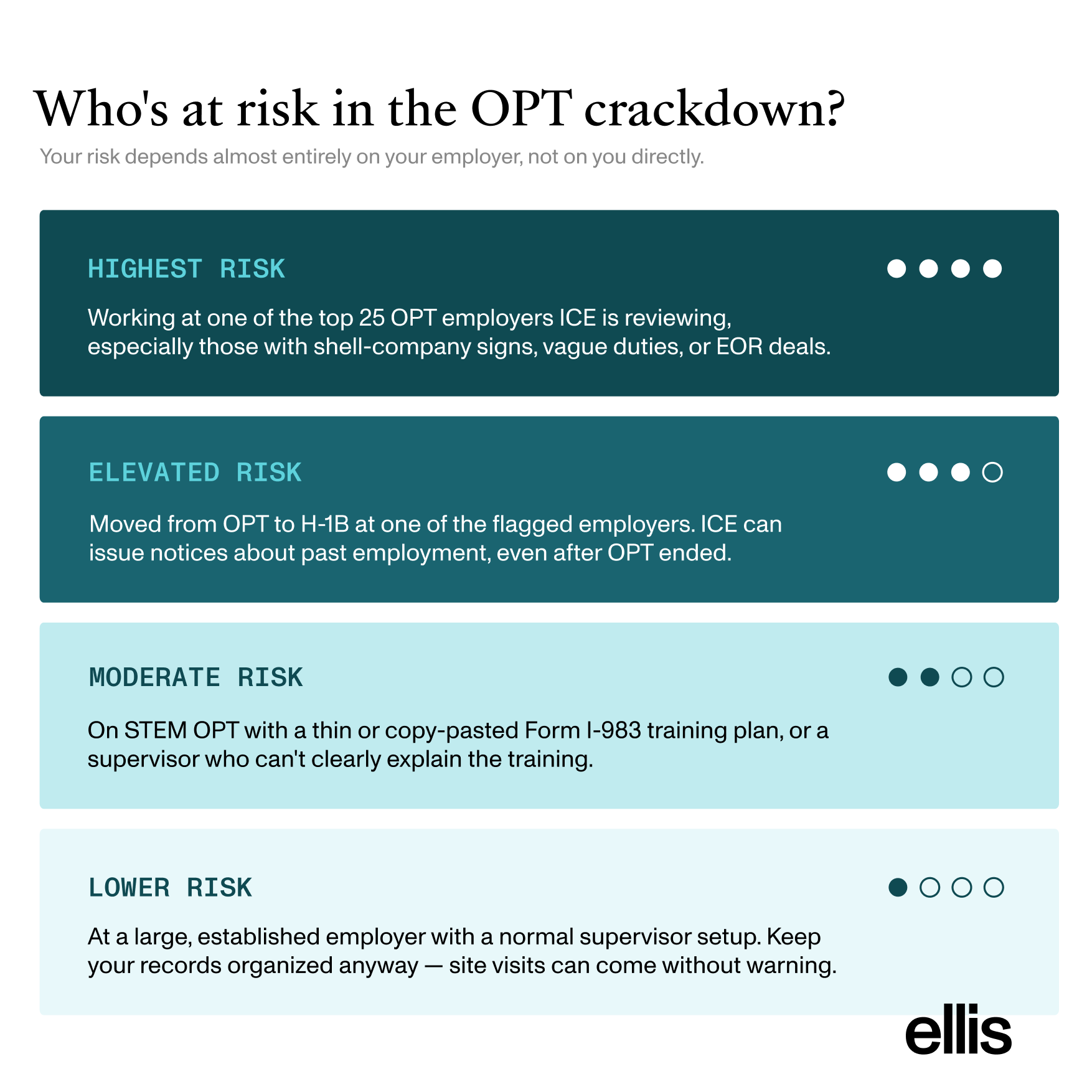
- Highest risk. Students working now at one of the top 25 OPT employers ICE is reviewing, especially employers with shell-company signs: lots of OPT workers at small addresses, offshore payroll, vague duties, training firms that "place" students at unrelated client sites, or employer-of-record (EOR) deals that do not match SEVP records.
- Elevated risk. Students who moved from OPT to H-1B at one of the flagged employers. ICE has said it can send notices about old employment.
- Moderate risk. STEM OPT students whose Form I-983 training plan is thin or copied across many students, whose supervisors cannot explain the training, or whose SEVP Portal updates have gaps.
- Lower risk. Students at well-known, large employers with normal supervisor setups. Keep your records clean anyway in case of a surprise site visit.
How do I know if my OPT employer is legitimate?
There is no public ICE blacklist. The patterns ICE has flagged are your best self-check. If two or more of these apply to your current OPT or STEM OPT job, talk to your DSO and an immigration attorney:
- The employer has far more OPT workers than total employees, based on LinkedIn, business filings, or your own count.
- The work address is a home apartment, a virtual office, or a building you have never visited.
- Your supervisor is unclear, keeps changing, or works overseas, and you can't name one on-site manager.
- You get paid by stipend, 1099, or not at all, instead of a W-2 paycheck.
- The employer is vague about your day-to-day work, or your "training" only loosely matches your degree.
- The employer shares an office, leaders, or near-identical websites with other companies that also hire OPT students.
- HR and staffing contacts are based outside the US, with little US presence.
No single sign proves fraud. The pattern matters.
What should I do right now if I am on OPT?
A short checklist:
- Check your SEVP record. Make sure the employer name, EIN, address, and dates match real life. Fix gaps with your DSO right away.
- Save everything. Every offer letter, pay stub, W-2, tax filing, performance review, work product, training plan, and supervisor email. This is your proof of good faith if ICE later investigates your employer.
- Keep your I-983 current (STEM OPT). Update on time. Document supervision. Finish 12- and 24-month evaluations with real signatures.
- Do not travel until you talk to a DSO. Re-entering the US while ICE is reviewing your employer is the riskiest move you can make in the next 90 days.
- Get a free consult with an immigration attorney if you see any red flags. Many firms are offering 15- to 30-minute calls for OPT students this month.
- Do not quit suddenly. Walking off without a backup work permit can create its own status problems. Coordinate the move.
If you get a Request for Evidence (RFE), Notice to Appear (NTA), or any message from ICE or HSI, stop, save everything, and call a lawyer before you reply.
What should employers of OPT students do right now?
Surprise site visits are the new normal. A reasonable plan:
- Audit your OPT and STEM OPT roster against real headcount and office space.
- Refresh every active Form I-983 with a specific training plan and a named on-site supervisor.
- Run a mock site visit. Train front-desk staff to find supervisors, badges, I-9s, payroll, and training plans within 30 minutes.
- Tighten reporting. Report every change in worksite, hours, supervisor, or wages to the SEVP Portal within 10 business days.
- Document supervision. Keep weekly check-ins, reviews, and project assignments on paper.
- Train recruiters to avoid pitches that promise OPT placement or claim to "manage" SEVP reporting.
- Call immigration counsel before any FDNS or HSI visit.
The next 60 days are your window to find and fix problems on your own terms.
Why are Indian students disproportionately affected?
About half of OPT and STEM OPT participants are Indian nationals, so any large enforcement push affects this group more than any other.
First, the federal allegations target specific consulting firms and shell companies, many with handlers in India. They do not target Indian students as a group. Most OPT students from India work real jobs at real employers. Second, most affected students are victims of the consulting firms they trusted. They are not the people running the scheme. Treating the two groups as one is bad journalism and worse policy.
The practical risk is still real. Indian students use smaller staffing-firm paths into US jobs more often than other groups do, and ICE is examining that part of the OPT system most closely. Indian student groups and consular offices are now expanding legal-aid referrals.
How does the F-1 to H-1B transition work in light of the crackdown?
Many OPT and STEM OPT students plan to move from F-1 to H-1B, often through the H-1B cap lottery in their last OPT year. The crackdown adds three risks to that move:
- A fake OPT employer can damage your record later. ICE can send notices about past OPT work, even after you have moved to an H-1B with a different sponsor.
- H-1B status does not erase the old record. If ICE later flags your old OPT employer, USCIS can review your F-1 status. That can affect future H-1B extensions, green-card filings, and adjustment-of-status cases.
- Timing matters. Quitting a flagged employer too fast can push you past OPT's 90-day unemployment limit (150 days for STEM OPT) and create its own status problem.
If you are moving from F-1 to H-1B right now: confirm your current employer's good standing before you file the change-of-status. Save every piece of OPT-job proof. Be careful on Form I-129 employment history, since misrepresentation can compound the OPT problem. Ask counsel about cap-gap, which depends on your F-1 staying valid.
What happens next with the OPT crackdown?
Three timelines to watch:
- OMB review of the Duration of Status rule. Final rules usually clear OMB in 60 to 90 days. If the Federal Register publishes the rule this summer, the four-year cap can start in fall 2026.
- The next ICE update. Lyons's "tip of the iceberg" line was a signal. Expect more employer names, indictments, or larger numbers in the coming weeks.
- Congress. The Keep Innovators in America Act needs a Senate version to make real progress. Watch for committee hearings before the August recess.
The real question for students: will the crackdown change OPT itself, or only how the government polices it? DHS's rule entry suggests both are possible. Either way, the next 12 months will look very different from the OPT most students enrolled into.
Where can I get help with my OPT situation?
If you are a current F-1 student, STEM OPT participant, or employer of OPT workers and you want a quick review of your situation, contact our immigration team for a confidential 20-minute consult. The next 60 days are your window to find and fix problems on your own terms, before HSI arrives.
This article is informational and does not constitute legal advice. For specific guidance on your situation, talk to a licensed immigration attorney and your school's Designated School Official.