


If you hold an approved H-1B and plan to travel internationally, there's one more step between you and re-entry: the visa stamp.
H-1B visa stamping is the consular appointment where a U.S. embassy places that stamp in your passport. Let's break down how the H-1B visa stamping process works, what documents you need, and the policy changes from 2025 that affect your options.
Key Takeaways
- The visa stamp and your H-1B status are two separate things. Your stamp authorizes entry into the U.S.; your I-797 and I-94 establish your right to work.
- You generally only need a valid stamp when traveling internationally. If you stay inside the U.S., an expired stamp does not affect your work authorization.
- As of 2026, most applicants must complete stamping at a consulate in their home country. Third-country options and the domestic revalidation pilot are currently unavailable.
- Interview waivers (dropbox) are now significantly restricted for H-1B holders. Plan for an in-person consular interview unless you have confirmed you qualify for an exception.
What Is the Difference Between H-1B Visa Stamping and H-1B Status?
When USCIS approves your employer's I-129 petition, it grants you H-1B status. Your I-797 approval notice and I-94 record together establish your legal right to live and work in the United States.
An H-1B visa stamp (or visa foil) is a machine-readable sticker that a U.S. embassy or consulate places in your passport. It authorizes you to enter the U.S. in H-1B status. The stamp shows your name, visa type (H-1B), number of entries (M for multiple entry), and an annotation listing your sponsoring employer and petition end date (PED). It is a travel document, separate from your USCIS approval.
If you stay inside the U.S. without traveling, your stamp can expire without consequence. You keep full work authorization. Stamping only matters when you leave and need to re-enter.
How Does the H-1B Visa Stamping Process Work in 2026?
The H-1B consular processing sequence is largely the same across most countries, though wait times vary significantly by location. As of 2026, all H-1B applicants must stamp outside the U.S. The domestic revalidation pilot that briefly allowed in-country renewals in 2024 has been suspended with no confirmed restart date.
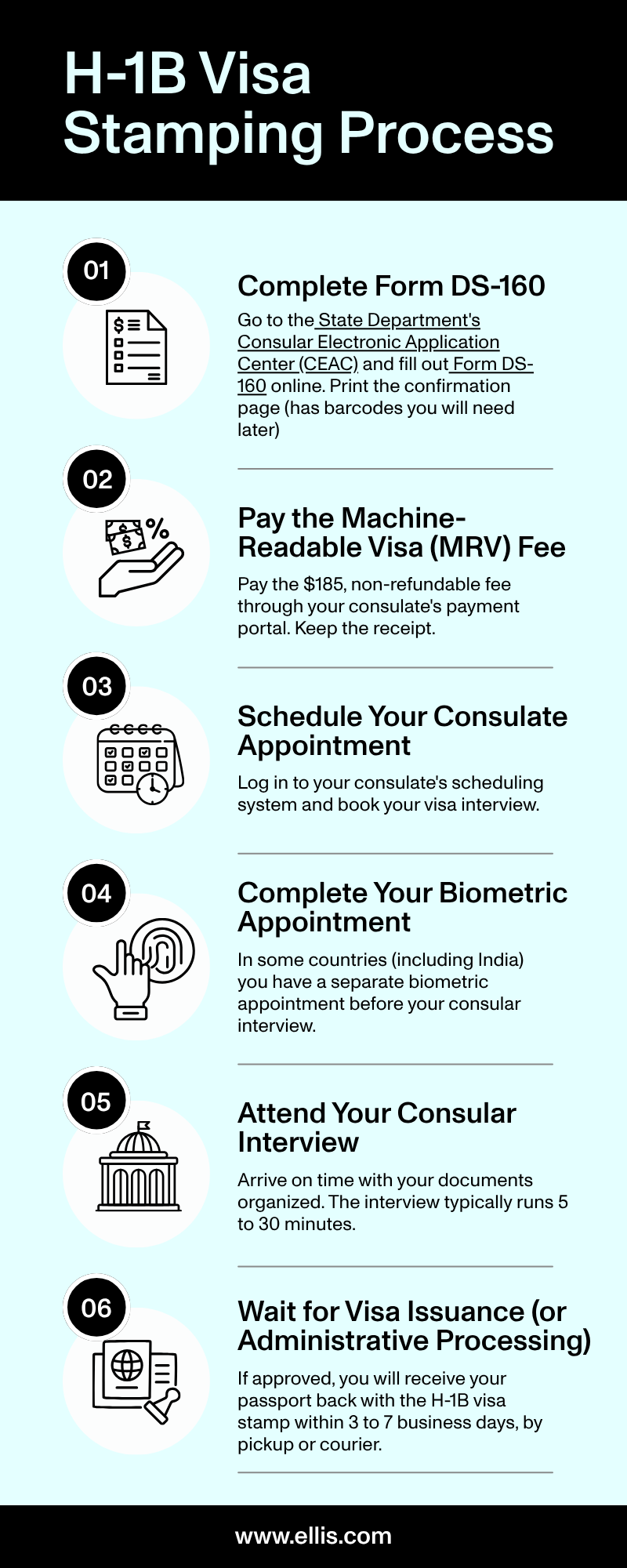
Step 1: Complete Form DS-160 (Online Nonimmigrant Visa Application)
Go to the State Department's Consular Electronic Application Center (CEAC) and fill out Form DS-160 online. The form covers your personal background, travel history, employment, and security questions. Budget 60 to 90 minutes. Every answer must match your I-129 petition exactly.
Print the DS-160 confirmation page when you finish. It has a barcode the consulate scans at your interview. Do not go to any appointment without it.
Step 2: Pay the Machine-Readable Visa (MRV) Fee
The MRV visa application fee is $185 and non-refundable. Pay through your consulate's payment portal and keep the receipt — you will need it at your interview. This fee is separate from the USCIS petition fees your employer paid.
Step 3: Schedule Your Consulate Appointment
Log in to your consulate's scheduling system and book your visa interview. As of 2026, you must schedule in your country of nationality or last residence. The option to stamp in a third country like Mexico or Canada was eliminated in September 2025.
Some applicants in regions with closed or limited consulates — parts of the Middle East, for example — have been directed to posts in Europe. Options vary and are not guaranteed; consult your immigration attorney with any questions.
2026 Warning: India Appointment Backlogs As of April 2026, consular appointments in India are severely backlogged following December 2025 State Department policy changes expanding social media and online presence reviews for H-1B and H-4 applicants. Some applicants in New Delhi are receiving appointment dates as far out as Summer 2027. If you are an Indian national planning international travel, consult with an immigration attorney before booking any flights.
Step 4: Complete Your Biometric Appointment at the Visa Application Center (VAC)
If you are applying in India or many other countries, you will have a separate biometric appointment at a Visa Application Center before your consular interview. Staff collect your fingerprints and photo. Book this appointment 1 to 3 days before your consulate date.
Step 5: Attend Your Consular Interview
Arrive on time with your documents organized. The interview typically runs 5 to 30 minutes. An officer will ask about your employer, your role, and your qualifications.
As of September 2025, H-1B interview waivers (the dropbox option) have been severely restricted. Most applicants now need to attend in person. Current eligibility criteria are covered in the interview waiver section below.
Step 6: Wait for Visa Issuance or Administrative Processing
If approved, you will receive your passport back with the H-1B visa stamp within 3 to 7 business days, by pickup or courier. If the officer issues a Form 221(g), your case has entered administrative processing. The 221(g) section below explains what to do next.
What Documents Do You Need for H-1B Visa Stamping?
Missing even one document at your H-1B visa interview can trigger a delay or a 221(g) administrative processing hold. Plan to bring everything on this list.
Document | Notes / Requirements |
|---|---|
Valid Passport | Must be valid 6+ months beyond intended U.S. entry date |
Form DS-160 Confirmation Page | Printed page with barcode; required at appointment |
Form I-797 Approval Notice | Original Notice of Action from USCIS |
Form I-129 Petition Copy | Full signed petition as filed by your employer |
Labor Condition Application (LCA / ETA 9035) | Must not be expired; see our LCA guide for details |
Visa Application Fee Receipt (MRV Fee) | $185; proof of payment required |
Passport-Style Photo | Must meet U.S. State Department specifications |
Employment Verification Letter | States job title, salary, start date on company letterhead |
Recent Pay Stubs (3 months) | For renewals; demonstrates continuous employment |
Most Recent W-2 Form | For renewals/extensions |
Resume / CV | Confirms education and experience alignment with petition |
Academic Transcripts & Diplomas | Particularly if specialty occupation credentials are scrutinized |
Your employer files the Labor Condition Application (LCA) with the Department of Labor before submitting your H-1B petition. Bring the certified LCA and the full I-129 to your interview. Keep all of the documents above organized and accessible.
Are H-1B Interview Waivers (Dropbox) Available in 2026?
The H-1B interview waiver, commonly called dropbox, previously allowed eligible applicants to renew their stamp by mail without an in-person interview. That changed in September 2025; the waiver is now severely restricted and largely unavailable for H-1B holders.
Dropbox Is Not Available for Most H-1B Renewals in 2026
Do not book flights or make travel arrangements based on an assumption that you will qualify for the interview waiver. As of April 2026, in-person interviews are required for the vast majority of H-1B applicants at all consulates, including those in India, Mexico, and Canada.
What Questions Do Consular Officers Ask at the H-1B Visa Interview?
Officers usually want to confirm two main things: that your petition details are accurate, and that a real employer-employee relationship exists. Questions generally fall into three categories.
Employment & Role
- What is your job title and what will you be doing in the United States?
- Who is your employer and where is the company located?
- What is your annual salary?
- Where specifically will you be working—at the employer’s headquarters or at a client site?
- Who is your direct supervisor?
Qualifications & Education
- What is your highest level of education and in what field?
- How many years of experience do you have in your specialty occupation?
- Walk me through your professional background.
Travel & Intent
- How long do you intend to remain in the United States?
- Do you have any plans to seek permanent residency?
- Have you ever been denied a U.S. visa or been removed from the United States?
Keep your answers straightforward and honest. Anything you say should match your I-129 and I-797 exactly.
How Long Does H-1B Visa Stamping Take in 2026?
Step | Typical Timeframe | 2026 Considerations |
|---|---|---|
Complete DS-160 Online | 1–3 days | Allow time to gather all employment and petition details |
Pay MRV Fee | Same day | Keep receipt; required at interview |
Schedule Consulate Interview | Varies widely | India: booked to Summer 2027 in some cities; plan far in advance |
Biometric Appointment (VAC) | 1 day | Must be 1–3 days before consular interview |
Consular Interview | Minutes–1 hour | In-person required for most applicants; dropbox severely restricted |
Passport Return / Visa Issuance | 3–7 business days | Assumes no 221(g); may be longer if administrative processing |
Administrative Processing (221g) | Weeks to months | No guaranteed timeline; security checks; attorney review advised |
What Is 221(g) Administrative Processing and What Should You Do?
A 221(g), administrative processing, is not a denial. It means the consulate needs more information or your case is pending a security or background check. It is stressful, but understanding it helps you plan.
What Triggers 221(g)?
- Missing or inconsistent documents between your DS-160 and I-129
- Complex employer arrangements such as staffing agencies, consulting firms, or client-site placements
- Prior immigration violations or visa refusals
- Security checks flagged by the government screening system
- Social media review flags under the December 2025 expanded policy
There is no set timeline. Cases can resolve in a few weeks or extend for several months. Do not book return flights or make firm travel plans until your stamped passport is in your hands.
If you receive a 221(g), contact an immigration attorney right away. An attorney can review the request, help you respond accurately, and communicate with the consulate on your behalf where permitted.
Do You Need New H-1B Stamping After a Job Change or Layoff?
Changing employers — including after a layoff — does not automatically mean you need new stamping. It depends on whether your current stamp is still valid.
Can I Use My Existing H-1B Stamp With a New Employer?
In many cases, yes. You can generally use a valid, unexpired H-1B visa stamp to re-enter the U.S. under a new employer's petition. The stamp does not need to reflect your current employer's name.
What If My Stamp Has Expired and I Changed Employers?
You will need to complete a new stamping appointment at a consulate abroad. Bring both the new employer's I-797 and the new employer's I-129 petition to your interview.
Important: Traveling With a Pending Petition
If your I-129 amendment or extension is pending with USCIS and you depart the U.S. before it is approved, your case may be treated as abandoned, which can complicate your ability to re-enter. Departing while a petition is pending may also trigger the $100,000 fee requirement under the September 2025 presidential proclamation. Consult an immigration attorney before traveling with any pending petition.
2025–2026 Policy Changes Affecting H-1B Visa Stamping
2025 brought major changes to H-1B stamping. Here’s what every applicant needs to know.
Why Did Third-Country Stamping End in September 2025?
In September 2025, the State Department ended third-country stamping. You can no longer book an appointment in Mexico or Canada if that’s not your home country. Everyone must now stamp in their country of nationality or last residence. This has made backlogs worse, especially in India.
Dropbox Waivers Severely Restricted (September 2025)
Starting September 2, 2025, most H-1B applicants must appear in person for an interview. Even straightforward renewals that used to qualify for dropbox now require a consular appointment.
Is the Domestic H-1B Visa Revalidation Pilot Still Active?
No. The domestic revalidation pilot—which briefly let workers renew their stamps without leaving the U.S.—has been suspended. As of April 2026, there’s no confirmed restart date. Congress has pushed for it to reopen, but no timeline has been set.
What Is the Expanded Online Presence Review for H-1B Applications?
In December 2025, the State Department expanded social media and online presence reviews for H-1B and H-4 applications. In practice, this has caused a surge in appointment delays—especially in India.
What Is the $100,000 H-1B Petition Fee and Who Pays It?
A presidential proclamation effective September 21, 2025 requires employers to pay $100,000 for certain H-1B petitions. The fee applies when the worker is outside the U.S. without a valid visa, or when the petition requests consular notification or port-of-entry notification. Extensions and amendments for workers already inside the U.S. with valid status are generally exempt. Confirm with your attorney before filing.
How Does H-4 Visa Stamping Work for Dependents?
H-4 stamping follows the same consular process as H-1B. Each dependent needs their own DS-160 and pays their own MRV fee. Spouses bring a marriage certificate; children bring a birth certificate. Everyone needs to show evidence of the primary H-1B holder's approved status.
As of 2026, H-4 applications are subject to the same expanded online presence review as H-1B, which means longer wait times at high-volume consular posts.
Need Help With H-1B Visa Stamping?
H-1B visa stamping has become significantly more complex in 2026. Consular backlogs, restricted interview waivers, the end of third-country stamping, and expanded security reviews have made preparation more important than ever. Ellis can guide you through every step and be your resource if complications arise. Schedule a consultation today.