


If you've ever filled out a U.S. immigration form and hit a field asking for your "A-Number," you're not alone in pausing. The alien registration number is one of the most important identifiers in the U.S. immigration system, but it can be confusing to understand.
Let’s break down your alien registration number, how to find it on your documents, and how it differs from similar-sounding numbers you may have encountered.
Key Takeaways
- Your alien registration number is a unique 7-to-9 digit ID that generally starts with an “A”. It's assigned by DHS that links all your U.S. immigration records and never changes.
- You can find it on your green card, EAD, immigrant visa, or Form I-797, usually labeled "USCIS#" or "Alien #."
- The A-number and USCIS number are the same thing, just formatted differently. Neither is the same as your green card number or USCIS case number.
What Is an Alien Registration Number?
An alien registration number (commonly called an A-number or A#) is a unique identification number assigned by the U.S. Department of Homeland Security (DHS) to noncitizens.
It functions as your personal ID within the U.S. immigration system, linking every application, petition, and case record to you across your lifetime. In USCIS systems, you may also see it referred to as your A-number USCIS or simply your USCIS number — it's the same identifier.
The number is between 7 and 9 digits long and is always written with the letter "A" in front of it, for example, A-123456789.
If your number has fewer than nine digits, you'll need to add leading zeros when filling out official forms. So A-1234567 would become A-001234567.
One important thing to know early: your A-number does not change. Whether you renew a green card, change immigration status, or eventually apply for citizenship, the same number stays with you throughout your entire immigration history.
Who Gets an Alien Registration Number?
Not every noncitizen in the U.S. is assigned an A-number. It is generally issued when a person's immigration process involves a long-term record: someone applying for permanent residency, seeking asylum, or obtaining certain work authorizations.
You will typically receive an A-number if you:
- Apply for a green card (lawful permanent residence), whether through family, employment, or refugee/asylee status
- Apply for asylum
- Are placed in removal proceedings before an immigration court
- Receive an Employment Authorization Document (EAD) as an F-1 student
Most short-term visitors (tourists, business travelers, and the majority of nonimmigrant visa holders) do not receive an A-number. H-1B workers, for example, are not automatically assigned one. However, if an H-1B holder has previously gone through another immigration process that triggered an A-number, that same number carries forward into any new filings.
How to Find Your Alien Registration Number
Your A-number appears on several official immigration documents. Below is where to look on each one. If you need the alien registration number on I-797, the alien registration number on EAD, or the a number on green card, use the checklist below.
On Your Green Card (Form I-551)
Your A-number is printed on the front of your Permanent Resident Card, labeled as "USCIS#" or "Alien #." It is a 7-to-9-digit number starting with "A."
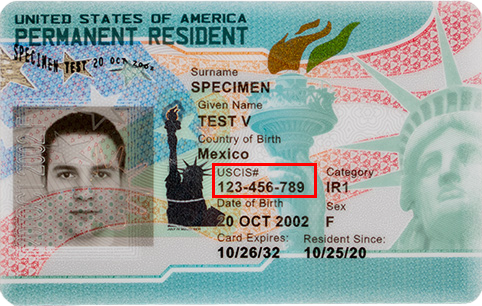
Do not confuse it with the Document Number, which is a 13-character code found on the back of the card — these are two different identifiers.
On Your Employment Authorization Document (EAD)
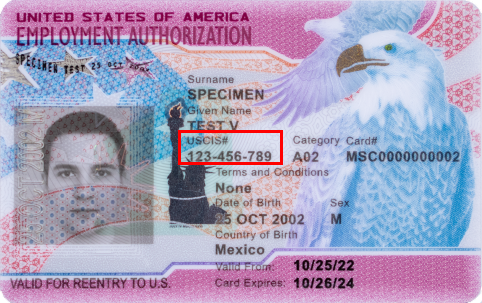
If you hold a work permit, your A-number appears on the front of the card beneath the label "USCIS#." The format is the same as on a green card. This is the alien registration number on EAD or Form I-766.
On Your Immigrant Visa
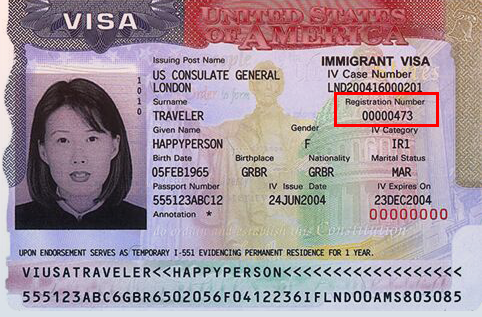
Your immigrant visa — the stamp placed in your passport at a U.S. consulate — lists your A-number as the "Registration Number," typically located in the top right section of the stamp. Note that this applies only to immigrant visas. A nonimmigrant visa does not contain an alien registration number.
On a Notice of Action (Form I-797)
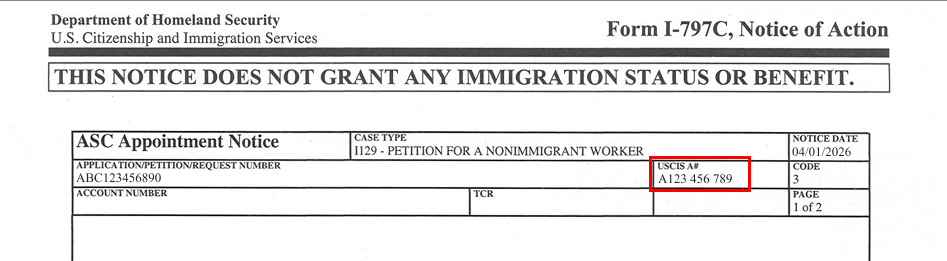
When USCIS sends you an approval notice or receipt notice, your A-number may appear in the upper right section of the document next to "USCIS#." This is most commonly found on the I-797C biometrics notice. Not all versions of the I-797 include it, so check the top right corner first. For the alien registration number on I-797, the upper right area is the best place to look.
On a Immigrant Data Summary and USCIS Immigrant Fee Handout
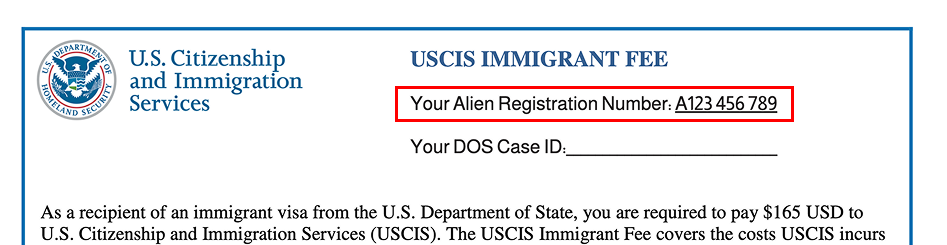
If you went through consular processing to get your green card, you likely received an Immigrant Data Summary stapled to the front of your visa package. Your A-number appears at the top of this document.
Alien Number vs. USCIS Number: What's the Difference?
This is one of the most common points of confusion, and the answer is simple: they are the same number. Put simply, alien number vs USCIS number is a matter of formatting only. The USCIS number is just the A-number displayed without the letter "A" in front of it. If your A-number is A-123456789, your USCIS number is 123456789.
On newer green cards and EADs, the label "USCIS#" replaced older "Alien #" labeling, which is part of why the two terms cause so much confusion. For practical purposes, including on Form I-9, either format is acceptable.
Alien Registration Number vs. Green Card Number
These are different, and mixing them up on a form can cause real problems. The alien registration number identifies you as a person within the immigration system and appears across many documents throughout your life.
The green card number is a 13-character identifier specific to your current green card, found on the back of the card. If your green card is renewed or replaced, the green card number changes — your A-number does not.
What Is Your A-Number Used For?
Your A-number serves as the central link connecting your entire immigration history. U.S. immigration agencies (like USCIS, ICE, and the immigration courts) use it to pull your full record: every application you've filed, every decision that was made, your prior immigration statuses, and any enforcement history.
In practical terms, you'll need your A-number when:
- Filing immigration applications and petitions with USCIS
- Completing Form I-9 as a lawful permanent resident
- Checking your case status online through your USCIS account
- Appearing before an immigration judge
- Applying for U.S. citizenship (naturalization)
A missing or incorrect A-number on a form can cause processing delays, trigger a Request for Evidence, or result in your application being routed to the wrong file. Providing the wrong number is generally worse than leaving the field blank, so accuracy matters.
What If You Can't Find Your A-Number?
If you've searched your documents and still can't locate it, here are your options:
- Review all past immigration documents. Check any USCIS notices, approval letters, or old green cards or EADs you may have stored away. The number appears on more documents than most people realize.
- Log in to your USCIS online account. If you've filed applications online, your A-number should be visible in your account dashboard.
- Consult your immigration attorney. If you're in the middle of an active case and need the number urgently, an immigration attorney can help you locate it quickly and ensure it's used correctly going forward.
- Contact USCIS directly. Call the USCIS Contact Center at 1-800-375-5283. Be prepared to verify your identity.
- Submit a FOIA request. You can request your immigration file from USCIS through a Freedom of Information Act (FOIA) request. This gives you access to your full record and will include your A-number.