

Form I-94 (Arrival/Departure Record) is one of the most important documents for any foreign national in the U.S. While your visa gets you to the door, the I-94 determines how long you can actually stay inside.
Key Takeaways
- Proof of Legal Status: Your I-94 date, NOT your visa expiration date, controls your legal status. Even if your visa is valid for 10 years, you must leave (or apply for an extension) before the "Admit Until" date on your I-94.
- Digital Records: Most records are now electronic and can be retrieved online.
- Accuracy Matters: A typo in your I-94 can lead to issues with driver’s licenses, Social Security, and future green card applications.
- Check Every Entry: Download your new I-94 every time you re-enter the U.S. to ensure there are no errors. The CBP portal also allows you to pull a five-year history of your U.S. arrivals and departures.
- Let Ellis handle it: We track and manage immigration records for you and your workers — all in one place. See how it works.
What is an I-94?
Form I-94 is the official Arrival/Departure Record issued by U.S. Customs and Border Protection to nonimmigrants who enter the U.S. This includes travelers on H-1B, F-1, B-2, and L-1 visas.
While your visa is an entry document that allows you to request entry at a port, the I-94 is the record that shows you were actually admitted and lists the conditions of your stay.
Since 2013, the process has been almost entirely digital for individuals arriving by air or sea. Instead of a paper card, a digital record is created automatically upon your arrival.
Where to find your I-94 record
Since 2013, most records are digital. You will likely not receive a paper card at the airport.
How to get your I-94 record online:
- Go to the Official Site: i94.cbp.dhs.gov

- Select "Get Most Recent I-94" (or "View Travel History" for a five-year log).
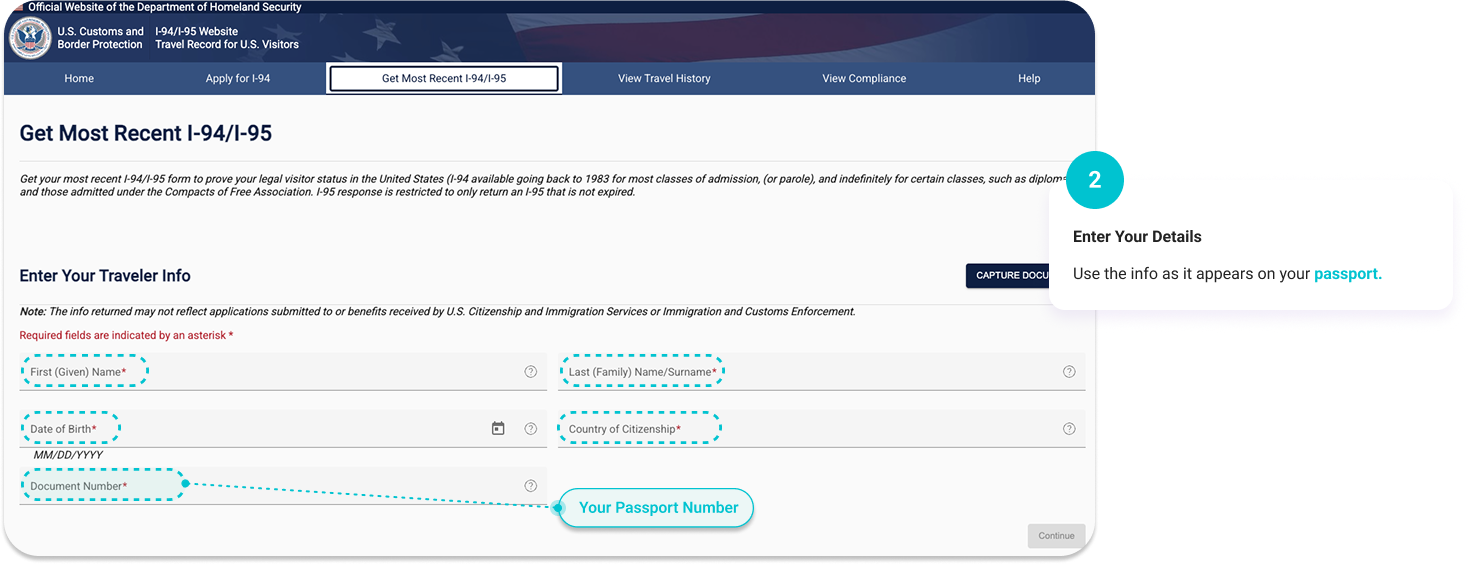
- Enter Details Exactly: Use the info as it appears on the passport you used to enter the U.S.
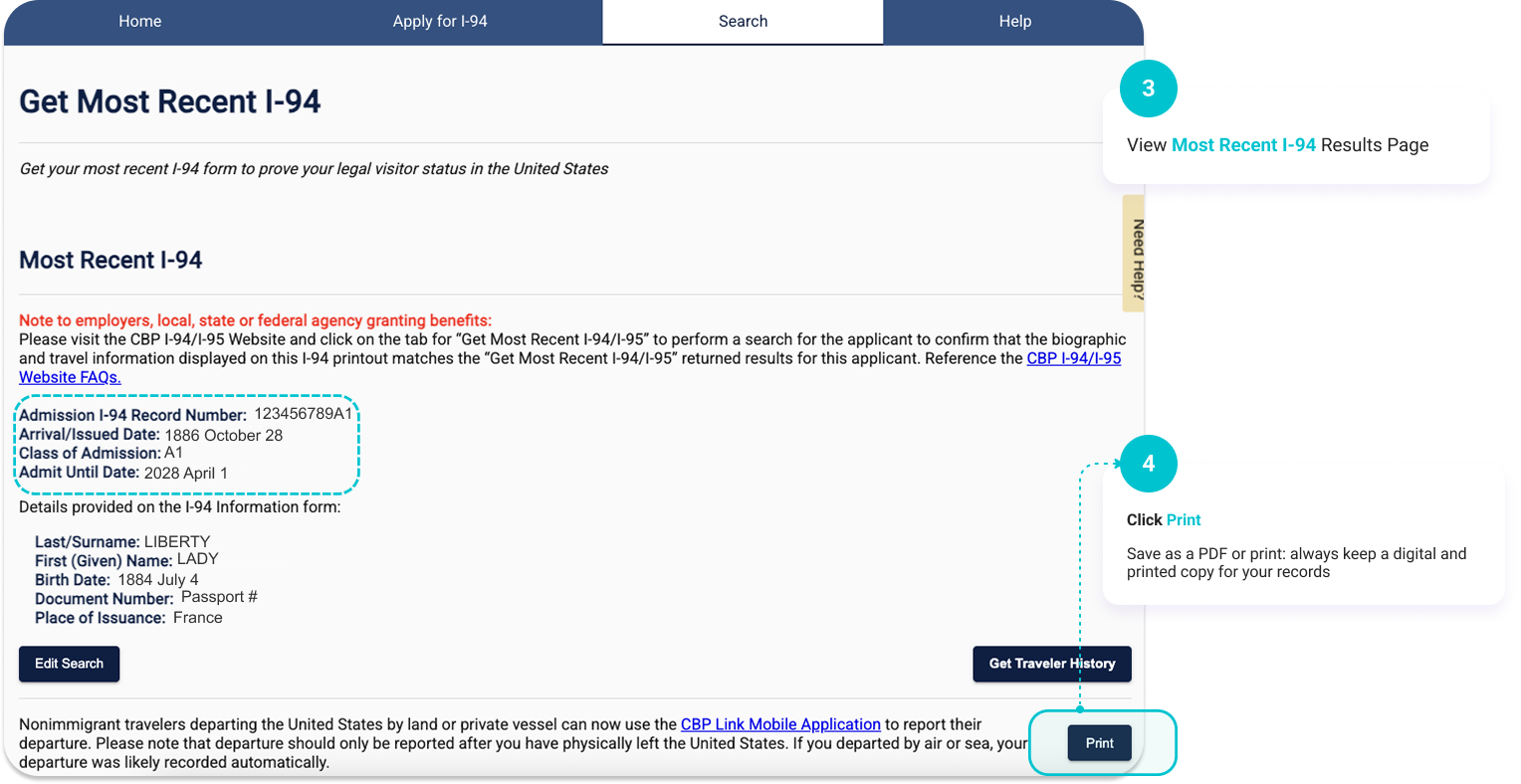
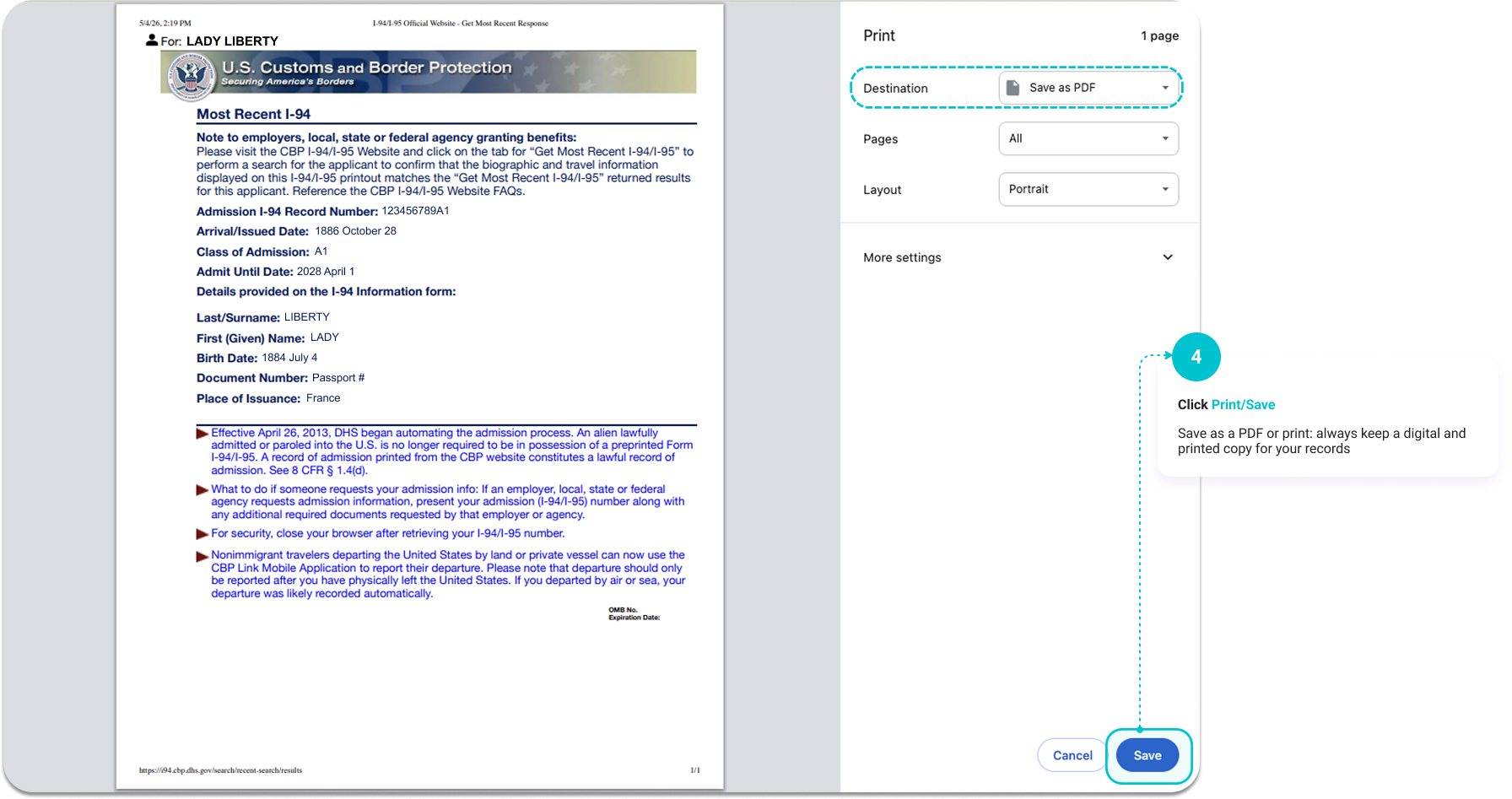
- Save the PDF: Always keep a digital and printed copy for your records.
Paper I-94 Records
If you entered at a land border or arrived prior to the 2013 digital transition, you may have a paper I-94 card stapled into your passport. If this card is lost or stolen, you must file Form I-102 with USCIS to request a replacement.
How to read your I-94
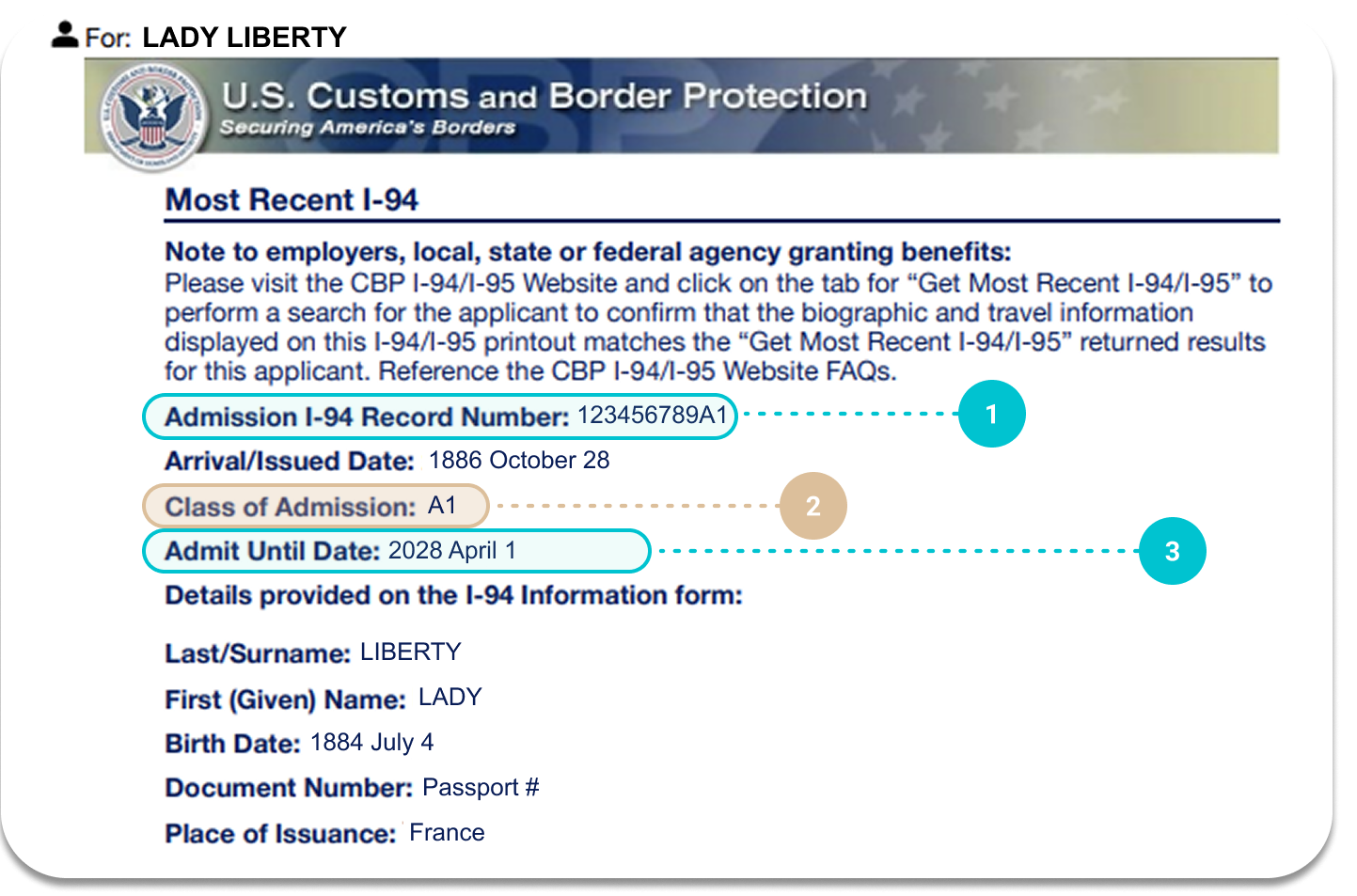
When you download your record, pay close attention to these three fields:
- Admission (I-94) Number: An 11-digit unique identifier used for employment verification.
- Class of Admission: Your specific visa category, such as H-1B or F-1.
- Admit Until Date: This is the most important date. It is the day your legal stay expires. You must leave or file an extension before this date.
Note on "D/S": If your "Admit Until Date" says "D/S" (Duration of Status), you are generally legal as long as you maintain your program requirements. This is common for F-1 students.
I-94 vs. Visa Stamp vs. Passport Entry Stamp
It is common to confuse these documents, but they serve different purposes:
- Visa Stamp: This is found in your passport and allows you to travel to a U.S. port of entry.
- Passport Entry Stamp: This is a physical ink stamp from the CBP officer. It often contains a handwritten date, but the digital I-94 is the legally governing record.
- I-94 Record: This is the final word on your legal status and expiration.
What to do if your I-94 is lost or wrong
Errors can happen. CBP officers might mistype a name or give you the wrong "Admit Until" date based on your Form I-797 approval.
- For simple typos: Contact a CBP Deferred Inspection Site. Many can fix errors via email.
- For expired records: You may be "out of status," which carries serious overstay consequences.
- For missing records: If you can't find your record online, double-check that you aren't confusing your A-Number with your I-94 number.
I-94 Travel History
The CBP portal also provides an "I-94 Travel History" tool. This pulls a list of your arrivals and departures for the last five to ten years. You will often need this when filing for a Green Card (Form I-485) to prove you haven't spent too much time outside the country. You can download it for free, any time.
How to retrieve it
- Visit i94.cbp.dhs.gov/I94
- Select "View Travel History"
- Enter your passport details exactly as they appear on the passport you used
- Save or print the record as a PDF
The tool usually returns the past five years. For some travelers, it can go back ten years. There's no fee, and no limit on how often you can pull it.
What the record shows
Each row in your travel history includes:
- Date of arrival and, when CBP can match it, date of departure
- Port of entry, usually shown as a three-letter airport code or a land-border name
- Class of admission, the visa category you entered under
- Carrier, the airline or vessel that sent your manifest
Air and sea entries are reliable. Land border crossings between the U.S. and Canada or Mexico can be spotty, especially for trips before 2013. Not every land port records both directions of crossing.
When you actually need it
Form | Why it asks |
|---|---|
Form I-485 (Adjustment of Status) | Every U.S. entry since you first received a visa |
Form N-400 (Naturalization) | Every absence in the last five years, or three for spouses of U.S. citizens. Used to check continuous residence and physical presence. |
Form DS-260 (Consular processing) | All U.S. travel for the past five years |
Form I-131 (Reentry Permit) | Past absences, to check whether you've given up your residence |
Visa renewals | Consular officers often ask for the last five years of U.S. visits |
Used by the IRS to figure out if you owe U.S. taxes |
Common gaps and how to handle them
- Missing land-border entries. Trips to or from Canada and Mexico, especially before 2013, may not show up. Use your passport stamps as backup.
- Arrival with no matching departure. If your airline didn't send a passenger manifest, the record can show that you entered but never left. Boarding passes, foreign entry stamps, and credit card records from abroad can fill the gap.
- Older trips not showing. If you need entries from beyond the tool's window, file a Privacy Act or FOIA request with CBP for your full I-94 history. Processing usually takes a few months.
- Wrong information in a returned row. If a date or visa class is wrong and it matters for an upcoming filing, contact a CBP Deferred Inspection Site. Bring documentation like a boarding pass, hotel receipt, or foreign exit stamp, and ask them to fix it.
Practical tips
- Pull it once a year as a record-keeping habit, especially if you travel internationally often.
- Save a PDF before each passport renewal. Once your old passport is retired, the visa and entry stamps inside it are harder to use as proof.
- Cross-check against your own records before filing any USCIS form. Errors you catch early are easy to fix. Errors USCIS catches can delay your case by months.
Let Ellis Handle It
Tracking and managing I-94 records can be a hassle — and missing a date has real consequences. Ellis retrieves up-to-date immigration records every day for you and your entire workforce, all in one place. Get in touch to streamline your immigration management.
Disclaimer: This article is for informational purposes only and does not constitute legal advice. For specific legal guidance regarding your status, please consult with a qualified immigration attorney.