


In Brief: Your country of residence is the country where you actually live and spend most of your time, based on physical presence and personal ties, not necessarily where you hold citizenship. It's used by governments to determine your legal status and your eligibility for certain benefits, and it can be different from your nationality.
Key Takeaways
- What is it? Country of residence is where you currently live and conduct your day to day life, most of the time, regardless of where you hold citizenship.
- How is it determined? Countries look at your physical presence, your personal and economic ties, and the actual time you spend there. Most countries require physical presence to count you as a resident.
- Can it differ from nationality? Yes. Your country of residence can differ from your nationality. Nationality is your legal relationship to a state and typically which country's passport you hold. Residence is where you actually live.
- Important: You may be treated as a resident under more than one country's rules at the same time, but for most immigration and legal purposes, you can only have one primary country of residence at a time.
- Need help? Ellis's immigration experts handle the details so your residency status doesn't hold up your case. Get in touch today →
What does country of residence mean?
Country of residence refers to the specific country where an individual lives most of the time and conducts their actual, day to day life. It's your primary home, the place where you sleep most nights, keep your belongings, and build your social life and social circles.
Country of residence is NOT automatically:
- Your country of birth
- Your citizenship
- The country on your passport
For example: a U.S. citizen who has lived and worked in Lisbon for the past three years has Portugal as their country of residence, even though the United States remains their nationality.
Most countries require physical presence to establish residence: actual time spent there, not just an intent to live there someday or a lease signed on paper. Government forms that ask for your "country of residence" want the particular country where you live right now, not where you're from or where you'd like to end up.
A helpful shortcut: nationality answers "where do you belong legally?" Country of residence answers "where do you actually live?" Most of the time these two questions have the same answer. When they don't, the difference matters.
Country of Residence vs. Nationality vs. Citizenship vs. Domicile
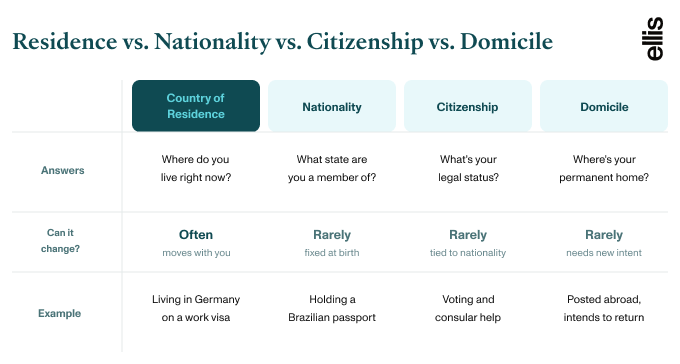
These four terms get used interchangeably in casual conversation, but each has a distinct legal meaning, and immigration forms often ask for more than one on the same application.
Term | What it means | Example |
|---|---|---|
Country of residence | Where you actually live most of the time | Living and working in Germany on a work visa |
Nationality / citizenship | Your legal membership in a sovereign state | Holding a Brazilian passport as a Brazilian citizen |
Domicile | Your permanent home, intended to be indefinite | A U.S. citizen stationed abroad who intends to return to the US |
Legal resident | Someone with legal permission to live in a country without citizenship | A green card holder in the U.S. |
A few distinctions worth spelling out:
- Nationality is tied to where you were born or to your parents' citizenship, and it rarely changes.
- Citizenship means the same thing as nationality in most countries. It comes with rights country of residence does not: voting, holding a passport, and diplomatic protection abroad, since a country can act on behalf of its nationals under international law.
- Legal resident describes someone with permission to live in a country without holding citizenship there, like a green card holder in the United States.
- Domicile is narrower than residence: it's the one home you intend to keep indefinitely, even while temporarily living elsewhere. U.S. immigration sponsors, for example, must prove they maintain a domicile in the United States even while stationed abroad for work.
Can you have more than one country of residence?
Yes, but not for every purpose. You can be treated as a resident in multiple countries at the same time, since different countries apply their own residency rules independently. It's entirely possible for two separate countries to each consider you a resident under their own laws in the same year, if you spend meaningful time and maintain real ties in both places. This is common for global citizens, remote workers, and people with multiple homes across two or more countries.
For most immigration and legal purposes, though, you can only have one PRIMARY country of residence at a time. Most immigration systems, employers, schools, and benefits programs expect you to name that one country, since it's where your day to day life actually happens.
When two countries could both claim you, agencies typically break the tie by looking at your vital interests:
- Where your family lives
- Where your job is based
- Where your economic ties and property are
- Where you spend the most actual time
A Brazilian citizen who splits the year between Sao Paulo and Lisbon could, in principle, meet each country's residency threshold on its own terms. But when a form asks for one country of residence, don't assume you can pick whichever is most convenient. Different agencies may ask for different things, so read what's actually being requested.
Why country of residence matters
Your country of residence has significant implications well beyond paperwork. It shapes which local laws apply to your day to day life, which local services and social services you can access, and what your legal status actually allows you to do. Here's where it matters most:
- Which laws apply. Country of residence may influence which country's laws apply to certain legal matters, such as contracts, property, family law, and where you pay taxes.
- Where you file paperwork. Government agencies use your stated country of residence to determine where to file and which office has jurisdiction over your case. Getting this wrong, or leaving outdated information on an active application, is one of the most common points of confusion and can cause real delays.
- Benefits eligibility. Country of residence is a key factor in determining eligibility for healthcare and education benefits in many countries, since these programs are typically built around the population that actually lives and uses services there.
- Immigration status. Your country of residence influences your immigration status directly. It's frequently a threshold requirement for immigration benefits like certain visas, permanent residency, and naturalization timelines.
Knowing which term does what helps you make informed decisions about visas, benefits, and long-term plans.
How is residency status determined?
Residency status is determined by weighing several factors together, and how long you intend to stay. There's no single test that applies everywhere, since residency requirements vary by country and by the purpose of the application. The most common points nearly every country checks:
- Physical presence. Most countries count actual days spent in the country over a set period.
- Personal reasons and ties. Where your family lives, where your children go to school, and where you keep your primary home.
- Economic ties. Where you work, where your income comes from, and where your property or bank accounts are based.
- Financial stability. Proof of financial stability, since immigration authorities want to see that you can support yourself.
- Background checks and health insurance. Many countries require these as part of the legal criteria for residency, depending on the specific circumstances of your application.
Not all residency is the same once you have it. Residence can be temporary or permanent depending on your legal status:
Temporary residence | Permanent residence | |
|---|---|---|
Tied to a specific purpose? | Yes, like a work visa or study program | No |
Needs renewal? | Usually, on a set schedule | No fixed expiration |
Reflects | A defined purpose for being there | A settled legal status |
Work permits and work visas establish your right to work, but they don't automatically make a country your country of residence. That only happens once you're actually living there for most of the year.
Country of residence on immigration applications
Immigration forms frequently ask for your country of residence, and it's easy to answer this incorrectly if you default to your citizenship out of habit. Forms don't all ask the same question, either:
Form field | What it's really asking |
|---|---|
Country of residence | Where you currently, physically live |
Where you habitually lived immediately before entering the U.S. | |
Citizenship / nationality | Which country you're a legal member of |
In the United States, this distinction shows up constantly. Someone living in the U.S. on an H-1B work visa has the United States as their country of residence, even though their citizenship sits with a different country. A green card changes your legal status to lawful permanent resident, which is a stronger form of residency than a temporary work visa, but it still isn't citizenship. Permanent residency through a green card gives you the right to live and work in the U.S. indefinitely, while your nationality can remain unchanged.
Read each form carefully rather than assuming these fields are asking the same thing twice.
Country of residence and international travel
Your nationality, not your country of residence, is usually what determines your visa-free travel access and passport privileges. A passport from a country with strong visa-free travel agreements gets you into many countries without a visa, regardless of where you currently live.
However, country of residence can still affect international travel in a couple of practical ways:
- Visa waiver eligibility. Some countries base visa requirements or waiver eligibility partly on where an applicant is currently living and applying from, not just their nationality.
- Re-entry rules. If you're a legal resident of one country but a national of a different country, check re-entry rules for both before you travel. A lapse in your residency permit could affect your ability to return.
How Ellis can help
Figuring out your country of residence is usually straightforward. It gets complicated fast when you're splitting time between more than one country, sponsoring a family member, or trying to reconcile a residency question with a pending visa or green card case. Ellis is a team of immigration attorneys backed by a case-management platform, so someone who knows your specific circumstances is looking at the details, not just software. Schedule a free consult →
This article is for informational purposes only and is not legal advice.