

If you want to bring a family member to the United States, the process starts with one form: Form I-130. Officially called the Petition for Alien Relative, it's how a U.S. citizen or lawful permanent resident establishes a qualifying family relationship with a foreign relative. It's the first step toward that relative getting a green card.
This guide covers what the I-130 is, who can file it, who qualifies as a beneficiary, what it costs, and what to expect after you file.
Key Takeaways
- Who files? A U.S. citizen or lawful permanent resident (LPR / green card holder) petitioning for a qualifying family member.
- Who qualifies? U.S. citizens can petition for spouses, parents, children, and siblings. LPRs can only petition for spouses and unmarried children.
- How much? $625 online or $675 by paper. The fee only covers the I-130; the beneficiary's eventual green card application has separate fees.
- Should I use an attorney? It’s strongly recommended. Bona fide relationship evidence, document translations, and category selection are common rejection points. Schedule a free consultation today.
What is Form I-130?
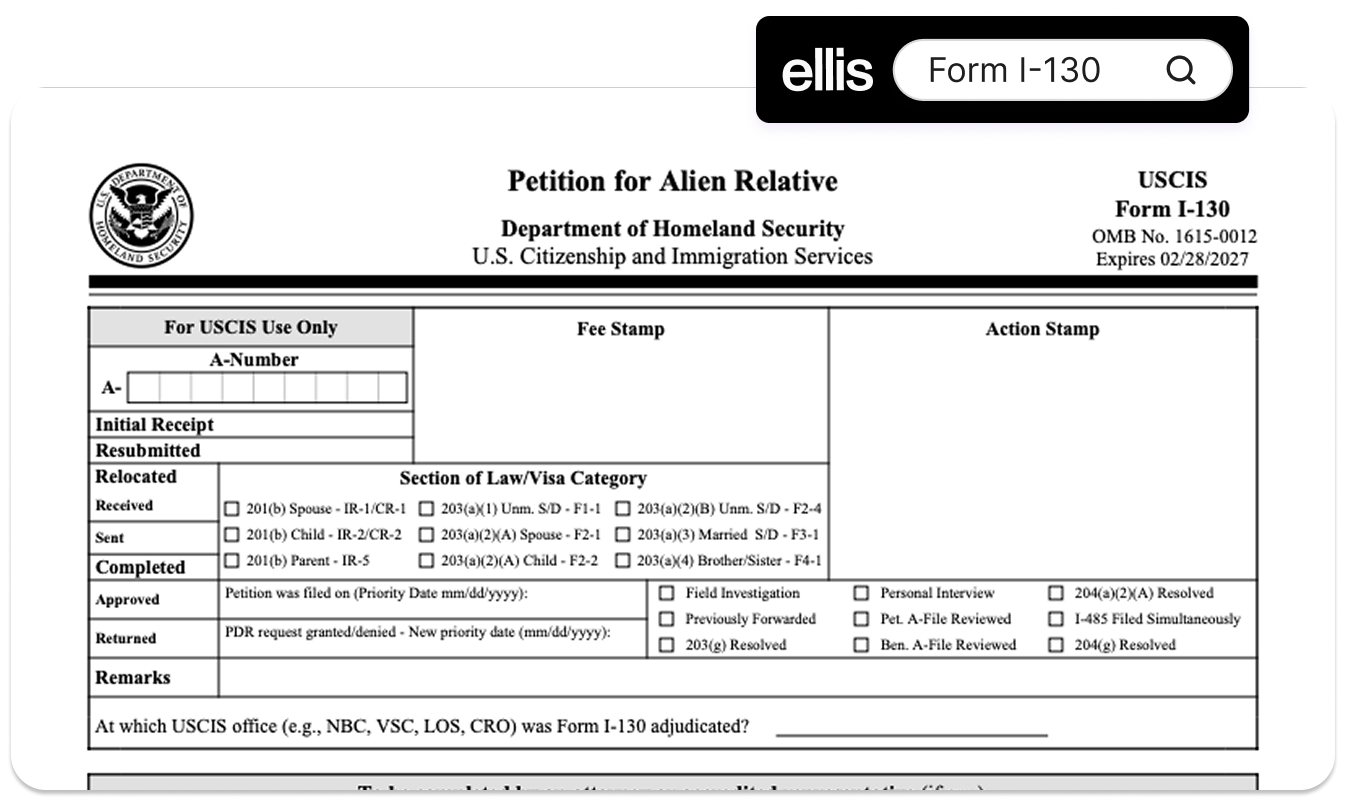
Form I-130, the Petition for Alien Relative, is the USCIS form used to establish that a qualifying family relationship exists between a U.S. citizen or lawful permanent resident and a foreign relative. It does not, by itself, give the relative a green card. It opens the door. Once approved, the beneficiary can apply for a green card through adjustment of status (Form I-485) if they're inside the U.S., or consular processing if they're abroad.
The form is 12 pages and asks about both the petitioner (the U.S. citizen or LPR) and the beneficiary (the foreign relative). You file it with USCIS along with evidence of the relationship.
The petitioner's status — citizen versus Legal Permanent Resident (LPR) — determines which family members are eligible and how fast the process moves.
Who Can File Form I-130?
Two groups of petitioners can file an I-130:
U.S. citizens can file for:
- Spouse
- Unmarried children under 21
- Parents (if the petitioner is 21 or older)
- Married children of any age
- Unmarried children 21 or older
- Siblings (if the petitioner is 21 or older)
Lawful permanent residents (green card holders) can file for:
- Spouse
- Unmarried children of any age
LPRs cannot petition for parents, siblings, or married children. Once an LPR naturalizes and becomes a U.S. citizen, those categories become available.
Who Qualifies as a Beneficiary?
Family-based immigration splits into two big buckets that determine the wait:
Immediate Relatives. The spouse, parents (if the petitioner is 21 or older), and unmarried children under 21 of a U.S. citizen. There's no annual numerical limit, so no wait list. Once the I-130 is approved, the beneficiary can apply for a green card right away.
Family Preference Categories. Subject to annual numerical caps and wait lists tracked by the monthly Visa Bulletin. Wait times depend on the category and the beneficiary's country of birth.
Category | Beneficiary | Petitioner |
|---|---|---|
F1 | Unmarried adult children (21+) | U.S. citizen |
F2A | Spouse and unmarried children under 21 | LPR |
F2B | Unmarried adult children (21+) | LPR |
F3 | Married children (any age) | U.S. citizen |
F4 | Siblings | U.S. citizen, 21+ |
For more on how the wait works, see our guide to understanding priority dates.
What Does the I-130 Cost in 2026?
The 2026 filing fee structure for Form I-130:
Filing method | Fee |
|---|---|
Online | $625 |
Paper | $675 |
The fee covers only the I-130 petition. The beneficiary's eventual green card application has separate fees. The I-485 filing fee for adults is $1,440 in 2026.
A fee waiver (Form I-912) is available for limited humanitarian categories.
What You'll Need to File
A complete I-130 packet usually includes:
- Form I-130 (12 pages)
- Form I-130A if the petition is for a spouse (extra biographic information)
- Proof of the petitioner's U.S. citizenship or LPR status — birth certificate, naturalization certificate, U.S. passport, or copy of green card
- Proof of qualifying relationship — marriage certificate (spouses), birth certificates (parents/children/siblings), adoption decrees, etc.
- Bona fide marriage evidence for spouse petitions — joint financial documents, photos, lease agreements, affidavits from family and friends, travel records
- Two passport-style photos (one of petitioner, one of beneficiary)
- Translations for any document not in English, with a certified translator's statement
- Filing fee ($625 online or $675 paper)
Bona Fide Marriage Evidence
A bona fide marriage is a marriage entered into in good faith. Proving yours is bona fide is the most-scrutinized part of a spouse petition and the #1 reason petitions hit a Request for Evidence (RFE). USCIS wants proof the relationship is real, ongoing, and lived together, not just legally documented. A complete packet pulls from four categories:
- Shared finances — joint bank accounts, tax returns, insurance, beneficiary designations
- Shared residence — joint lease or mortgage, utility bills, mail at the same address
- Shared life — photos with family and friends across time, travel records, kids' birth certificates
- Third-party confirmation — sworn affidavits from family, friends, neighbors, religious or community contacts
If USCIS suspects fraud despite the documentation, they may schedule a Stokes interview — separate spouse interviews asking detailed questions about daily life.
The I-130 Process, Step by Step
- Confirm eligibility. The petitioner must be a U.S. citizen or LPR with a qualifying relationship to the beneficiary.
- Gather supporting documents. Translations, photos, evidence of relationship, status proof.
- File the package online via the USCIS portal or by mail to the relevant USCIS lockbox. Check the Form I-130 instructions on uscis.gov for the right address for your situation.
- Receive Form I-797C Receipt Notice — typically within 4 to 6 weeks.
- Respond to any RFE if USCIS requests additional evidence.
- Receive a decision. Approval comes via another Form I-797 Notice of Action.
- Next steps depend on the beneficiary's location and category.
For current wait times, check the USCIS processing times tool on uscis.gov.
What Happens After I-130 Approval
After the I-130 is approved, the path forward depends on:
Where the beneficiary is. Inside the U.S. with valid status — adjustment of status via Form I-485. Outside the U.S. — consular processing through the National Visa Center and a U.S. consulate. Our guide to preparing for an immigrant U.S. interview covers what to expect at the interview.
Whether the beneficiary's category has a wait. Immediate relatives can move forward immediately. Family preference applicants must wait for the priority date to become current — see the State Department's monthly Visa Bulletin for current dates.
For immediate relatives already in the U.S., the I-130 and I-485 can often be filed concurrently. That saves months. For family preference cases, the wait varies dramatically by category and country of birth. Mexican and Filipino F4 (sibling) cases, for example, can take decades.
Once approved as a green card holder, the beneficiary will receive an Alien Registration Number (learn how to find your A-Number) and a physical green card.
Final Tips
The I-130 is the foundation of every family-based green card. The form itself is straightforward, but the evidence packet, especially for spouse petitions, is where most cases get tripped up.
A few clear rules:
- Document the relationship thoroughly. Especially for marriages: more evidence is almost always better.
- Translate everything. Any document not in English needs a certified translation.
- File the right forms together. Spouse petitions need both I-130 and I-130A.
- Track your priority date. For family preference categories, the Visa Bulletin governs when you can move to the next step.
- Get attorney review. Family-based cases involve sensitive documentation and tight evidence standards. Errors are expensive to fix later.
Need help filing your I-130?
Ellis combines experienced immigration attorneys with a modern case management platform. Every I-130 we handle goes through structured workflows, automated checks, and full attorney review.
Schedule a free consult → and we'll walk you through your specific case strategy at no cost.