


The Short Version: Birthright citizenship is mostly an American and Latin American concept. Most of the world doesn't have it. The U.S. has had it since 1868, but it's currently being challenged in the Supreme Court.
About 33 countries have birthright citizenship, meaning citizenship granted just by being born on their soil. The United States is one of them. Most countries with birthright citizenship are in Latin America and the Caribbean. Almost no countries in Europe or Asia offer it unconditionally.
Key Takeaways
- How many countries have birthright citizenship: About 33 countries have unrestricted birthright citizenship (jus soli). Another ~30 have a conditional version. The majority of countries in the world, including most of Europe and Asia, do not offer it.
- Where most of them are: The Americas. Canada, the United States, Mexico, and nearly all of Latin America and the Caribbean have birthright citizenship.
- Why it's rare outside the Americas: Most other countries use jus sanguinis, where citizenship passes from parent to child, not from place of birth.
- Countries that ended it: The UK ended unconditional birthright citizenship in 1983. Australia restricted it in 1986. Ireland ended it by referendum in 2004.
- The U.S. right now: Birthright citizenship is still in effect. The Supreme Court is expected to rule on President Trump's executive order to end it by late June or early July 2026.
Here's what you need to know about birthright citizenship globally: what it is, which countries have it, and how the current U.S. debate fits into the bigger picture.
What Is Birthright Citizenship (Jus Soli)?
Birthright citizenship, also called jus soli (Latin for "right of the soil"), means that anyone born in a country automatically becomes a citizen of that country. It doesn't matter where their parents are from or what their immigration status is.
The alternative is jus sanguinis ("right of blood"), where citizenship is inherited from a parent, not granted by place of birth. Most countries in Europe, Asia, the Middle East, and Africa use this system.
Some countries use a mix of both: a child born there gets citizenship only if at least one parent is a citizen or permanent resident. This is called conditional jus soli.
How Many Countries Have Birthright Citizenship?
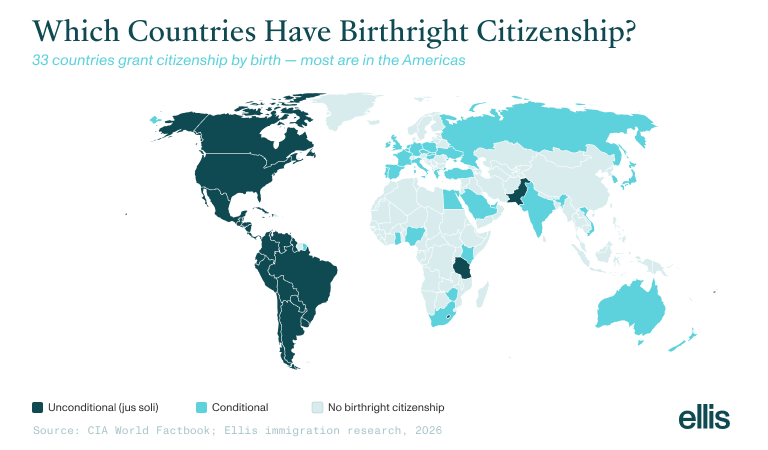
About 33 countries offer unconditional birthright citizenship. Another ~30 countries offer a conditional version, where at least one parent must be a citizen, permanent resident, or long-term resident.
The majority of the world's nearly 200 countries do not offer birthright citizenship in any form.
Which Countries Have Unconditional Birthright Citizenship?
The full list of countries with unrestricted jus soli is heavily concentrated in the Western Hemisphere.
North America
- United States
- Canada
- Mexico
Central America and the Caribbean
- Belize, Costa Rica, El Salvador, Guatemala, Honduras, Nicaragua, Panama
- Cuba, Haiti, Jamaica, Trinidad and Tobago, Barbados, Grenada, Dominica, Antigua and Barbuda, St. Kitts and Nevis, Guyana
South America
- Brazil, Argentina, Colombia, Ecuador, Bolivia, Paraguay, Uruguay, Peru, Chile, Venezuela
Africa
- Tanzania, Lesotho
Asia
- Pakistan
Oceania
- Fiji, Tuvalu
Nearly every country in this list is in the Americas, a pattern that dates back to deliberate policy choices made during periods of immigration and national formation in the 18th and 19th centuries.
Do Other Countries Have Birthright Citizenship?
Yes, but most do not. Outside the Americas, unconditional birthright citizenship is rare. Pakistan, Tanzania, Lesotho, Fiji, and Tuvalu are among the few non-American countries that still offer it.
Most countries in Europe, Asia, the Middle East, and Africa use jus sanguinis, where citizenship passes from parent to child, not from place of birth. A child born in Germany to two non-German parents does not automatically become German. A child born in Japan to non-Japanese parents does not become Japanese.
About 30 additional countries offer a conditional version: birthright citizenship only if at least one parent is a legal resident or citizen.
Which Countries Have Conditional Birthright Citizenship?
About 30 countries grant citizenship to children born on their soil, but only under certain conditions. Usually at least one parent must be a citizen, permanent resident, or long-term legal resident.
Examples include:
- France: A child born in France to foreign parents can become a citizen at age 18 if they have lived in France for at least five years. A child born in France to a parent who was also born in France gets citizenship at birth.
- Germany: A child born in Germany to foreign parents gets citizenship if at least one parent has been a legal permanent resident for eight or more years.
- Portugal: A child born in Portugal becomes a citizen if a parent has been a legal resident for at least one year.
- Ireland: Since 2005, at least one parent must be an Irish or British citizen, a permanent resident, or a legal resident of at least three years (excluding students and asylum seekers).
- Australia: A child born in Australia gets citizenship if at least one parent is an Australian citizen or permanent resident, or if the child lives in Australia for the first ten years of their life.
- New Zealand: Similar to Australia since 2006. At least one parent must be a citizen or permanent resident.
Why Does the United States Have Birthright Citizenship?
The United States has birthright citizenship because of the Fourteenth Amendment to the U.S. Constitution, ratified in 1868. It was passed after the Civil War specifically to guarantee citizenship to formerly enslaved people and their descendants.
The amendment says: "All persons born or naturalized in the United States, and subject to the jurisdiction thereof, are citizens of the United States."
In 1898, the Supreme Court confirmed in United States v. Wong Kim Ark that this applied to children born to immigrant parents as well. The Court ruled that a man born in San Francisco to Chinese parents was a U.S. citizen. That precedent has stood for over 125 years.
Unlike most countries, the U.S. cannot change birthright citizenship with a simple law. Changing it would require a constitutional amendment, which needs two-thirds of Congress and approval by 38 states.
Why Is Birthright Citizenship So Common in the Americas?
The Americas (North, Central, and South) adopted jus soli largely because of their history as immigrant-receiving nations. In the 18th and 19th centuries, newly independent countries in the Americas wanted to grow their populations and integrate waves of immigrants. Granting citizenship by birth was a practical way to do that.
Europe, by contrast, developed around older nation-states with strong ethnic and dynastic identities. Jus sanguinis, citizenship inherited through bloodlines, fit better with those traditions.
That historical divide explains why birthright citizenship is nearly universal in the Americas and nearly absent in Europe today.
Which Countries Have Ended Birthright Citizenship?
Several countries that once had unconditional birthright citizenship have restricted or ended it in recent decades.
United Kingdom (1983): The British Nationality Act 1981 ended unconditional birthright citizenship effective January 1, 1983. Before that, anyone born on British soil was automatically a British citizen. Now, at least one parent must be a British citizen or settled resident.
India (1987): India ended unconditional birthright citizenship in 1987. Children born in India after that date are only citizens if at least one parent is an Indian citizen, and neither parent is an undocumented immigrant.
Australia (1986): Australia added a parental requirement in 1986. A child born in Australia is a citizen only if at least one parent is an Australian citizen or permanent resident.
Ireland (2005): Ireland was the last country in Europe with unconditional birthright citizenship. In 2004, 79% of voters in a national referendum voted to end it, amending the constitution to require that at least one parent have significant ties to Ireland. The change took effect in 2005.
Dominican Republic (2010): The Dominican Republic amended its constitution to exclude children of undocumented immigrants from citizenship, retroactively affecting a large population of people of Haitian descent.
Each of these cases was driven by concerns about immigration, national identity, or administrative burden. These are the same concerns now driving the debate in the United States.
How Does the U.S. Compare to Other Developed Nations?
Among high-income, high-immigration countries, the United States and Canada are the only two that still have fully unconditional birthright citizenship.
Country | Birthright Citizenship | System | Year Restricted |
|---|---|---|---|
United States | Yes (pending ruling) | Unconditional jus soli | N/A |
Canada | Yes | Unconditional jus soli | N/A |
Mexico | Yes | Unconditional jus soli | N/A |
United Kingdom | Conditional | Requires citizen/settled parent | 1983 |
Australia | Conditional | Requires citizen/PR parent | 1986 |
India | Conditional | Requires citizen parent | 1987 |
Ireland | Conditional | Requires resident parent | 2005 |
New Zealand | Conditional | Requires citizen/PR parent | 2006 |
Germany | Conditional | Requires 8-yr permanent resident parent | N/A |
France | Conditional | Requires France-born or resident parent | N/A |
The U.S. is also unique in that changing birthright citizenship requires amending the Constitution. That's a much higher bar than the legislative or referendum-based changes other countries used.
What Does This Mean for Immigrants in the U.S. Right Now?
For H-1B visa holders, student visa holders, and others on temporary visas, birthright citizenship has long been a certainty: a child born in the U.S. is a citizen, full stop.
President Trump's executive order, signed January 20, 2025, would change that. It would end birthright citizenship for children of undocumented immigrants and people on temporary visas. Every court that has reviewed the order has blocked it. The Supreme Court is expected to issue a ruling by late June or early July 2026. For a full breakdown of the case and what each outcome means for families, see our guide to the Supreme Court's birthright citizenship decision.
If the order is upheld, the U.S. would effectively join Australia, the UK, and Ireland in moving to a conditional system. It would be one of the most significant changes to U.S. immigration law in more than a century.
For families currently going through the green card process, and for those considering naturalization, the ruling will matter. Until it comes down, birthright citizenship is still the law.
The information in this article is for general guidance only and is not legal advice.