

Key Takeaways
- Who files? Lawful permanent residents who have held a green card for at least 5 years (or 3 years if married to a U.S. citizen) and meet residency, physical presence, and good moral character requirements.
- How much? $710 online or $760 by paper. Biometrics included. Reduced fee of $380 for low-income applicants. Free for military.
- How long? Typically 4 to 12 months, varying by USCIS field office.
- Citizenship test? Yes. English (speaking, reading, writing) and a civics test (10 questions, must answer 6 correctly). Age and disability exemptions apply.
- Should I use an attorney? Routine cases can often self-file. Strongly recommended if you have a criminal record, long trips abroad, tax issues, or any prior immigration violation. Free Ellis consult →
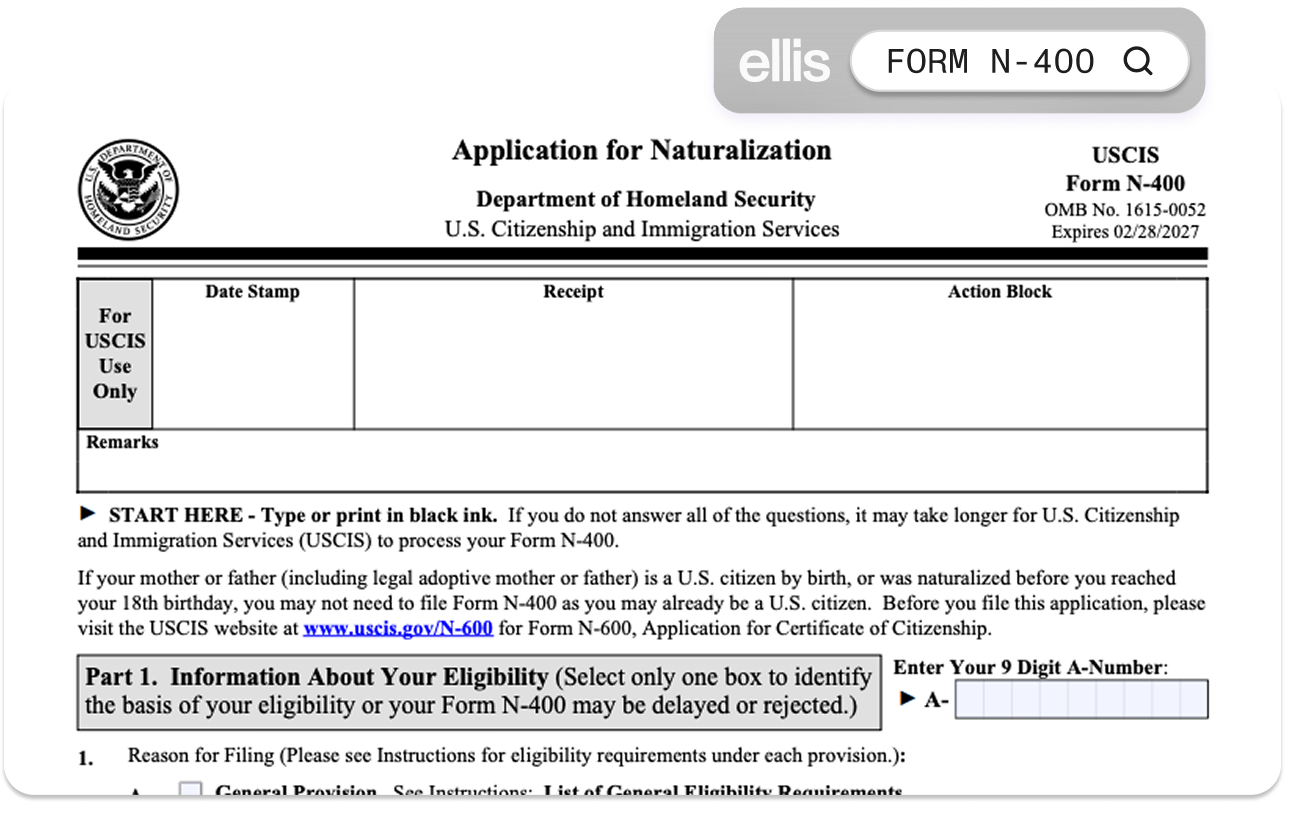
If you're a lawful permanent resident ready to become a U.S. citizen, you'll file one form: Form N-400. Officially called the Application for Naturalization, it's the last step in the immigration journey for most people who've been green card holders for at least 3 to 5 years.
This guide covers what the N-400 is, who can file it, how much it costs, what's on the citizenship test, and what happens after approval.
What is Form N-400?
Form N-400 is the USCIS application lawful permanent residents (LPRs) use to apply for U.S. citizenship through naturalization. Approval makes you a U.S. citizen with all the rights and obligations that come with it: the right to vote, hold a U.S. passport, sponsor more family members, and serve on a jury.
The form is 20 pages and asks about your immigration history, residence, time outside the U.S., employment, marriages, children, criminal history, and your understanding of the oath of allegiance. You file it with USCIS, either online or by mail.
Naturalization is the final immigration milestone for most people. Once you're a citizen, you no longer renew green cards, worry about losing status, or need most USCIS forms ever again.
Who Can File Form N-400?
To file N-400, you generally need to meet eight requirements:
- Be a lawful permanent resident. Hold a valid green card (no I-90 renewal required to apply).
- Be at least 18 years old.
- Have continuous residence in the U.S. for at least 5 years as an LPR (or 3 years if you've been married to and living with the same U.S. citizen for those 3 years).
- Have physical presence in the U.S. for at least 30 months out of the last 5 years (or 18 months out of 3 for the 3-year track).
- Have lived in your USCIS district for at least 3 months before filing.
- Demonstrate good moral character during the 5-year (or 3-year) period before filing.
- Show basic English proficiency (with exemptions for age and disability).
- Pass a civics test on U.S. history and government (with exemptions).
You also need to:
- Be willing to swear an oath of allegiance to the United States.
- Show attachment to the principles of the U.S. Constitution.
- Have registered for Selective Service if you're a male LPR who lived in the U.S. between ages 18 and 26.
You may NOT be eligible if you've:
- Been convicted of certain crimes (some permanent bars, some 5-year bars).
- Failed to pay federal, state, or local taxes.
- Failed to pay court-ordered child support.
- Falsely claimed to be a U.S. citizen.
- Voted in a U.S. election as a non-citizen.
- Spent more than 6 continuous months outside the U.S. during the eligibility period (may break continuous residence).
What Does the N-400 Cost in 2026?
The 2026 filing fee structure for Form N-400:
Applicant | Filing Fee | Notes |
|---|---|---|
Standard, online | $710 | Biometrics included |
Standard, paper | $760 | Biometrics included |
Reduced fee (household income 150–400% of FPG) | $380 | File Form I-942 with N-400 |
Military (Section 328 or 329) | $0 | Free |
Fee waiver (Form I-912) | $0 | For applicants facing financial hardship |
Online filing is faster and $50 cheaper. Reduced fee and fee waiver eligibility depend on your income and circumstances.
Eligibility Rules Worth Knowing
Three rules trip applicants up most often. A quick orientation:
The 5-year vs. 3-year rule. Most LPRs apply after 5 years. The shorter 3-year track applies only if you've been a green card holder AND married to and living with the same U.S. citizen for the full 3 years before filing. The citizenship of your spouse matters at every moment of the 3 years, not just at filing.
Continuous residence. Trips outside the U.S. lasting 6 months or more can break continuous residence. Trips of 1 year or more almost always break it. If you broke continuous residence, the clock resets, and you typically wait 4 years and 1 day after returning before you can file again.
Good moral character. USCIS reviews your conduct during the 5-year (or 3-year) period before filing, but they can also look back further for serious issues. Common things that hurt: tax problems, unpaid child support, drunk driving, drug offenses, false statements on prior immigration applications. Some convictions create permanent bars to naturalization.
What You'll Need to File
A complete N-400 package usually includes:
- The completed N-400 form (20 pages)
- Filing fee (or Form I-942 for reduced fee, or Form I-912 for waiver)
- Copy of your green card (front and back)
- Two passport-style photos (paper filings only)
- Tax records for at least the past 3 years (5 for the standard track)
- Selective Service registration documentation if you're a male between 18 and 31
- Court records and police certificates for any arrests, charges, or convictions
- Marriage certificate (3-year track) and proof of marital union (joint tax returns, lease, bank accounts)
- Divorce decrees or death certificates for prior marriages
- Travel history for the past 5 years (the USCIS travel history tool helps reconstruct trips)
Full N-400 packets usually run 50 to 150 pages depending on your travel history and personal circumstances. Most of the rejection-causing errors come from incomplete tax records or missing court documents for old arrests.
The N-400 Process, Step by Step
- Confirm eligibility. Run through the 8 requirements. Calculate your 5-year (or 3-year) anniversary. You can file up to 90 days before the anniversary date.
- Gather documents. Tax records, court records, travel history, marriage documents.
- File online or by paper. Online is faster and $50 cheaper. Most LPRs qualify for online filing.
- Pay the fee. $710 online, $760 paper, $380 reduced, $0 military or waiver.
- Receive your Form I-797C Receipt Notice within 2 to 4 weeks.
- Attend biometrics at an Application Support Center, usually 4 to 8 weeks after filing. USCIS captures fingerprints, photo, and signature.
- Attend your interview at your local USCIS field office, usually 4 to 10 months after filing. The officer reviews your application, asks questions, and administers the English and civics tests.
- Receive a decision. Approval same day or by mail. Some cases are continued for additional evidence.
- Attend the oath ceremony within a few weeks of approval. You take the Oath of Allegiance and receive your Certificate of Naturalization. You are now a U.S. citizen.
How long does the N-400 take?
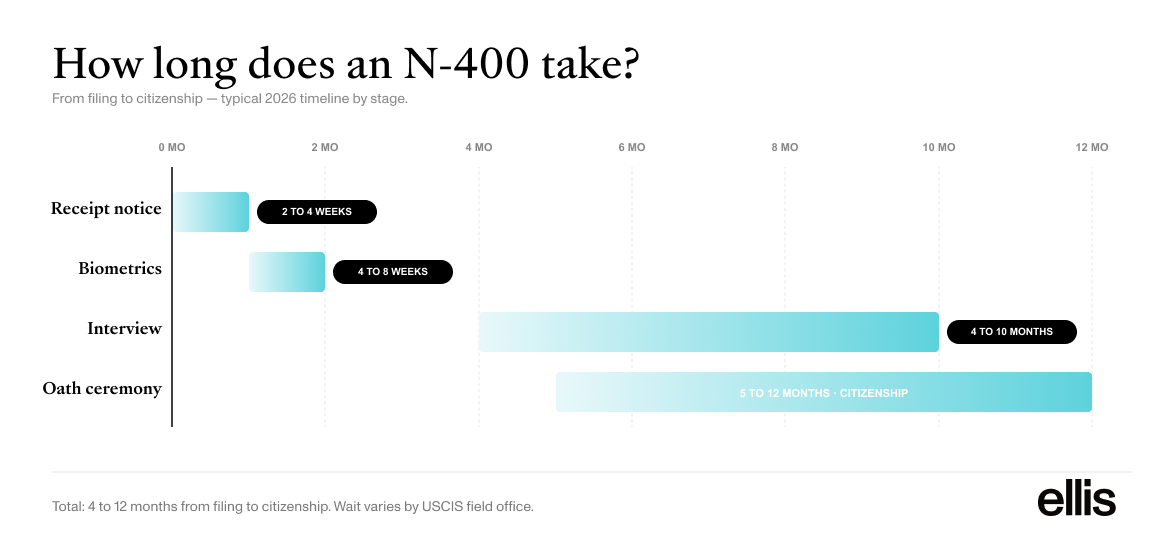
N-400 processing times in 2026 typically run:
Stage | Typical wait |
|---|---|
Receipt notice | 2 to 4 weeks |
Biometrics appointment | 4 to 8 weeks after filing |
Interview | 4 to 10 months after filing |
Decision | Same day to 4 weeks after interview |
Oath ceremony | 0 to 6 weeks after approval |
Total: filing to citizenship | 4 to 12 months |
Processing times vary widely by USCIS field office. Some offices run 3 to 5 months end to end; others stretch past 12 months. Check the USCIS processing times tool or our USCIS processing times tracker for current data.
Premium processing is NOT available for Form N-400.
The Citizenship Test
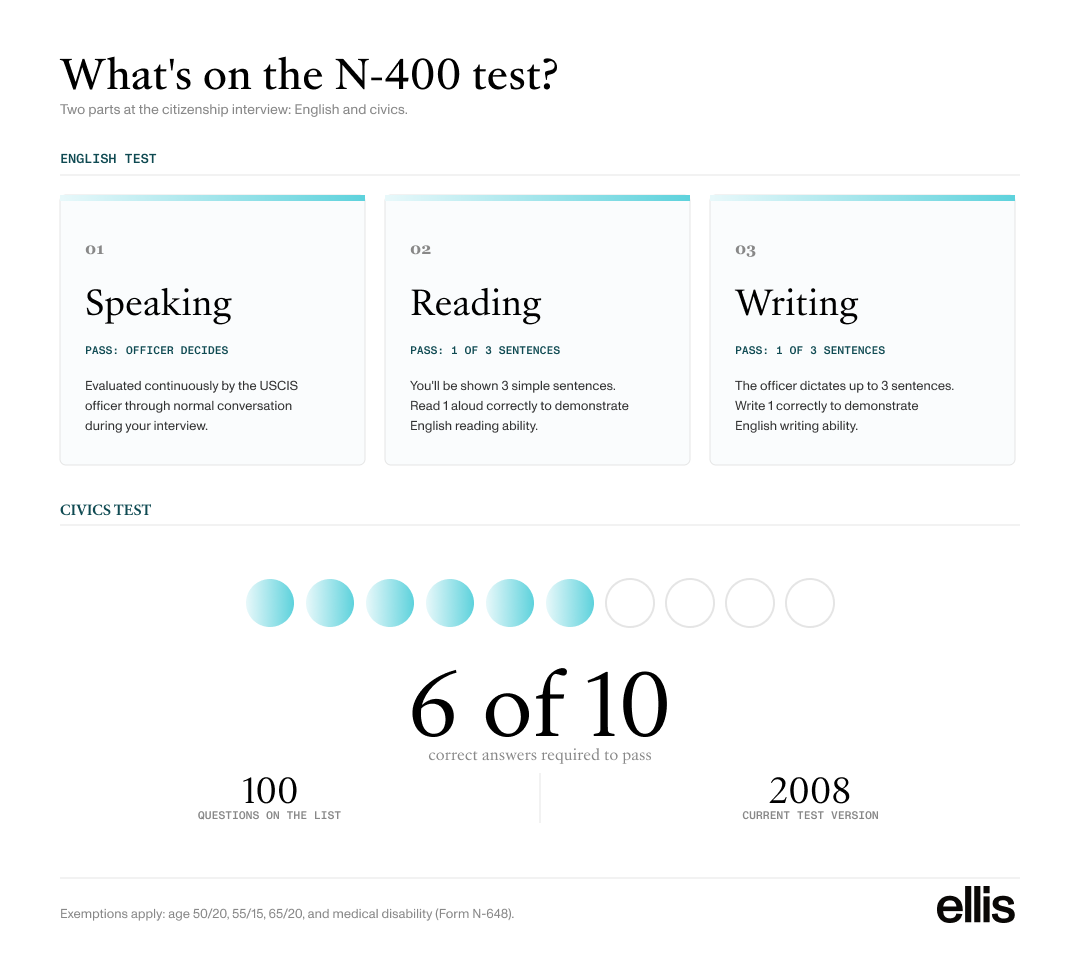
Most N-400 applicants take two tests at the interview: an English test and a civics test.
English test (3 parts):
- Speaking: The officer assesses your spoken English during the interview itself.
- Reading: Read one of three sentences correctly out of three attempts.
- Writing: Write one of three sentences correctly out of three attempts.
Civics test: 10 questions chosen from a list of 100 possible questions about U.S. history and government. You need to answer at least 6 correctly. The current version is the 2008 test. The 2020 revision was rolled back.
If you fail either test, USCIS gives you a second chance, usually 60 to 90 days later. If you fail both attempts, the N-400 is denied. You can refile.
Age and Disability Exemptions
Several exemptions apply:
Exemption | Who qualifies | What changes |
|---|---|---|
50/20 | 50+ years old, 20+ years as LPR | No English test; civics test in your native language |
55/15 | 55+ years old, 15+ years as LPR | No English test; civics test in your native language |
65/20 | 65+ years old, 20+ years as LPR | No English test; simplified 20-question civics test, easier questions |
Medical disability | Physical or mental condition documented on Form N-648 | English and civics tests may be waived |
The medical disability exemption requires a licensed medical professional to complete Form N-648 within 6 months before filing N-400.
After Approval: The Oath Ceremony
Once USCIS approves your N-400, you receive a notice for your oath ceremony. At the ceremony, you take the Oath of Allegiance to the United States. The moment you complete the oath, you are a U.S. citizen.
You'll receive your Certificate of Naturalization at the ceremony. Hold onto it. You'll need it for:
- Applying for a U.S. passport (do this immediately)
- Updating your Social Security record from non-citizen to citizen
- Registering to vote
- Sponsoring family members for green cards
- Proving citizenship for federal employment and security clearances
Common Reasons N-400s Get Denied
Most N-400 denials trace back to a handful of issues:
- Continuous residence broken. Trips of 6+ months abroad without proper documentation.
- Failure to pay or file taxes. USCIS asks for tax transcripts; outstanding balances or unfiled returns are red flags.
- Criminal record. Even old arrests can trigger denial if not properly documented.
- Selective Service issues. Males who lived in the U.S. between 18 and 26 must have registered.
- Failed civics or English test. Two failed attempts mean denial.
- Misrepresentation. Inconsistencies between N-400 answers and prior immigration filings.
If your N-400 is denied, you have 30 days to file a Motion to Reopen or Reconsider (Form N-336). You can also refile after addressing the issue.
Final Tips
Form N-400 is the last form most immigrants ever file. The application itself is long but manageable, and most cases that meet the basic eligibility requirements get approved.
A few clear rules:
- File 90 days before, not after. USCIS rejects applications filed too early.
- Calculate your physical presence carefully. Half-day trips count. Pull your full travel history before filing.
- Address tax and criminal issues before filing. Don't hope USCIS won't notice. They will.
- Study for the civics test. USCIS publishes all 100 questions and answers in advance.
- Get attorney help if anything in your history is complicated. Criminal record, tax problems, long absences, prior immigration violations.
Need help filing your N-400?
Ellis combines experienced immigration attorneys with a modern case management platform. Routine N-400s can be self-filed, but complicated cases (criminal history, long absences, tax issues, prior immigration problems) almost always benefit from legal review before submission.
Schedule a free consult today.
Disclaimer: This article is for informational purposes only and does not constitute legal advice. Immigration law changes frequently. For specific legal guidance regarding your case, please consult with a qualified immigration attorney.