

Key Takeaways
- Who files? Conditional residents with a 2-year green card based on marriage to a U.S. citizen or lawful permanent resident (CR1, CR2 categories).
- How much? $750 filing fee. Biometrics included.
- When to file? Within the 90 days before your conditional green card expires. Filing earlier or later creates problems.
- How long? Typically 12 to 36 months. USCIS automatically extends your conditional status by 48 months while you wait.
- What if my marriage ended? You can still file using a waiver: divorce, abuse, hardship, or death of your spouse.
- Should I use an attorney? Joint filings with strong marriage evidence can often self-file. Strongly recommended for any waiver case or if your marriage has issues. Free Ellis consult →
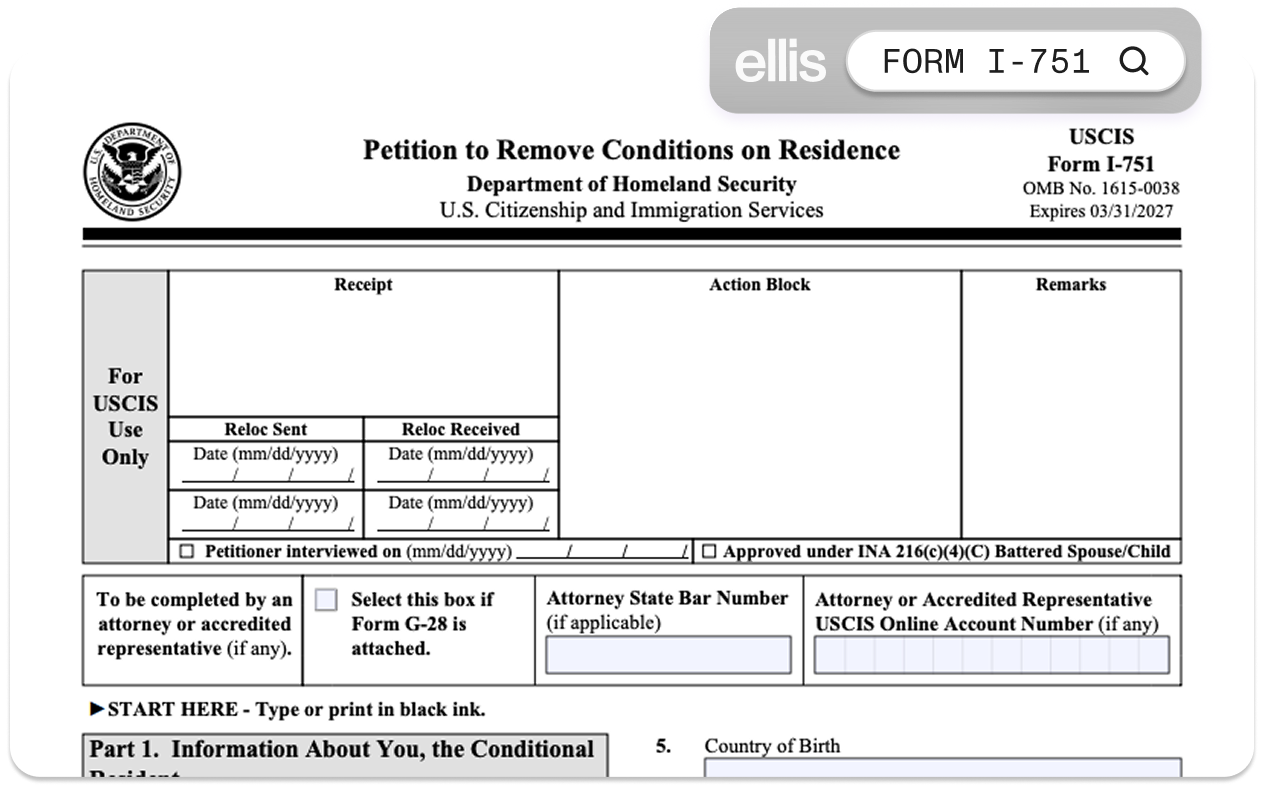
What is Form I-751?
Form I-751 is the USCIS petition you file to remove the conditions on a 2-year green card and become a regular 10-year lawful permanent resident.
Conditional residence is USCIS's way of testing marriage-based green card cases. If you received your green card based on a marriage that was less than 2 years old at the time of approval, USCIS issued you a CR1 or CR2 green card valid for exactly 2 years. The condition: you must prove the marriage is real (a "bona fide marriage") before USCIS removes the condition.
If you don't file Form I-751 on time, your conditional residence ends and you can be placed in removal proceedings. The 90-day filing window before expiration is hard to miss but easy to forget.
Who Files Form I-751?
You file Form I-751 if you're a conditional permanent resident who got your green card through:
- Marriage to a U.S. citizen where the marriage was less than 2 years old at green card approval (CR1 category).
- Marriage to a lawful permanent resident under the same circumstances (rare; usually involves derivative children too).
- Derivative child of a conditional resident parent (CR2 category).
You do NOT file I-751 if:
- You have a regular 10-year green card. Use Form I-90 to renew or replace it.
- You're an EB-5 investor with conditional residence. Use Form I-829 (different form).
- You're applying for U.S. citizenship. File Form N-400 instead (which doesn't require I-751 if filed correctly).
Joint vs. Waiver Filing Options
How you file the I-751 depends on whether you're still married and your circumstances. There are five filing options:
Filing type | Who uses it | What you provide |
|---|---|---|
Joint filing | Married couples still together | Both spouses sign; submit marriage evidence |
Divorce waiver | Marriage ended but was bona fide | Final divorce decree + marriage evidence |
Abuse waiver (VAWA) | Spouse was abusive | Evidence of abuse; can file even while married |
Extreme hardship waiver | Removal would cause extreme hardship | Evidence of hardship circumstances |
Widow(er) | U.S. citizen spouse passed away | Death certificate + marriage evidence |
Joint filing is the most common path. Waiver filings are more complex and almost always benefit from attorney involvement.
If you're considering a divorce waiver, you generally need the divorce finalized before filing (not just initiated). USCIS will issue an RFE if you file a joint petition then divorce mid-process; you can convert the petition to a waiver if needed.
What Does the I-751 Cost in 2026?
The 2026 filing fee structure for Form I-751:
Item | Fee | Notes |
|---|---|---|
Filing fee | $750 | Biometrics included |
Fee waiver (Form I-912) | $0 | Limited categories (battered spouses, low income) |
USCIS rolled the previous $85 biometrics fee into the I-751 fee in April 2024. You no longer pay biometrics separately.
Premium processing is NOT available for Form I-751.
Evidence of a Bona Fide Marriage
The strength of your evidence determines whether USCIS approves your I-751 without an interview, issues an RFE, or schedules an interview. Strong evidence falls into three buckets:
Financial commingling:
- Joint federal and state tax returns (filed jointly)
- Joint bank account statements
- Joint credit card statements
- Joint loan documents (auto, mortgage, student)
- Beneficiary designations on retirement accounts and life insurance
Shared residence:
- Joint lease or mortgage
- Utility bills addressed to both spouses
- Mail addressed to both at the same address
- Photos of you together at home
Shared life:
- Photos together over time (vacations, holidays, family events)
- Birth certificates of children together
- Travel records showing trips taken together
- Affidavits from friends and family
- Joint health insurance, car insurance, or other policies
The goal is to show the marriage exists in real life, not just on paper. Quantity matters less than range. Five years of joint tax returns and one joint bank account beats a dozen photos.
For practical guidance on assembling the binder, see our supporting documents guide.
What You'll Need to File
A complete I-751 package usually includes:
- The completed I-751 form (11 pages)
- Filing fee ($750) or Form I-912 fee waiver request
- Copy of your conditional green card (front and back)
- Two passport-style photos (paper filings only)
- Marriage certificate
- Birth certificates of any children born to the marriage
- Strong evidence of bona fide marriage (see categories above)
- For divorce waiver: final divorce decree
- For abuse waiver: police reports, medical records, restraining orders, sworn statements
- For hardship waiver: evidence of extreme hardship circumstances
- For widow(er): death certificate of U.S. citizen spouse
Most I-751 packets run 100 to 300 pages. The bulk is marriage evidence, not the form itself.
The I-751 Process, Step by Step
- Identify your filing window. Calculate the date 90 days before your conditional green card expires. That's your earliest filing date.
- Gather evidence. Marriage documents, financial records, photos, affidavits. Start months before the filing window opens.
- Determine your filing type. Joint with your spouse, or a waiver if circumstances require.
- Complete the I-751 form. Both spouses sign for joint filings.
- File with USCIS. Mail to the appropriate lockbox or file online.
- Pay the fee. $750 covers everything (no separate biometrics fee).
- Receive Form I-797C Receipt Notice within 2 to 4 weeks. This notice automatically extends your conditional residence by 48 months while the I-751 is pending.
- Attend biometrics at an Application Support Center, usually 4 to 8 weeks after filing.
- Respond to any Request for Evidence (RFE) within the deadline. RFEs are common when initial evidence is thin.
- Attend an interview if USCIS schedules one. Many I-751 cases are decided without interviews when evidence is strong.
- Receive a decision. If approved, you receive your 10-year green card in the mail.
How long does the I-751 take?
I-751 processing times in 2026 typically run:
Filing type | Typical processing time |
|---|---|
Joint filing (strong evidence) | 12 to 24 months |
Joint filing (with RFE or interview) | 18 to 36 months |
Divorce waiver | 18 to 36 months |
Abuse waiver (VAWA) | 18 to 36 months |
Widow(er) | 12 to 30 months |
Check the USCIS processing times tool for current data, or our USCIS processing times tracker for a plain-English summary.
Premium processing is NOT available for Form I-751. There's no way to pay extra for faster service.
After Filing: The 48-Month Extension
The most important thing to know about I-751 timing: your conditional green card legally expires 2 years from grant, but USCIS automatically extends your status for 48 months when you file the I-751.
The extension comes through your Form I-797C Receipt Notice. Together with your expired conditional green card, the receipt notice serves as evidence of your status for:
- Form I-9 employment verification (employers can verify with the receipt + expired card)
- International travel and re-entry (CBP recognizes the receipt extension)
- Driver's license renewals (varies by state; the receipt usually works)
- Bank, financial, and credit applications
If you need stronger evidence, request an ADIT stamp (Form I-551 stamp) at your local USCIS field office. The ADIT stamp goes in your passport and provides the same evidence as a green card.
I-751 vs. I-90 vs. N-400
These three forms are often confused. A quick comparison:
Form | Purpose | Who uses it |
|---|---|---|
Form I-751 | Remove conditions on a 2-year green card | Conditional residents through marriage |
Renew or replace a 10-year green card | LPRs with a permanent (non-conditional) card | |
Form N-400 | Apply for U.S. citizenship | LPRs eligible for naturalization |
If your card expires in 2 years with category CR1 or CR2, you need I-751.
If your card expires in 10 years and is a regular IR1, EB, or other category, you need I-90.
If you've been an LPR for 3 years (spouse of U.S. citizen) or 5 years, you can apply for citizenship using N-400 — even if your conditional residence isn't yet removed. In that case, USCIS often adjudicates the I-751 and N-400 together.
Common Reasons I-751s Get Denied
Most I-751 denials trace back to a handful of issues:
- Thin marriage evidence. Joint tax returns and one bank account aren't enough. USCIS looks for breadth across financial, residence, and life evidence.
- Inconsistent statements. Information on the I-751 doesn't match prior I-130 or I-485 filings, or doesn't match what the couple says at the interview.
- Marriage ended without filing a waiver. Filing jointly after a divorce or separation, instead of converting to a waiver, raises red flags.
- Late filing without explanation. Filing after the 90-day window without a valid reason (illness, military service, USCIS error).
- Criminal issues. Convictions, especially for crimes of moral turpitude or domestic violence, can derail a case.
- Failed interview. Spouses give different answers to basic questions about their life together.
An RFE isn't a denial. Most I-751 RFEs ask for more bona fide marriage evidence. Respond fully and on time.
Final Tips
Form I-751 is the bridge between conditional and permanent residence. The form itself is short. The evidence packet is where cases are won or lost.
A few clear rules:
- File within the 90-day window before your conditional green card expires.
- Build strong evidence early. Save joint records throughout the 2 years, not just at filing.
- Convert to a waiver promptly if your marriage ends. Don't file jointly hoping things work out.
- Get attorney help for waiver cases. Divorce, abuse, and hardship waivers are complex.
- Use your I-797 extension for I-9, travel, and renewals while you wait.
Need help filing your I-751?
Ellis combines experienced immigration attorneys with a modern case management platform. Joint I-751 filings with strong evidence can often be self-filed, but waiver cases and any case with marriage complications almost always benefit from legal review.
Schedule a free consult → and we'll walk through your specific case at no cost.
Disclaimer: This article is for informational purposes only and does not constitute legal advice. Immigration law changes frequently. For specific legal guidance regarding your case, please consult with a qualified immigration attorney.