


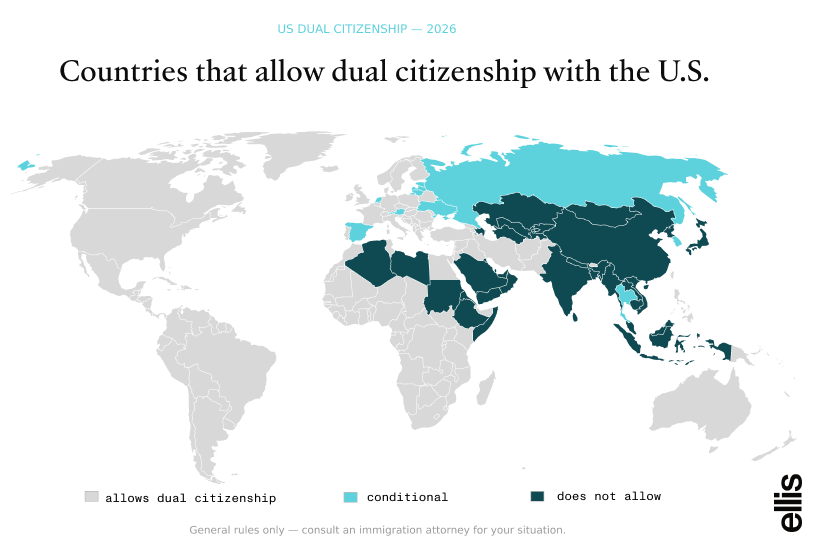
In short: Dual citizenship is still fully legal in the US. The Exclusive Citizenship Act of 2025 would change that, but it's stalled in committee and hasn't passed. The catch is the other country: nations like India, China, and Japan do not allow it.
Roughly 15 million people in the United States hold citizenship in more than one country. Maybe you were born here to foreign parents. Maybe you naturalized in another country while staying American. Maybe you're an HR leader trying to understand what dual nationality means for your workforce.
Whatever your situation, this guide has the answers. We cover how US dual citizenship works, who qualifies, what your obligations are, which countries allow it, and what recent proposed laws actually mean (spoiler: nothing has changed yet).
Key Takeaways
- US dual citizenship is legal in 2026. The Supreme Court has protected it since the 1960s, and just reaffirmed the breadth of 14th Amendment citizenship protections in Trump v. Barbara (June 30, 2026). No new law has changed anything.
- Both countries' laws apply. That means possible foreign military obligations, compliance requirements in each country, and rights that may differ depending on where a dual citizen is located.
- Proposed laws haven't changed anything yet. The Exclusive Citizenship Act of 2025 is stalled. Renunciation is permanent — the bill hasn't passed.
- Most countries allow it, some don't. About 150 countries allow dual citizenship with the US. India, China, and Japan remain the biggest exceptions.
- Navigating US immigration? Ellis helps individuals and employers manage visas, green cards, and naturalization, all in one place.
Does the US Allow Dual Citizenship?
The United States fully allows dual citizenship in 2026. US law doesn't require citizens to choose one nationality over another. There's no federal law that forces a US citizen to give up foreign citizenship just because they hold it.
The only way to lose American citizenship is to voluntarily renounce it, with specific intent to give it up.
The legal record on this is consistent:
- The Supreme Court ruled in Afroyim v. Rusk (1967) that Congress can't strip citizenship without a person's consent. The US Supreme Court recognizes dual citizenship rights through this ruling and others that followed.
- In Vance v. Terrazas (1980), the Court added that even acts like swearing loyalty to another country don't end US citizenship unless the person intended to give it up.
- Most recently, in Trump v. Barbara (2026), the Court struck down an executive order that tried to narrow who counts as a citizen under the 14th Amendment, reaffirming that citizenship guarantees under the Constitution can't be curtailed by executive action alone.
- The State Department confirms: Americans may hold dual or multiple citizenships. They just need to use a US passport to enter the United States.
One common confusion: when a lawful permanent resident becomes a naturalized citizen, the oath includes language about renouncing allegiance to foreign states. But under US immigration law, this doesn't actually require giving up foreign citizenship. If the other country permits it, dual nationality holds in both.
What Is Dual Citizenship (Dual Nationality)?
Dual citizenship (also called dual nationality) is when a person is legally recognized as a citizen of two countries simultaneously. It's not a separate immigration law status you apply for. It's simply what happens when your citizenship status is recognized by more than one country at the same time. As a dual citizen, you hold dual nationality with full rights in both countries, and full obligations too.
A few important distinctions:
- Citizenship is the legal bond between you and a country. Comes with rights (voting, work, residence) and duties (military service, jury duty, and others depending on the country).
- Nationality is often used interchangeably with citizenship, though some countries draw a finer line.
No limit exists on how many citizenships a US citizen can hold. Someone born in the US to an Irish parent and an Italian parent could hold triple citizenship from birth. The US doesn't require a formal application for dual citizenship because it's not a separate status. It just happens when you meet the citizenship rules of more than one country at the same time.
How to Obtain Dual Citizenship as a US Citizen or Foreign National
Birthright Citizenship
The 14th Amendment grants citizenship to almost everyone born on US soil. If a child is born in the US to Canadian parents on work visas, that child is automatically American. And because Canada grants citizenship by descent to children born abroad to Canadian parents, the child holds both citizenships from birth.
This rule was tested and reaffirmed on June 30, 2026, when the Supreme Court decided Trump v. Barbara. The case challenged Executive Order 14160, which had tried to deny citizenship to children born in the US to parents who were undocumented or present on temporary visas. In a 6-3 decision, the Court held that children born on US soil and "subject to the jurisdiction" of the United States are citizens at birth under the 14th Amendment's Citizenship Clause, regardless of their parents' immigration status — a rule that differs sharply from how many other countries approach birthright citizenship. That means the birthright pathway to dual citizenship described here remains fully intact; the executive branch can't narrow it unilaterally.
This is birthright citizenship at work. The US doesn't maintain an official list of which other countries recognize it. Each family's situation depends on the other country's law.
Birth Abroad to a US Parent
Children born outside the US to at least one US citizen parent may acquire US citizenship at birth if the US parent meets certain residency requirements. A child born in Germany in 2023 to a US mother could be both American and German.
Naturalization in the US
Foreign nationals who go through the N-400 naturalization process become US citizens but don't automatically lose their original citizenship. Whether they can maintain dual citizenship depends entirely on the other country's law.
For example: India does not allow dual citizenship. An Indian citizen who naturalizes in the US automatically loses Indian citizenship under Indian law. The US side is fine with it. The foreign country effectively forbids dual citizenship.
Naturalization typically requires 2 to 10 years of residence, depending on the country. In the US, the standard path requires 5 years as a lawful permanent resident (3 if married to a US citizen).
Naturalization Abroad
Americans who naturalize in another country (Canada, Ireland, Mexico, and others) generally retain US citizenship, as long as they don't declare an intent to give it up.
Other routes to acquire citizenship abroad:
- Marriage: can cut residency requirements in half in many countries
- Citizenship by descent: through parents or grandparents, depending on the other country's rules
- Citizenship by investment: the fastest route to obtain citizenship in another country, but costly (programs in Malta, Portugal, and Caribbean nations)
Legal Rights and Responsibilities of Dual Citizens
Rights and Protections
US dual citizens have all the rights of American citizenship: they can vote in US elections, work without restriction, hold a US passport, and access government benefits. They may also have voting rights, property rights, and residency rights in the other country, including the right to travel on that country's passport.
Access to two passports makes international travel easier, with visa-free entry to a wider range of destinations than either passport alone might offer.
US citizens must use a US passport to enter the United States, regardless of what other passport they hold.
Consular Protection Abroad
US embassies can generally help American citizens who run into trouble overseas. But dual citizenship can complicate consular protection in the other country of citizenship.
If a dual citizen is in the other country of their citizenship, that country may treat them as exclusively its own national. The US embassy's ability to intervene in local arrests, military matters, or family law disputes may be limited or refused.
This matters a lot for employers sending dual-national employees on international assignments. If a US-Brazilian dual citizen runs into a legal issue in Brazil, for example the US consulate may have limited ability to help.
Government Jobs and Security Clearances
Holding dual citizenship can complicate eligibility for certain government positions. Security clearance investigations closely examine foreign nationality, use of a foreign passport, and any history of service in a foreign military. Some countries also restrict employment for dual citizens in government or defense sectors, which can affect international assignments for employees who hold other nationalities.
Dual status doesn't automatically disqualify someone from a clearance, but it does trigger extra scrutiny.
Military Service and Obligations for Dual Citizens
Dual citizens may face military obligations in both countries. South Korea, Israel, Greece, and Turkey all have mandatory military service requirements that can apply to dual nationals, even those who grew up abroad.
Some countries require renunciation of other citizenships for military service. Others have formal exemption processes for overseas citizens.
For US purposes: voluntarily serving in a foreign military can raise flags, especially for security clearances. In extreme cases, serving in a hostile foreign armed force could trigger expatriation proceedings if the government can show the person intended to give up US citizenship.
For employers, the relevant questions are whether an employee has active foreign military obligations that could affect travel or availability, and whether any foreign service history affects clearance eligibility. Both factors are worth reviewing before placing dual nationals in roles with security requirements.
Which Countries Allow Dual Citizenship? (And Which Don't)
Countries That Allow Dual Citizenship
Popular countries allowing dual citizenship with the US include Canada, Mexico, Ireland, the UK, Italy, Brazil, Australia, and Portugal. These countries let their citizens naturalize elsewhere, or accept new citizens who already hold US citizenship, without requiring renunciation. UK nationals, including those from British Overseas Territories, can generally hold dual citizenship as well.
Germany generally accepts multiple nationalities since June 2024, a big shift from its historically restrictive rules. This means German citizens who naturalize in the US (and Americans who naturalize in Germany) can now hold both citizenships. This also affects British nationals living in Germany post-Brexit, who may have new options.
Spain and the Netherlands have conditional rules: Spain has dual citizenship treaties with several Latin American countries, while the Netherlands requires prior government approval in most cases.
Countries That Restrict or Forbid Dual Citizenship
Some countries effectively forbid dual citizenship through automatic nationality loss:
- India: Indian citizens who voluntarily acquire foreign citizenship automatically lose Indian nationality. India offers the Overseas Citizenship of India (OCI) card as a partial substitute.
- China: Chinese citizenship law automatically ends upon acquiring foreign citizenship. Chinese citizenship is lost the moment someone naturalizes elsewhere.
- Japan: Dual citizens must choose one nationality by age 22, or within two years of acquiring a second citizenship after age 20. Japan requires individuals to hold one nationality only.
- German citizens and others from countries that previously restricted dual status may now have new options under recent law changes.
Some countries allow dual citizenship only through descent, limiting options for those without family ties to that country. Others require advance permission before naturalizing elsewhere, and failure to get it can mean automatic loss of original citizenship.
Multiple Nationalities and Triple Citizenship
Some people end up with three or more citizenships, through birth in one country, descent from another, and naturalization in a third. This is legal under US law. There's no cap on multiple nationalities for US citizens.
But holding multiple nationalities creates more complexity: overlapping military obligations, conflicting residency rules, and local restrictions on property or employment that vary by country.
Planning a path to permanent residence or naturalization? See how Ellis supports the full journey.
Proposed Laws and Current Citizenship Status in 2026
US dual citizenship law has been stable for decades. The most significant recent proposal is the Exclusive Citizenship Act of 2025 (Senate Bill S. 3283), introduced December 2025. If enacted, it would:
- Require current dual citizens to renounce one nationality within one year
- Strip US citizenship from anyone who naturalizes abroad without giving up their other citizenship
- Create a federal registry of dual nationals
As of mid-2026, S. 3283 has not been enacted. It remains stalled in the Senate Judiciary Committee with no hearings, no votes, and no companion bill in the House. No federal requirement currently exists to register as a dual citizen or choose between citizenships.
Why this bill faces steep hurdles:
- Constitutional barriers. Afroyim v. Rusk established that involuntary loss of citizenship violates the 14th Amendment. The Supreme Court's June 2026 decision in Trump v. Barbara reinforced how seriously the Court treats 14th Amendment citizenship guarantees, striking down an executive attempt to narrow birthright citizenship. Forcing former citizens to lose status for passively holding a foreign nationality would almost certainly be struck down by the Supreme Court.
- Administrative impracticality. Millions of forced renunciations would overwhelm both US and foreign consular systems.
- Impact on Americans abroad. Millions of US citizens living overseas (and their employers) would face immediate disruption.
- Lack of bipartisan support. The bill has drawn opposition from immigration advocates, business groups, and civil liberties organizations.
Renunciation is permanent. As of mid-2026, nothing in the bill has taken legal effect.
Dual Citizenship and Employers: What HR Needs to Know
About 4.4% of US citizens hold citizenship in at least one other country.
Dual Citizenship as a Mobility Asset
Most dual citizens acquired their status through birth or family ties, not deliberate planning. But for mobility-heavy roles, dual nationality can meaningfully reduce cost and timeline:
- A dual US-Irish citizen can work in any EU country without a separate work visa
- A US-Canadian dual national can be deployed to a Canadian office without sponsorship
- Dual citizens can travel with two passports, choosing the one that offers better visa-free access
Compliance Considerations
Dual citizenship creates complexity in a few areas relevant to employers:
- Export controls and sanctions: An employee's foreign nationality may require additional screening or restrict access to certain technologies under US export regulations
- Security clearances: Dual status triggers more investigation, especially for history of foreign military service, foreign military obligations, or use of a foreign passport for non-travel purposes
- Loss of work authorization: If a dual citizen renounced or lost US citizenship, they'd need a separate H-1B, L-1, or employment-based green card to continue working in the US
Tracking relevant immigration status data — work authorization documents, passport expirations, visa categories — is standard practice for global teams, as long as it's done within anti-discrimination requirements.
Ellis is a US immigration-focused legal tech platform helping employers and employees navigate visas, green cards, and naturalization, including situations involving dual nationality. If your team is managing any stage of the US immigration process, from visa sponsorship to naturalization, we can help you build a strategy that accounts for the full picture.
Get in touch today.
This article is for general informational purposes only and does not constitute legal advice.