

The new public charge rule takes effect September 18, 2026, and applies to green card applications (Form I-485) filed on or after that date. Under USCIS guidance announced August 18, 2026, any means-tested public benefit received on or after September 18, including food stamps and housing assistance, can count in the public charge test.
On August 18, 2026, USCIS explained how officers will apply the public charge test now that DHS has ended the 2022 rule. The changes reach further than many applicants expect: more benefits will count, work-based applicants are covered too, and an old bond process is coming back. Here is what changes, who it affects, and what stays the same.
Key Takeaways
- What changed? DHS ended the 2022 public charge rule. Starting September 18, 2026, USCIS may count any means-tested public benefit received on or after that date, not just cash aid.
- Who is affected? Most family-based and work-based green card applicants filing Form I-485. Humanitarian groups such as asylees, refugees, and VAWA self-petitioners stay exempt.
- When? Applications postmarked or filed online before September 18, 2026 are decided under the current, narrower standard. Applications filed on or after that date fall under the new rule.
- Important: Benefits received BEFORE September 18, 2026 are still judged under the old standard. Past use of SNAP or housing help does NOT count against you retroactively.
- Need help? Ellis attorneys prepare I-485 filings and track every deadline in one place. Talk to Ellis →
What is a public charge?
A public charge is, roughly, someone the government believes will depend on public benefits to get by. The Immigration and Nationality Act says that a person who, in the opinion of the reviewing officer, is "likely at any time to become a public charge" is inadmissible, and USCIS can deny a green card application on that basis.
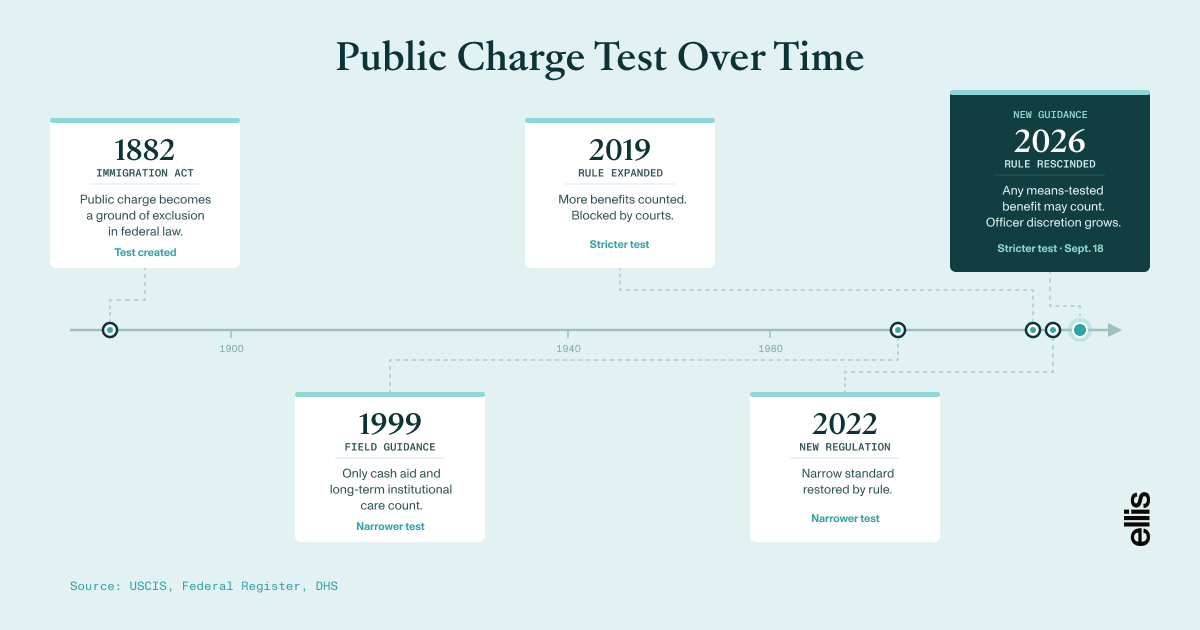
The idea has been part of U.S. law since the 1880s, but the way the government applies it keeps moving. Guidance from 1999 set a narrow test, a 2019 rule made it stricter before courts blocked it, a 2022 rule made it narrow again, and the 2026 change now moves the test back in the stricter direction.
What changed on August 18, 2026?
USCIS published new Policy Manual guidance that tells officers how to make public charge decisions under the new framework. The guidance carries out a DHS final rule announced July 16, 2026 and published in the Federal Register on July 20, 2026, which ends the 2022 public charge regulation.
Both take effect September 18, 2026, and the guidance applies to every Form I-485 postmarked or filed online on or after that date. It replaces all earlier public charge guidance, including the 1999 Interim Field Guidance that governed most of the past two decades.
The 2026 rule removes the old definitions and leaves the decision to officer judgment, guided by the Policy Manual. This likely gives each officer much more room to weigh a case their own way, so results may differ from office to office. Lawsuits are also possible, since courts blocked the 2019 rule several times and advocacy groups have raised similar concerns here. As of publication, the rule is still set to take effect September 18, 2026.
Which benefits count under the new public charge rule?
The biggest change is which benefits an officer can count, and the date you received the benefit decides which standard applies.
Benefit received | Standard applied |
|---|---|
Before Sept. 18, 2026 | Only public cash assistance for income maintenance and long-term institutionalization at government expense count |
On or after Sept. 18, 2026 | Any means-tested public benefit may count |
What counts as "means-tested"
A means-tested public benefit is generally one you qualify for based on income or financial need. The rule does not define the term precisely.
The benefits USCIS names as examples
For benefits received on or after September 18, 2026, USCIS says it may consider any means-tested benefit, and it names these as examples:
- Cash assistance for income maintenance
- Housing assistance
- Food stamps (SNAP)
- Financial aid for college
- "Any other similar benefit"
What about Medicaid and CHIP?
The rule does not give a fixed list of programs. It removes the 2022 definitions that told officers to ignore whole groups of benefits, including Medicaid, CHIP, SNAP, and housing assistance. With those exclusions gone, officers may now weigh health coverage like Medicaid case by case, though USCIS has not said that any single program causes a denial on its own.
Benefits received before September 18, 2026 are still judged under the old, narrow standard, so a family that used SNAP in 2025 is not penalized for it under the new standard.
Who does the public charge test apply to (and who is exempt)?
Every adjustment of status applicant is subject to the public charge test unless Congress made their category exempt. Here is how the USCIS announcement breaks it down:
Subject to public charge | NOT subject (exempt) |
|---|---|
• Family-based applicants: spouses, children, parents, and siblings of U.S. citizens; spouses and children of green card holders; fiancé(e)s, widows, and widowers • All employment-based applicants: priority workers, advanced-degree professionals, skilled workers, investors, and religious workers • Diversity visa immigrants | • Asylees and refugees • Victims of trafficking and qualifying crimes (T and U nonimmigrants) • VAWA self-petitioners • Special immigrant juveniles • TPS applicants • Afghan and Iraqi interpreters • Cuban and Haitian entrants • Surviving family of military members • Several smaller categories |
Spouses and parents of U.S. citizens are subject, and so is every work-based applicant. The exempt column is mostly humanitarian. The complete list, with every category, is in the USCIS Policy Manual.
How does USCIS decide who is a public charge?
There is no automatic disqualification under the guidance. Officers weigh five factors set by law:
- Your age
- Your health
- Your family status
- Your assets, resources, and financial status
- Your education and skills
They may also consider Form I-864, the Affidavit of Support, which is the form where a sponsor promises to use their own income to support you.
How the factors are weighed
Receiving a benefit is one piece of evidence, not a verdict. USCIS calls it a case-by-case decision made in the totality of the circumstances, which in plain terms means the officer looks at everything in your file together. A young, healthy applicant with a steady job and a strong sponsor may receive a benefit and still be approved. That said, the guidance also gives officers more discretion, so the weight any one factor gets can vary.
USCIS has also said it will revise Form I-485 with new public charge questions about household finances, health insurance, work history, and benefits.
What is a public charge bond?
A public charge bond is a financial promise, posted with USCIS, that an applicant will not become a public charge. The new guidance revives this tool after decades of disuse.
If an officer finds an applicant inadmissible only on public charge grounds, USCIS may invite them to post a bond.
How the bond works
- Invitation only. USCIS offers the bond through a Notice of Intent to Deny and will not accept a bond it did not ask for.
- Cash or surety. The bond can be cash or a surety bond from a Treasury-certified surety company, filed on Form I-945.
- Amount set case by case, based on how much government help the applicant might qualify for over the next five years.
- If posted as instructed, the officer may approve the green card.
Should you file Form I-485 before September 18, 2026?
That depends on the facts of each case, but the date itself works like this: under the USCIS announcement, the filing date controls, not the decision date.
- Filed before September 18, 2026 (postmarked or submitted online): decided under the current 2022 standard, even if USCIS decides the case months later.
- Filed on or after September 18, 2026: decided under the new guidance.
- Benefits follow the same date logic. Benefits received before September 18 are weighed under the old, narrow standard no matter when the case is decided, and benefits received on or after that date fall under the broader test.
Whether filing sooner makes sense, and whether keeping a benefit carries risk, depends on the facts of each case, including your category, your household finances, and your sponsor. Those are questions for a licensed immigration attorney, not a general article.
How Ellis can help
Public charge is about to become one of the most judgment-driven parts of a green card case, and the record you file is likely to matter more than it has in years. Ellis attorneys prepare the full I-485 package, build the financial evidence around the five factors, and respond if USCIS raises public charge concerns. Schedule a free consult →
This article is for general informational purposes and is not legal advice.