

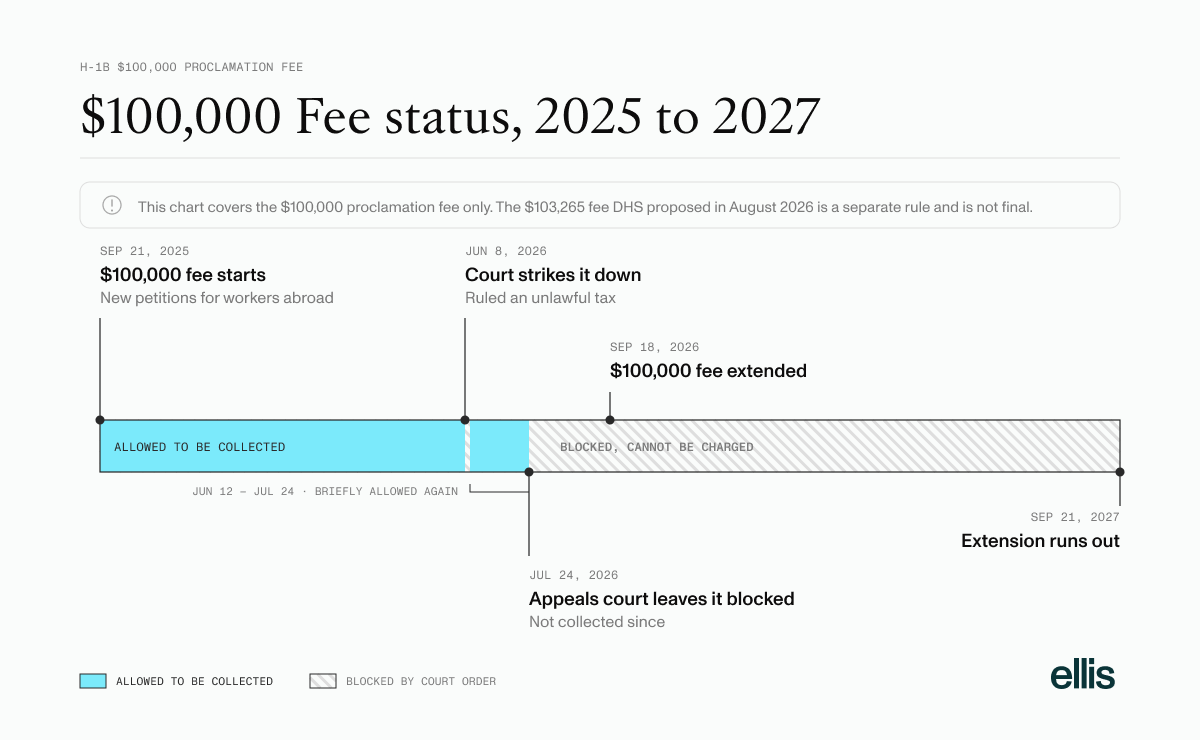
The $100,000 H-1B fee is not being collected as of September 21, 2026. A federal court struck it down as an unlawful tax on June 8, 2026, and a federal appeals court left that ruling in place on July 24, 2026. President Trump extended the fee through September 21, 2027 in a proclamation signed September 18, 2026, but the court ruling still blocks it.
Key Takeaways
- Is it being collected? No, and not since July 24, 2026. The September 18 proclamation did not change that.
- So what actually changed? Only the end date, which moved from September 21, 2026 to September 21, 2027. The fee stays blocked by the court ruling.
- Don't confuse it with: the $103,265 fee DHS proposed in August, or the executive order signed the same day, which covers other cases.
- Need help? Ellis attorneys prepare the petition and our platform tracks everything in one place for you. Start here →
What did Trump sign on September 18, 2026?
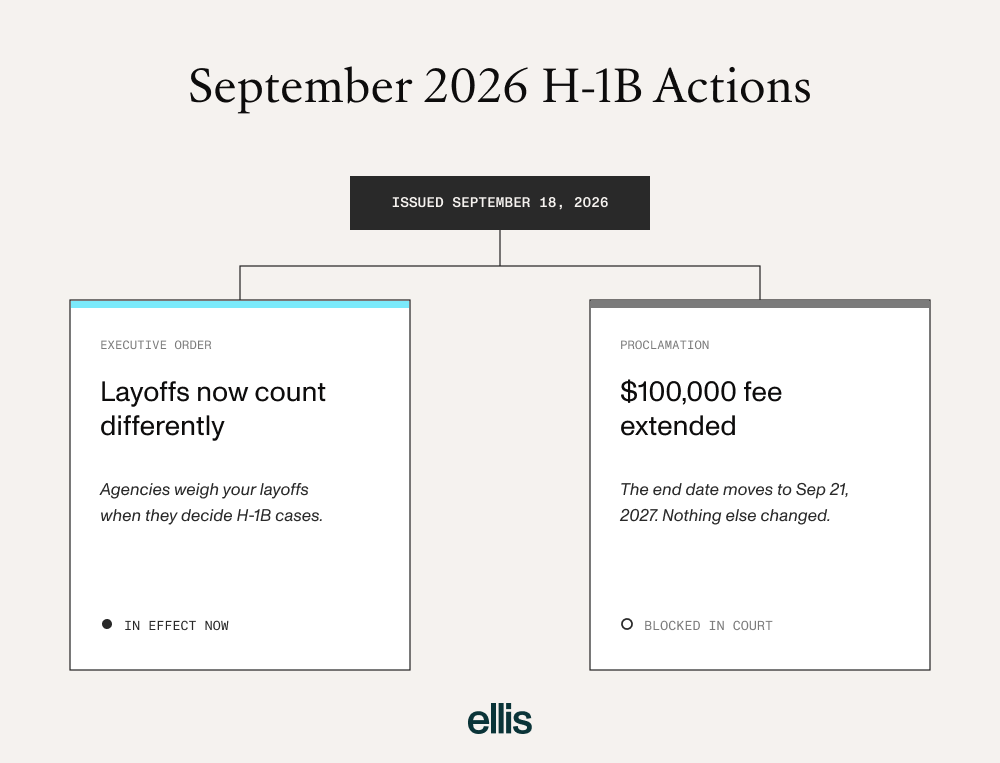
The proclamation moved the end date of a fee that was set to expire on September 21, 2026 to September 21, 2027.
Signing three days early kept the policy from lapsing. A lapse would have left the government nothing to restore if it wins in court. For employers, nothing changes today.
A separate executive order on H-1B and employer layoffs was signed the same day. It is unrelated to the fee. You can read about that order here.
Is the $100,000 H-1B fee still active?
No. As of September 21, 2026, neither USCIS nor the State Department can charge the $100,000 payment. A district court wiped out the rules behind it, and that order still stands.
This has been true since July 24, 2026, when the First Circuit court refused to pause the ruling while the appeal runs.
The September 18 proclamation did not change it. A proclamation cannot revive agency rules a court has struck down. The extension keeps the requirement on the books, nothing more.
How did the $100,000 H-1B fee get here? Full timeline
Date | What happened |
|---|---|
Sept 19, 2025 | Proclamation signed, creating the $100,000 payment |
Sept 21, 2025 | Proclamation takes effect |
Oct 2025 to Dec 2025 | Three lawsuits filed, including Chamber of Commerce v. DHS |
Dec 23, 2025 | A DC district court upholds the fee. That case is on appeal |
June 8, 2026 | A Massachusetts district court vacates the fee policies entirely |
June 12, 2026 | Government appeals. The district court briefly pauses its own ruling |
July 24, 2026 | First Circuit denies the stay. The vacatur stands and collection stops |
Aug 25, 2026 | DHS proposes a separate $103,265 fee through rulemaking |
Sept 18, 2026 | Proclamation extends the $100,000 fee through Sept 21, 2027 |
The June 8 ruling called the payment an unlawful tax. The fee then became collectible again for a few weeks that June, until the appeals court closed it off.
Not every court has agreed. A DC district court upheld the fee in December 2025, and that appeal is still pending. If the two circuits split, Supreme Court review becomes more likely.
Who does the $100,000 H-1B fee apply to?
The fee reached a narrow group. It applied to new H-1B petitions for workers who were already outside the United States. Those are the cases that run through consular processing.
Filing type | Covered by the $100,000 fee |
|---|---|
New petition, worker abroad | Yes |
No | |
H-1B transfer to a new employer | No |
No | |
Change of status filed inside the US | No |
That last row is why most F-1 students were never in scope. A student moving from F-1 to H-1B inside the United States files a change of status, not a consular case.
Did anyone actually pay the $100,000 fee?
Yes, but very few. There were two windows when the fee could actually be charged. The first ran from September 21, 2025 to June 8, 2026, when the Massachusetts court struck the fee down. The second was a six-week stretch that summer, ending July 24, 2026.
Most employers avoided it by not filing. USCIS's own figures, published in DHS's fee analysis for the $103,265 proposed rule, show initial consular H-1B receipts fell 91.2 percent. That is the exact category the fee hit. The Institute for Progress notes the drop deepened each month the fee was in force, from 81 percent to more than 97 percent.
A USCIS official told the court in Global Nurse Force v. Trump that the agency had taken in 85 payments totaling about $8.5 million as of February 15, 2026. USCIS has not published a final collection total since.
Refunds are unresolved. The June ruling stopped the policy going forward but did not order money back, and no case has settled what happens to payments already made.
If the government wins on appeal, USCIS would have to publish new instructions before collection could restart.
How is the $103,265 DHS fee different?
$100,000 proclamation | $103,265 proposed rule | |
|---|---|---|
Created by | Presidential proclamation | DHS rulemaking |
Status | Vacated, not being collected | Proposed, not final |
Applies to | New petitions, worker abroad | All cap-subject petitions, even for individuals in the U.S. |
Paid when | At the consular stage | At filing |
Exemptions | Case-by-case national interest |
Comments close September 24, 2026. A final rule cannot take effect for at least 30 days after publication, so any realistic start date falls in 2027. The new H-1B fee for 2026 has the full proposal.
If both survived, they would stack, on top of the standard H-1B filing fees and any premium processing fee.
What does this mean for FY 2028 cap planning?
Nothing is settled, but the timing helps. Registration for the FY 2028 cap does not open until spring 2027. That leaves months for the First Circuit court to rule, the DC Circuit court to weigh in, and the DHS rule to be finished or dropped.
Employers budgeting for that season are tracking three numbers instead of one. Standard filing fees are fixed and known. The $100,000 payment is blocked, but alive on paper through September 2027. The $103,265 fee is still only a proposal. Which ones apply to a given petition depends on where the worker is and whether the case is cap-subject, so it is worth settling during cap planning.
How Ellis can help
H-1B fee exposure now depends on litigation status, filing type, and where the worker is sitting when the petition goes in. Ellis attorneys file the petition, apply the fees that actually control on the filing date, and flag changes as the appeals move. Schedule a free consult →
This article is for general informational purposes only. It is not legal advice.