

The P-1 visa is a US work visa for internationally recognized athletes (P-1A) and members of internationally recognized entertainment groups (P-1B). A US employer, agent, or sponsor files Form I-129 with USCIS, which costs most employers $1,615 in 2026. Individual P-1A athletes can be admitted for up to 5 years, with a 10-year maximum stay.
The P-1 covers a wide range of roles: a soccer club signing a striker, an e-sports organization bringing a player to a franchised league, or a touring band's US promoter. This guide covers who qualifies under P-1A and P-1B, what the petition costs in 2026, how long USCIS takes, the rules for support staff (P-1S) and family (P-4), and how the P-1 compares to the O-1.
Key takeaways
- Who qualifies? Internationally recognized individual athletes and athletic teams (P-1A), and entertainment groups (P-1B).
- How much? The Form I-129 base fee is $1,015, plus a $600 Asylum Program Fee for most employers. Small employers pay $510 plus $300, and nonprofits pay $510 with no Asylum Program Fee. Optional premium processing costs $2,965.
- How long? Regular processing runs roughly 2 to 14 months depending on the service center. Premium processing guarantees USCIS action within 15 business days.
- Important: An athlete or entertainer can NOT self-petition for a P-1. A US employer, agent, or sponsoring organization must file the petition.
- Need help? Ellis attorneys build petitions and manage every deadline in one place. Start here →
What is a P-1 visa?
The P-1 is a temporary, employment-based nonimmigrant visa for athletes and entertainers coming to the United States to compete or perform at an internationally recognized level. It comes from section 101(a)(15)(P) of the Immigration and Nationality Act (INA) and splits into two main tracks: P-1A for athletes and athletic teams, and P-1B for members of entertainment groups.
First, a US petitioner files Form I-129 (Petition for a Nonimmigrant Worker) with USCIS. Once USCIS approves it, the beneficiary applies for the visa at a US embassy or consulate, where officers follow the State Department's guidance at 9 FAM 402.14.
Two related classifications travel with the P-1. Essential support personnel, such as coaches and trainers, use the P-1S classification. Spouses and children use the P-4.
P-1A visa: internationally recognized athletes
The P-1A covers individual athletes and athletic teams that are internationally recognized. That means their skill and recognition sit well above the ordinary level, and their achievement is renowned, leading, or well known in more than one country.
USCIS also asks whether the event or league has a distinguished reputation and an internationally recognized level of performance. Factors that count include viewership, attendance, revenue, media coverage, and the caliber of past participants.
Four groups of athletes commonly use the P-1A:
- Individual athletes competing at an internationally recognized level, such as tennis players, golfers, or fighters entering US events.
- Athletic teams recognized internationally as a unit. Each member gets P-1A status tied to the team, and the team's recognition, not each player's, carries the petition.
- Professional athletes employed by a team in an association of six or more professional sports teams whose combined revenues exceed $10 million per year, or by a minor league affiliate of such a team. This is how major league signings and minor league prospects qualify.
- Amateur athletes and coaches, in narrow cases, when they perform for a US team in a foreign league or association with at least 15 amateur teams, where that league is the highest level of amateur competition for the sport in its country and participation makes players ineligible for NCAA scholarships. Theatrical ice skaters also qualify under a special provision.
P-1A evidence requirements
A P-1A petition starts with a copy of a tendered contract with a major US sports league or team, if contracts are standard in the sport. It then needs documentation of at least two of the following:
- Prior significant participation with a major US sports league
- International competition with a national team
- Prior significant participation in US intercollegiate competition
- A written statement from an official of the sport's governing body
- A written statement from sports media or a recognized expert
- International rankings
- A significant honor or award in the sport
E-sports players and the P-1A
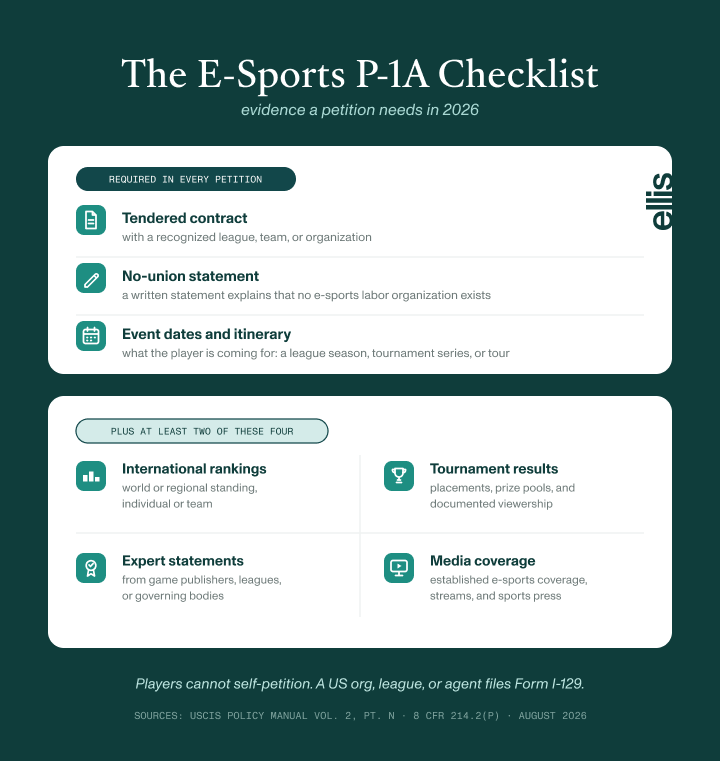
Esports players can qualify for P-1A visas as internationally recognized athletes. USCIS has approved P-1A petitions for professional gamers since 2013, when a League of Legends player got the first widely reported esports approval.
Nothing in the statute or regulations limits "sport" to physical athletics. Franchised leagues in games like League of Legends, Counter-Strike, Dota 2, and VALORANT have used the category since.
The evidence is the same as for any other athlete:
- International rankings, individual or team
- Major tournament results, with documented viewership and prize pools
- Recognized league play, such as a franchised league contract
- Media coverage in established esports and sports press
Three things make esports petitions different:
- No labor organization exists for esports. Instead of the usual consultation letter, petitions include a statement explaining that no appropriate consulting organization exists.
- Newer game titles may lack a trail of rankings or league history, which makes international recognition harder to show.
- Players cannot file for themselves. An esports organization, tournament organizer, or agent files the petition.
P-1B visa: internationally recognized entertainment groups
The P-1B is for members of entertainment groups, not solo artists. The group itself must be internationally recognized, with skill and recognition well above the ordinary level. A solo performer with an international reputation generally looks to the O-1B instead.
The defining rule is the 75% one-year membership requirement: at least 75% of the group's members must have had a substantial and sustained relationship with the group for at least one year. That is why established bands, dance companies, and theater ensembles fit the P-1B, while a group put together for one tour usually does not.
USCIS can waive the one year in a few cases, such as when a new member steps in for an essential member who is ill.
P-1B evidence requirements
To show international recognition, the petition includes evidence of significant international awards or prizes, or at least three of the following:
- Starring or leading roles in productions with distinguished reputations
- International acclaim documented in critical reviews and major media
- Starring roles for organizations with distinguished reputations
- A record of major commercial or critically acclaimed successes shown through box office receipts, ratings, or sales
- Significant recognition from critics, experts, or media outlets
- High compensation compared with others in the field
P-1 visa requirements: what every petition includes
Every P-1 petition, athlete or entertainer, is built from the same core parts. The petitioner (the US employer, agent, or sponsoring organization) files on behalf of the beneficiary (the athlete, team members, or group members) and includes:
- A written consultation from an appropriate labor organization. This consultation letter, sometimes called an advisory opinion, describes the work qualifications, and the organization can instead issue a letter of no objection. If no appropriate labor organization exists for the field, as in esports, the petition explains that.
- A copy of the written contract, or a summary of the terms of an oral agreement, between the petitioner and the beneficiary.
- An explanation of the event, competition, or performance, with beginning and ending dates. When the beneficiary will work in multiple locations or for multiple employers, the petition includes an itinerary and, for multiple employers, an agent authorized to act for all of them.
- The category-specific evidence of international recognition described above.
How much does a P-1 visa cost in 2026?
Most employers pay $1,615 in USCIS filing fees for a P-1 petition in 2026: the $1,015 Form I-129 base fee plus the $600 Asylum Program Fee. Fees drop for small employers and nonprofits, and the beneficiary pays separate consular fees when applying for the visa abroad.
Fee | Amount (2026) | Notes |
|---|---|---|
Form I-129 base fee | $1,015 | $510 for employers with 25 or fewer full-time employees and for 501(c)(3) nonprofits |
Asylum Program Fee | $600 | $300 for small employers; $0 for 501(c)(3) nonprofits |
Premium processing (Form I-907) | $2,965 | Optional. Rose from $2,805 on March 1, 2026 |
Consular visa application fee (MRV) | $205 | Paid by each applicant, including P-1S and P-4 |
$250 | Applies to visas issued on or after October 1, 2025; collection has rolled out unevenly across consulates |
Fees are current as of publication. The USCIS fee schedule and the State Department fee page control.
No rule says who has to pay P-1 costs, unlike some H-1B fees. In practice the petitioner pays the USCIS filing fees and the athlete or entertainer pays the consular fees. The two sides can split costs however they agree.
Two other costs sit outside the table. Family members who change or extend status inside the US file Form I-539, which has its own fee. Attorney fees depend on how complex the case is, how many people it covers, and how much of the evidence already exists.
How long does P-1 visa processing take?
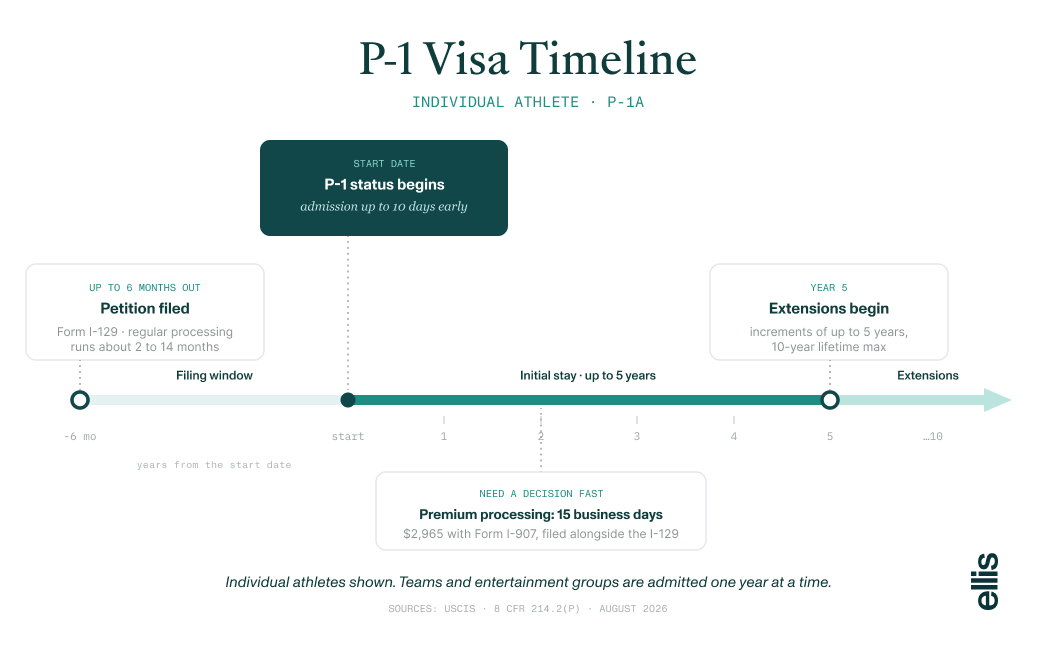
Regular P-1 processing time depends on which service center gets the case, with recent ranges run from about 2 months to more than a year. USCIS processing times shift month to month, so the time posted for the center handling the case close to filing is the one that matters.
Premium processing is available for P-1 petitions. For $2,965, USCIS guarantees action on the case, an approval, denial, or request for evidence, within 15 business days. Because event dates are fixed and regular processing can run long, premium processing is common here.
The P-1 has no annual numerical cap and no lottery, unlike the H-1B. There is no cap-season window, so timing follows the event date rather than a quota.
Form I-129 petitions can be filed up to six months before the employment start date. After approval, USCIS issues Form I-797, which the beneficiary uses at the consular stage.
How long can you stay on a P-1 visa?
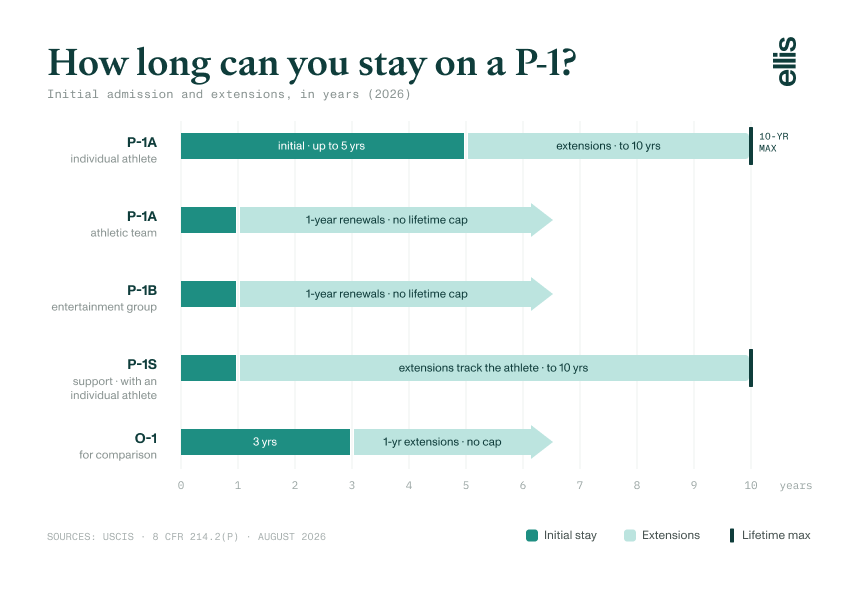
Timing depends on the "event." For an individual athlete, an event can be a full season, a tournament series, or even a multiyear contract, which is how five-year admissions happen.
Teams and entertainment groups get one year at a time, no matter how long the contract runs. A multiyear signing means filing an extension of stay every year. Extensions use a new Form I-129, and a person already in the US in another status may request a change of status on the same form.
Initial period of stay | Extensions | |
|---|---|---|
P-1A individual athlete | Time needed for the event, up to 5 years | Up to 5 years, with a 10-year total maximum |
P-1A athletic team | Time needed for the event, up to 1 year | Increments of up to 1 year |
P-1B entertainment group | Time needed for the event, up to 1 year | Increments of up to 1 year |
P-1S support personnel | 1 year (up to 5 for those supporting individual athletes' multiyear stays) | Mirrors the principal, 10-year cap when supporting individual athletes |
What you can and can't do on a P-1
P-1 status only allows work for the petitioner and the events listed in the approved petition. Anything beyond that needs its own petition.
- Second jobs and side gigs. A P-1 athlete or entertainer cannot take a second job, side gigs, or appearance fees from another employer unless a petition covers that work. Anything outside the petition is unauthorized employment, which can end their status and cause problems with future filings.
- Changing employers. Changing employers requires a new petition, and the new employer must file Form I-129 before the athlete or entertainer starts work.
- Trades, for professional athletes. A traded player keeps work authorization automatically for 30 days after the trade. If the new team files its I-129 in that window, the player can keep playing while the petition is pending.
P-4 visas for spouses and children
The spouse and unmarried children under 21 of a P-1 or P-1S holder can get P-4 status. P-4 status does not include work authorization. P-4 dependents cannot work in the United States, but they can attend school or college.
Family abroad applies for P-4 visas at the consulate alongside the principal. Dependents already in the US file Form I-539 to change or extend status.
P-1 vs O-1, P-2, and P-3: which category fits?
Visa | Purpose | Who uses it |
|---|---|---|
P-1A / P-1B | International recognition as an athlete, team, or entertainment group | Athletes, teams, esports players, established bands and ensembles |
Extraordinary ability of an individual | Solo artists, coaches with sustained acclaim, elite individual athletes | |
P-2 | Reciprocal exchange programs between US and foreign organizations | Artists and entertainers entering under a formal exchange, often union-administered |
P-3 | Culturally unique programs | Artists and entertainers performing, teaching, or coaching in a culturally unique setting |
How to apply for a P-1 visa, step by step
The process generally runs in five stages:
- Gather the evidence. The petitioner assembles the evidence of international recognition, obtains the labor organization consultation, and prepares the contract and itinerary.
- File Form I-129. The petitioner files with USCIS with the filing fees, optionally adding premium processing.
- USCIS decides. USCIS approves the petition and issues Form I-797, or sends a request for evidence asking for more documentation.
- Apply at the consulate. The beneficiary completes the DS-160, pays the $205 visa application fee, and attends a visa interview at a US embassy or consulate, typically bringing a passport, the DS-160 confirmation, the fee receipt, the I-797 approval notice, the contract and itinerary, and key evidence of recognition.
- Enter the US. The beneficiary can generally be admitted up to 10 days before the petition's validity period begins, though work can only start once the period is underway.
Canadian citizens skip step 4. Canada is visa-exempt for most nonimmigrant categories, so a Canadian athlete or entertainer does not get a P-1 visa stamp at a consulate. They present the Form I-797 approval notice and supporting documents to US Customs and Border Protection at the port of entry.
This article is for general informational purposes only and is not legal advice.