

The J-1 visa is a nonimmigrant visa for a foreign citizen approved to join an exchange visitor program in the United States. These U.S. Department of State programs promote the interchange of knowledge and skills in education, culture, work, and training. J-1 visa holders can only work under the terms of their program, which is run by a designated sponsor.
Thinking about a J-1 visa? It is the visa for students, researchers, interns, teachers, physicians, au pairs, and other exchange visitors coming to the United States. This guide covers the categories, who qualifies, what it costs in 2026, how to apply, and the two-year home rule that catches many people by surprise.
Key Takeaways
- What is it? A nonimmigrant visa for participants in a U.S. Department of State exchange visitor program, authorized under the Mutual Educational and Cultural Exchange Act.
- How much? A $220 SEVIS I-901 fee for most categories, or $35 for au pairs, camp counselors, and summer work travel, plus a $185 visa application fee. Government-sponsored participants are often exempt.
- How long can I stay? Until your program ends, plus a 30-day grace period to leave the United States. You can enter up to 30 days before your program starts.
- Important: Some J-1 visa holders must return to their home country for two years before they can get certain visas or a green card. This is the 212(e) two-year home-country presence rule.
- Need help? Ellis pairs you with an immigration attorney and tracks your case start to finish. Start here →
What is a J-1 visa?
The J-1 visa is a nonimmigrant visa for people approved to take part in an exchange visitor program in the United States. It is often called the exchange visitor visa. The program exists to increase mutual understanding between people in the United States and other countries through the interchange of knowledge and skills.
The visa comes from two laws. The Immigration and Nationality Act sets out nonimmigrant visa categories, and the Mutual Educational and Cultural Exchange Act of 1961 created the exchange program itself. The U.S. Department of State runs it and designates the programs that qualify.
"Nonimmigrant" means the visa is temporary. You come for a specific program, keep J status while you take part, and are expected to leave when it ends. A J-1 visa is not a path to permanent residence on its own.
J-1 visa categories
There are about 15 J-1 visa categories, each tied to a type of exchange program. Your category is set by your sponsor and printed on your Form DS-2019. It controls what you can do, how long you can stay, and whether the two-year home rule applies.
Category | Who it is for |
|---|---|
Students (college/university and secondary) | Foreign students earning a degree or studying at a U.S. school |
Research scholars and professors | People conducting research or teaching at a U.S. institution |
Short-term scholar | Scholars visiting for a short period of research, teaching, or consulting |
Specialist | Experts with specialized knowledge sharing skills in their field |
Interns and trainees | Students, recent graduates, and professionals building career skills |
Teachers | Teachers working in accredited U.S. primary and secondary schools |
Physicians | Foreign medical graduates in graduate medical education or training |
Au pair, camp counselor, summer work travel | Cultural and work-travel programs for young adults |
Government and international visitors | Participants in official government and Department of State programs |
You can see the full list of exchange visitor categories on the Department of State exchange visitor page.
J-1 visa eligibility requirements
To qualify for a J-1 visa, you must be accepted into a designated exchange visitor program and meet that program's rules. The core eligibility requirements are the same across categories:
- A program sponsor. The J-1 visa requires sponsorship by an organization approved by the U.S. Department of State. You cannot apply on your own. The sponsor accepts you and issues your Form DS-2019.
- A valid passport. It must be valid for at least six months beyond your period of stay, unless your country has an agreement that waives this.
- Proof of financial support. You must show you have enough money to support yourself for the length of your stay.
- Ties to your home country. You must show ties to your home country or country of last residence, so the consular officer sees you plan to return.
How much does a J-1 visa cost in 2026?
A J-1 visa involves two main fees: the SEVIS I-901 fee and the visa application fee. Government-sponsored participants are often exempt from both.
Fee | Amount | Notes |
|---|---|---|
SEVIS I-901 fee | $220, or $35 for au pairs, camp counselors, and summer work travel | Paid after your sponsor issues your DS-2019. Participants in programs numbered G-1, G-2, G-3, or G-7 are often exempt. |
Visa application fee (DS-160) | $185 | Nonrefundable. Government-sponsored J visa applicants and their dependents do not pay it. |
Visa issuance fee | Varies by nationality | Based on reciprocity with your country. Many applicants pay nothing. |
You pay the SEVIS I-901 fee before your visa interview or before you arrive at the border. Keep the receipt. You will need it for your interview and at the port of entry.
How to apply for a J-1 visa
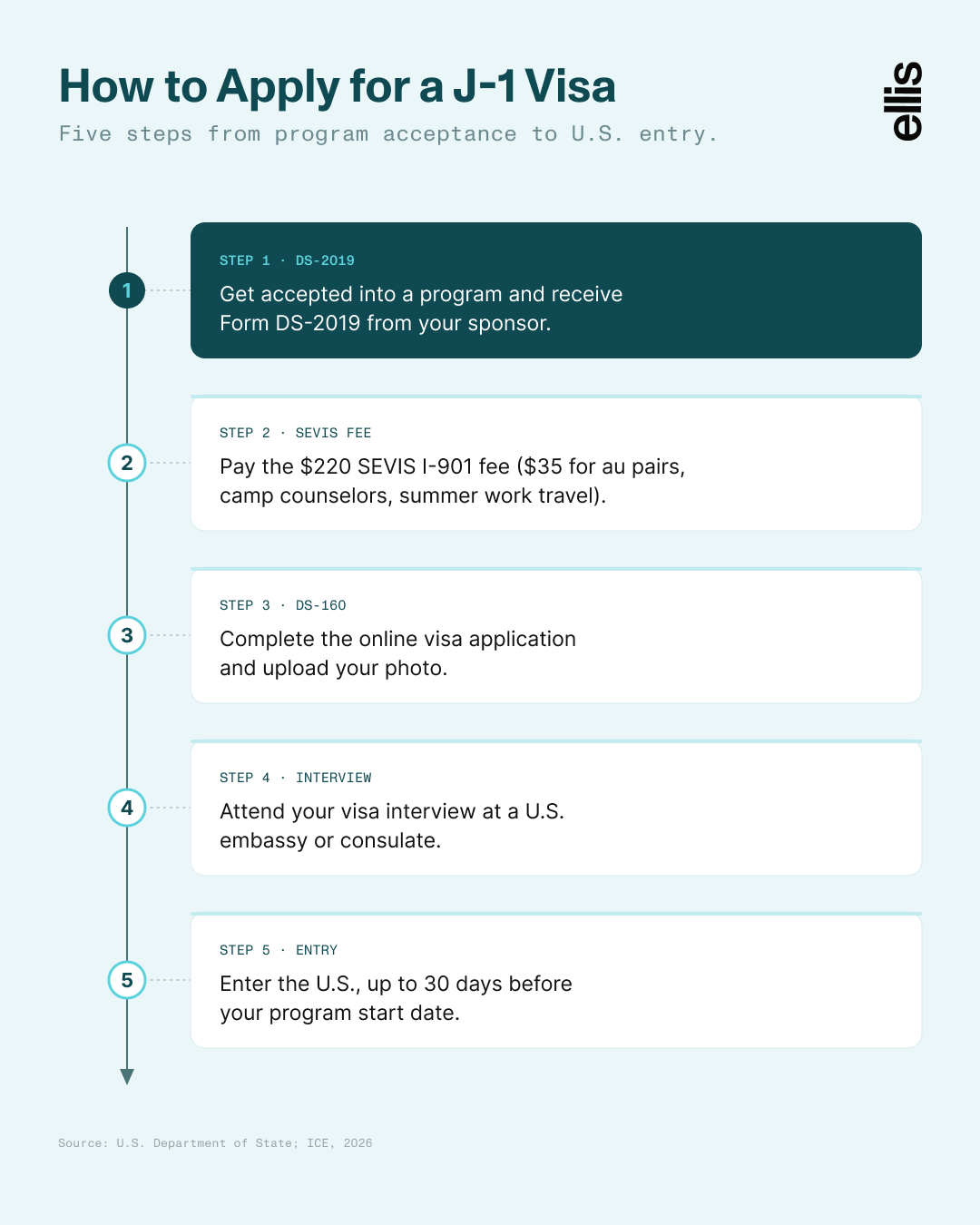
The first step is getting your Form DS-2019. After that, the application procedures follow a set order, though the exact steps can vary by embassy or consulate.
- Get accepted into a program and receive your Form DS-2019, the Certificate of Eligibility for Exchange Visitor Status, from your sponsor. Interns and trainees also get Form DS-7002.
- Pay the SEVIS I-901 fee once you are notified your record is active.
- Complete the online visa application, Form DS-160, and upload your photo.
- Schedule and attend your visa interview. Most J-1 applicants must interview at a U.S. embassy or consulate. A consular officer decides whether you qualify.
- Submit your passport, DS-160 confirmation, DS-2019, and fee receipts, and pay any visa issuance fee if it applies.
A visa lets you travel to a U.S. port of entry. It does not guarantee entry. U.S. Customs and Border Protection officers make the final decision when you arrive. You may enter the United States up to 30 days before your program start date, and no earlier. Citizens of Canada and Bermuda do not need the visa sticker itself but must show a valid DS-2019 to re-enter.
Working on a J-1 visa and bringing your family
J-1 visa holders can work, but only under the terms of their program. Your category defines the work, and your sponsor authorizes it. Working outside those terms puts your J status at risk.
Your spouse and unmarried children under 21 may apply for J-2 visas to join you for the length of your program, if your category allows dependents. They do not pay a separate SEVIS fee, but your sponsor must issue each of them a separate DS-2019. J-2 dependents can apply for employment authorization once they are in the United States.
J-1 visa sponsors
Every J-1 visa runs through a sponsor. Sponsors are organizations designated by the U.S. Department of State to operate exchange programs. They are the reason the program works, and they carry real responsibility for it.
Sponsors issue the DS-2019 form you use to apply for your visa. They must keep electronic records for each exchange visitor in SEVIS, the Student and Exchange Visitor Information System. A responsible officer at the sponsor monitors the welfare of exchange visitors during the program and can help extend the program when the rules allow.
The two-year home-country requirement (212(e))
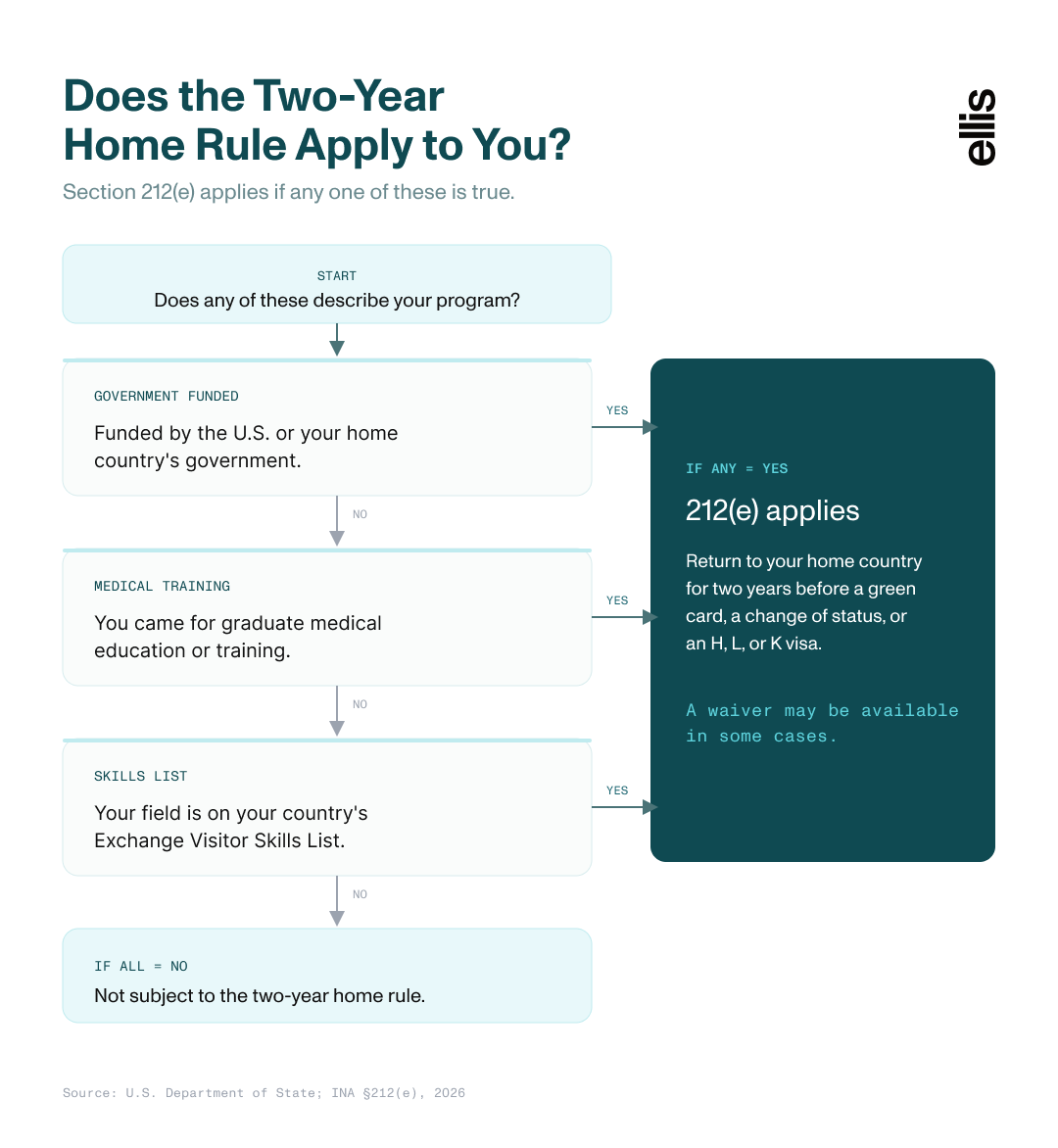
Some J-1 visa holders must return to their home country for two years after their program before they can get certain U.S. benefits. This is the two-year home-country physical presence requirement, based on section 212(e) of the Immigration and Nationality Act.
The requirement applies if any of these is true:
- Your program was funded, in whole or part, by the U.S. government or the government of your home country or country of last residence.
- You came to receive graduate medical education or training.
- Your field appears on the Exchange Visitor Skills List for your country, meaning your specialized knowledge or skill is needed at home.
If it applies to you, you must spend a cumulative total of two years in your home country before you can change status or adjust status in the United States, get an immigrant visa or green card, or get an H, L, or K visa. The two years do not have to be served all at once. They can be met in several intervals.
A waiver of the two-year requirement is possible in certain cases. You can read how to request one on the Department of State waiver page. Waivers are fact-specific, so many people get legal help before filing.
Maintaining status, extensions, and leaving the United States
You keep your J status by taking part in your program. You must engage in the program activities on your DS-2019 and follow your sponsor's rules. Stopping your program activities can end your status.
You may stay in the United States until your program ends, which is the expiration date on your DS-2019, not the date on your visa stamp. If you need more time, your sponsor may be able to extend your program within the category limits. Ask your responsible officer early.
When your program ends, you get a 30-day grace period to prepare and leave the country. During this time you cannot work or continue program activities. If your plans change while you are here, for example you receive a job offer, you may be able to request a change of status through USCIS, though the two-year home rule can block this until it is met or waived.
How Ellis can help
Most of a J-1 program is handled by your sponsor. Where it gets complicated is the two-year home rule and the waiver process, or when you want to change status or move toward a green card. Ellis pairs you with an immigration attorney and tracks your case from start to finish, so you know where you stand at every step. Schedule a free consult →
This article is for informational purposes only and is not legal advice.