


E-Verify is a free federal system that compares the information on an employee's Form I-9 against Department of Homeland Security and Social Security Administration records to confirm employment eligibility. It is voluntary for most employers, required for federal contractors, and mandatory under state laws in states including South Carolina.
Here is how the process works, what the three business day rule means, and where the system carries risk for employers.
Key Takeaways
- Who must use it? Anyone who employs students using F-1 STEM OPT and federal contractors. More than 20 states also require it for public employers and state contractors, and 10 states require it for private employers too.
- Deadline: Create the case by the third business day after the employee starts work.
- Cost: Free. Results come back quickly.
- Important: Mismatches and final nonconfirmations carry real exposure with both DHS and the Department of Justice, so employers commonly involve counsel before acting on one.
- Need help? Ellis attorneys handle I-9 and E-Verify compliance and our platform keeps every case and deadline in one place. Start here →
What is E-Verify?
E-Verify is an online system that checks whether a new employee can work in the United States. The employer enters the information the employee already gave on Form I-9. The system checks it against millions of government records held by the Department of Homeland Security and the Social Security Administration (SSA).
US Citizenship and Immigration Services runs it, working alongside the SSA. A few basics:
- It is free. No cost to enroll, no cost per case.
- It is available in all 50 states and US territories.
- Most employers use it through a normal web browser.
- Larger employers connect through web services, which pulls from an existing HR or onboarding system so nobody retypes I-9 data.
For a US citizen, the system compares name, date of birth, and Social Security number against SSA records. For a noncitizen, it also checks the work authorization documents against DHS databases. It often shows a photo from the government record so the employer can confirm it matches the document the employee handed over.
A short history
A 1996 immigration law required the federal government to test electronic verification. The resulting Basic Pilot Program launched in 1997 in six states, small and barely known outside them.
The program took the name E-Verify in 2007. More than a million employers are enrolled today, and state mandates drove most of that growth.
Form I-9 vs. E-Verify: two ways of confirming employment eligibility
Form I-9 is a record built from documents the employee hands over. E-Verify is an electronic check of what that record says against what the government already has on file.
Form I-9 | E-Verify | |
|---|---|---|
Required? | Yes, for every US employer | Voluntary federally, required in some states and for many federal contractors |
What it checks | Identity and work authorization documents the employee presents | Form I-9 information against DHS and SSA records |
SSN needed? | No | Yes |
When | Section 1 by the first day of work, Section 2 within three business days | After hire, within three business days of the start of work |
Who is covered | Everyone hired after November 6, 1986 | Generally new hires only, with a federal contractor exception |
Who has to use E-Verify?
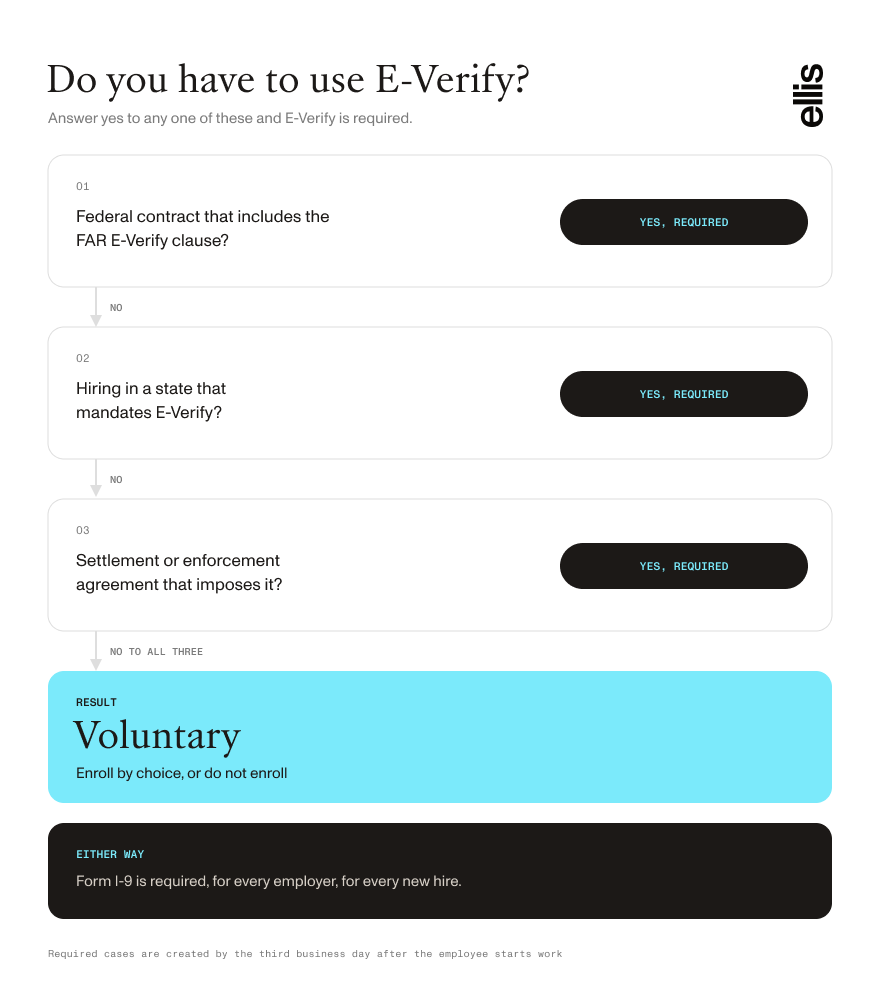
Under federal law, E-Verify is voluntary for most private employers. It becomes mandatory in a few situations:
- Employing international students who use F-1 STEM OPT work authorization
- A federal contract that includes the E-Verify clause
- A state law that requires it
- A settlement or enforcement agreement that imposes it
Employers enroll by choice for two reasons. Data problems surface on day one rather than years later in an audit. And participation creates a rebuttable presumption that they did not knowingly hire an unauthorized worker.
Signing up comes with rules. The main one is consistency: every new hire at a participating location gets a case, not just the ones that raise a question.
E-Verify is also not a screening tool. Under the program rules, the case is created after the person accepts the offer and starts work, never before, which places it in the hiring process rather than in recruiting.
A few states go further and cover specific industries, such as construction. Public contracting rules can reach those industries too.
States that require E-Verify
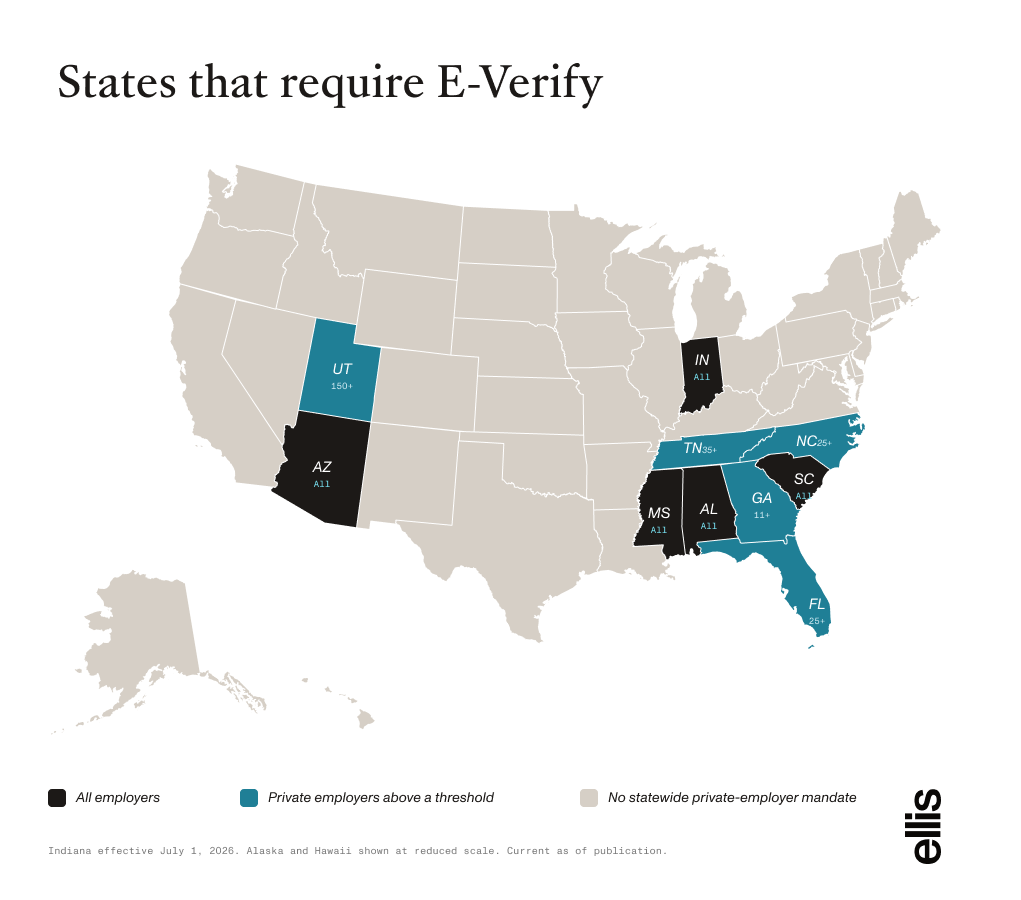
More than 20 states require E-Verify for public employers and state contractors. Ten of those states reach private employers as well, and that shorter list is the one most businesses need. Five cover every private employer. Five more apply only above a minimum employee count.
State | Who it covers | Threshold |
|---|---|---|
Alabama | All employers | None |
Arizona | All employers | None |
Indiana | All employers, effective July 1, 2026 | None |
Mississippi | All employers, phased in from 2008 and complete July 1, 2011 | None |
South Carolina | All employers | None |
Georgia | Private employers | More than 10 employees |
Florida | Private employers | 25 or more |
North Carolina | Private employers | 25 or more |
Tennessee | Private employers | 35 or more |
Utah | Private employers | 150 or more |
South Carolina stands out for being both broad and strict. Every employer in the state has had to verify new hires since January 1, 2012, within three business days of hiring. The Department of Labor, Licensing and Regulation enforces it, and penalties range from a year of probation with quarterly reports, to license suspension, to revocation for repeat violations.
Indiana is the newest addition. The FAIRNESS Act covers all Indiana employers as of July 1, 2026.
State requirements change from session to session. The figures above are current as of publication and worth confirming with the state agency.
How the E-Verify process works, step by step
The process starts with a completed Form I-9, because the case is built from what that form says. From there:
- The employer enters the employee's name, date of birth, Social Security number, the citizenship status the employee stated on the I-9, and the document information from Section 2.
- E-Verify compares that information against DHS and SSA databases.
- The system returns a result, almost always within seconds.
- If the employee showed a document with a photo, the employer confirms the photo E-Verify displays matches the document in hand.
- The employer closes the case once it reaches a final result.
The timing is where enrolled employers most often run into problems. The case is created no later than the third business day after the employee starts work for pay. Not three days after the offer, and not three days after the I-9 is signed. If an employee is waiting for a Social Security number to be issued, E-Verify allows the case to wait until the number arrives.
A case created after the deadline requires the employer to select a reason for the delay from a list.
E-Verify case results and what each one means
E-Verify returns six possible case results. Most cases end at Employment Authorized within seconds. Two results put the employer on a deadline.
Case result | What it means |
|---|---|
Employment Authorized | The information matched SSA or DHS records. The employee can work. |
Verification in Process | The case went to DHS for a closer look. No action needed yet. |
Tentative Nonconfirmation (Mismatch) | The information did not match. Tell the employee and give them a chance to act. |
Case in Continuance | The employee contacted DHS or visited SSA, and a final answer needs more time. |
Close Case and Resubmit | SSA or DHS wants a new case, often because a passport or driver's license number went in wrong. |
Final Nonconfirmation | E-Verify cannot confirm employment eligibility after the employee took action. |
When a case does not come back authorized
Most cases end at Employment Authorized. Two results do not, and both carry real exposure with DHS on the verification side and the Department of Justice on the anti-discrimination side.
The right handling depends on the facts of the specific case, so employers are best served at this point by talking to immigration counsel.
- A Tentative Nonconfirmation, which E-Verify now displays as a mismatch, means the information entered did not match the government records that were checked. According to USCIS, mismatches often trace back to ordinary data problems, such as a name changed after marriage and never updated with SSA.
- A Final Nonconfirmation means E-Verify could not confirm employment eligibility after the employee had an opportunity to act on the mismatch. It closes the E-Verify case. What it means for a particular employee depends on their immigration status and the circumstances.
Both come with notice requirements, referral procedures, and deadlines set by DHS, and both limit what an employer may do with the employee while the case is open.
E-Verify and existing employees
E-Verify is built for new hires. Under the program rules, employers generally do not run cases on people already on payroll, and verifying only part of the current workforce is one of the patterns that draws discrimination claims. Two exceptions exist:
- Federal contractors. They may verify employees assigned to a covered contract, and may choose to verify their entire workforce.
- The Status Change Report. E-Verify flags certain employees after the fact through this report.
The Status Change Report is newer. It lists E-Verify cases created with Employment Authorization Documents that DHS has since revoked or invalidated, including EADs tied to terminated parole and to expired Temporary Protected Status designations.
Employers and E-Verify Employer Agents pull the report from the Reports tab in their account. When a current employee appears on it, the reverification process runs through Supplement B of Form I-9, with unexpired documentation from List A or List C. How an employer handles an employee who cannot produce current work authorization is a question for counsel.
E-Verify does not monitor employees over time or flag an expiring work permit. Tracking expiration dates and reverification runs through Form I-9.
Federal contractors and the FAR E-Verify clause
Federal contractors are the largest group required to use E-Verify under federal rather than state law. The rule comes from the FAR E-Verify clause at FAR 52.222-54, which took effect on September 8, 2009.
It applies to larger prime contracts that run longer than 120 days, along with certain subcontracts for services and construction. The clause generally leaves out contracts for off-the-shelf commercial products and work performed entirely outside the United States.
The clause sets its own deadlines, and they are tighter than the ordinary rules:
Requirement | Deadline |
|---|---|
Enroll in E-Verify as a federal contractor | Within 30 calendar days of contract award |
Verify new hires | Within 3 business days after the date of hire |
Verify existing employees assigned to the contract | Within 90 calendar days of enrollment or 30 calendar days of the employee's assignment, whichever is later |
Optional: verify the entire workforce | Within 180 calendar days of electing the option |
An employee assigned to the contract is someone hired after November 6, 1986 who directly performs work in the United States under that contract. The rule does not reach people who only do support work, such as overhead or back-office functions, unless they perform real duties under the contract.
Whether a particular role falls inside or outside that definition is often a close call, and contractors who would rather not make it employee by employee sometimes elect the entire-workforce option instead.
How employers enroll and run an E-Verify account
Enrollment starts with a Memorandum of Understanding, the agreement between the employer, DHS, and SSA. It is not a formality. The MOU defines the employer's obligations, and enforcement agencies turn to it when something goes wrong.
Training comes next. Everyone who will handle cases completes the E-Verify tutorial and passes a knowledge test before getting access. Accounts are then organized by role:
- Program administrator. Manages users and cases for an account. This is the person most employers think of as the E-Verify contact.
- Corporate administrator. Manages multiple accounts across a company with several locations or subsidiaries, without creating cases directly.
- E-Verify Employer Agent. An outside party that creates and manages cases for the employer. Staffing firms, PEOs, and smaller businesses use this route often.
Enrolled employers also post notices where applicants and employees can see them, including the E-Verify participation poster and the Right to Work poster, in English and Spanish.
Staying compliant
Most E-Verify enforcement risk has nothing to do with the technology. It comes from treating people differently: verifying some new hires and not others, timing cases based on how someone looks or sounds, asking for extra or specific documents from employees who appear foreign born, and acting on a mismatch before it has been resolved.
The program rules are built to prevent that. They require consistent verification for every new hire at a participating site, regardless of citizenship status or national origin. They leave the choice of which acceptable documents to present with the employee. And they restrict what an employer may do while a case is unresolved.
The Immigrant and Employee Rights Section of the Department of Justice enforces the anti-discrimination provisions and has brought cases against employers whose E-Verify practices fell short.
It is also worth being precise about what participation buys an employer. The rebuttable presumption helps, but it is not a safe harbor and it does not reach Form I-9 paperwork violations.
How Ellis can help
E-Verify looks simple until a mismatch lands, a state mandate changes, or an audit notice arrives and the I-9 file has to hold up. Ellis attorneys handle I-9 and E-Verify compliance for employers, from enrollment and case review to federal contractor obligations and multi-state hiring, with every case and deadline tracked in one place. Schedule a free consult →
This article is for general informational purposes only. It is not legal advice.