

A federal judge in California has temporarily blocked the government from charging the $100,000 H-1B fee while a legal challenge moves forward.
The September 30 ruling from the U.S. District Court for the Northern District of California is the second federal court order to stop the fee. A Massachusetts federal court struck it down in June, the fee briefly came back, and the First Circuit refused to lift that ruling in July. The administration had extended the fee through 2027 days before this latest ruling. DHS has also proposed a separate $103,265 fee on cap-subject petitions, which these cases do not cover.
Key Takeaways
- Courts have blocked the $100,000 H-1B fee while the California case moves forward, so employers filing now do not pay it.
- This is the second federal court to stop the fee, after a Massachusetts court struck it down nationwide on June 8, 2026.
- The California ruling covers how the government set up the fee and does not settle whether the fee itself is legal.
- The government can still appeal, so employers should check which fees apply to each filing before they send it in.
Is the $100K H-1B fee still in place?
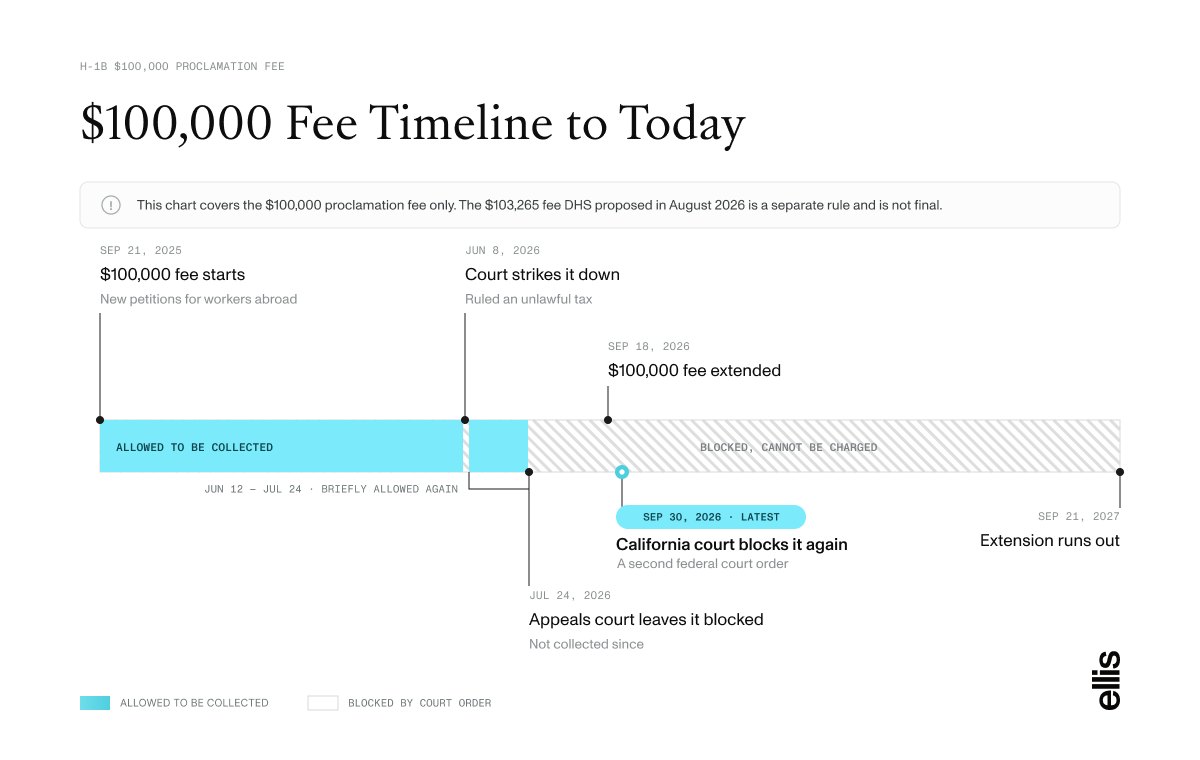
No. As of October 1, 2026, federal court orders block the $100,000 H-1B fee, and the government cannot collect it.
The California court issued a preliminary injunction, a temporary order that stops the government from charging the fee while the case plays out. A separate ruling out of Massachusetts keeps the fee off the table as well.
What did the California court rule on the $100K H-1B fee?
The case, Global Nurse Force v. Trump, argues that the government had no power to charge the fee and did not follow the right steps when it created the fee it first announced in September 2025.
The California court blocked the Department of Homeland Security (DHS) and other agencies from charging the fee while the case continues.
The court focused on whether the government followed the rulemaking steps the law requires. It did not decide whether the fee itself is legal. The ruling covers the current version of the fee, which the administration extended through 2027 earlier in September.
What is the status of the $100K H-1B fee lawsuit?
Two federal cases are still open.
A Massachusetts federal court struck down the fee on June 8, ruling that the charge worked like a tax, which the agency has no power to impose. A short pause let USCIS keep collecting while the government appealed, so the fee came back for several weeks. The First Circuit then turned down the government's request to pause that ruling on July 24, which put it back in force.
That appeal is still open. No appeals court has decided whether the fee is legal.
Who pays the $100K H-1B fee, and who is exempt?
The $100,000 fee applied to new H-1B petitions for workers outside the United States, and for workers here who could not change status. It never applied to every H-1B filing.
USCIS then narrowed it down more. Workers already in the United States in another status do not owe the fee if they can change status to H-1B. That covers F-1 students moving into H-1B work and L-1 and TN holders. USCIS also exempts extensions and amendments for current H-1B workers, plus H-1B transfers for workers who already count against the cap. An exempt worker can leave the country, apply for a visa and come back without owing the fee.
Cap-exempt employers, such as universities and nonprofit research groups, do not owe it either. Neither do students using cap-gap to cover the time before their H-1B starts.
Court orders block the fee, so no employer owes it today. Check the current USCIS H-1B guidance and your own case before you assume you owe anything extra.
What H-1B fees do employers pay in 2026?
The $100,000 fee is separate from the normal cost of sponsoring an H-1B worker. Employers still pay the Form I-129 petition fee, the ACWIA training fee, the fraud prevention and detection fee, and the asylum program fee. You also need a certified Labor Condition Application before you file the petition.
Premium processing is optional, and those fees went up in March 2026. Workers who apply for a visa at a consulate may also pay the visa integrity fee.
Some of these change with company size and petition type. See the full H-1B fee breakdown to confirm what applies to your filing, and check the amounts on the day you file. USCIS lists current requirements on its H-1B specialty occupations page.
Could the $100K H-1B fee come back?
Possibly. The California order is temporary, not the end of the case.
The government may appeal, and a later court decision or a new rule could change the fee's status. Employers getting ready for the FY 2027 H-1B cap should plan around the fees that apply on the day they file, not the fee a proclamation announced, and watch the registration dates as the season gets closer.
If you want a backup plan, look at alternatives to the H-1B, including how the O-1 compares for candidates who qualify.
Sponsoring an H-1B worker?
Ellis gives employers one place to run H-1B petitions, with immigration attorneys handling the filing and a clear view of the fees, deadlines and status on every case. Get in touch today.