

A conditional green card is lawful permanent resident status that lasts exactly two years instead of ten. The holder is a conditional permanent resident, with the same right to work, travel, and count time toward citizenship as any green card holder. The difference is that the status ends on its own unless the conditions are removed before the card expires.
This guide covers how to tell whether your card is conditional, what the CR and IR codes mean, what the status lets you do, and what has to happen before the two years run out.
Key Takeaways
- What is it? A green card valid for two years instead of ten years. Conditional residents can work, travel, and count the time toward citizenship like any permanent resident.
- Who has one? Spouses whose marriage was under two years old the day permanent residence was granted, children on that petition, and EB-5 investors.
- How can you tell? Two-year validity and a category code starting with CR. CR1, CR2, CR6, and CR7 are conditional. IR1, IR2, and IR6 are not.
- Important: A conditional green card cannot be renewed or extended. It ends on its own when the card expires, so file Form I-751 in the 90 days before that date.
- Need help? Ellis attorneys handle removal of conditions and track every deadline in one place. Start here →
What Is a Conditional Green Card?
A conditional green card is a two-year, probationary form of lawful permanent residence. The holder is a permanent resident in every legal sense. They simply hold that status on a clock, and they have to prove the basis for it was genuine before the status becomes permanent in the ordinary sense.
Two groups receive it. Most are spouses of US citizens or permanent residents whose marriage was less than two years old at the moment permanent residence was granted. The rest are EB-5 immigrant investors, whose conditions relate to their investment rather than a relationship.
What does "conditional permanent resident" mean?
A conditional permanent resident is a lawful permanent resident whose status carries a two-year expiration date. Often shortened to CPR or CR, it is the formal name for what most people call a conditional green card holder.
The "conditions" are not extra rules to follow day to day. There is no reporting requirement, no restriction on work or movement, and no check-in with the government during the two years. The conditions are a single requirement to satisfy at the end: showing that the marriage was entered in good faith, or that the investment did what it was supposed to do.
Conditional Green Card vs. 10-Year Green Card
Conditional green card | 10-year green card | |
|---|---|---|
Legal status | Lawful permanent resident | Lawful permanent resident |
Card validity | 2 years | 10 years |
Work in the US | Yes, without a separate permit | Yes, without a separate permit |
Travel in and out | Yes, same rules as any LPR | Yes |
Counts toward citizenship | Yes | Yes |
Renewable | No | Yes, with Form I-90 |
Extra filing required | Yes, Form I-751 or I-829 | No |
Status can lapse on its own | Yes, when the card expires | No |
CR and IR Category Codes
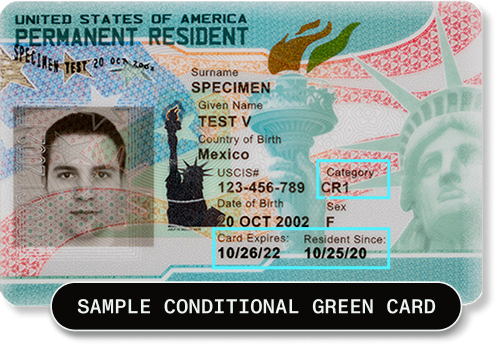
Two things on the card point out that it's conditional. The first is the validity period, which runs two years rather than ten. The second is the category code printed on the front, usually near the top right. Codes beginning with CR mean conditional residence.
Code | What it means | Conditional? |
|---|---|---|
CR1 | Spouse of a US citizen, entered on an immigrant visa | Yes |
CR6 | Spouse of a US citizen, adjusted status inside the US | Yes |
CR2 / CR7 | Child or stepchild included in the parent's case | Yes |
IR1 | Spouse of a US citizen, entered on an immigrant visa | No |
IR6 | Spouse of a US citizen, adjusted status inside the US | No |
IR2 | Child of a US citizen | No |
Why Do Conditional Green Cards Exist?
Conditional green cards exist to deter marriage fraud. Congress created the status in the Immigration Marriage Fraud Amendments of 1986 (IMFA).
Before 1986, a foreign national could marry a US citizen, receive permanent residence, and divorce soon after, and USCIS had no built-in way to check whether the marriage had been real. The two-year rule created a checkpoint. It gives the agency a second look at a point when a sham marriage has usually fallen apart and a genuine one has usually accumulated the ordinary evidence of a shared life: joint accounts, a shared lease, shared decisions.
Marriage on its own has never granted a green card. Eligibility is examined at several stages, from the initial I-130 petition through adjustment of status or consular processing. Conditional residence adds one more look at the end.
Who Gets a 2 Year Conditional Green Card?
Not everyone who immigrates through marriage receives conditional status. What decides it is how long the marriage has lasted at the moment permanent residence is granted.
- Spouses married less than two years. A marriage under two years old at approval produces conditional residence and a CR-category card. The clock runs from the wedding date to the date the green card is issued or status is adjusted, not to the date the petition was filed. A couple married on January 15, 2025, approved on October 1, 2026, has been married under two years, so the immigrating spouse becomes a conditional permanent resident.
- Children. Children and stepchildren included in a parent's marriage-based case usually derive conditional status under the same petition, with a CR2 or CR7 code, and they go through the same removal process.
- EB-5 investors. Immigrant investors and their dependents also receive two-year conditional cards. Their conditions concern the investment rather than a relationship, and they file Form I-829 rather than Form I-751. Removing conditions requires proof that the required capital stayed at risk and created at least 10 full-time jobs, at a threshold of $1,050,000, or $800,000 in a targeted employment area.
What Can You Do With a Conditional Green Card?
Nearly everything a 10-year green card holder can do. Conditional residents are lawful permanent residents, and the rights come with the status rather than with the card's expiration date.
- Work for any employer. No separate work permit is needed. The card itself is proof of both identity and employment authorization for Form I-9, and there is no restriction on employer, industry, or job changes.
- Travel in and out of the United States. Conditional residents reenter as returning residents on the same terms as any permanent resident. Trips of under six months are routine. Absences approaching or exceeding a year raise questions about whether residence was abandoned, and a permanent resident planning a long absence generally applies for a reentry permit before leaving. The removal-of-conditions deadline does not pause for time spent abroad.
- Live anywhere in the US, get a Social Security number, and get a state driver's license. The status supports all the ordinary documentation of settled life.
- Petition for certain family members. Permanent residents, including conditional ones, can generally file Form I-130 for a spouse or an unmarried child. Those cases sit in the family preference categories and wait for a visa to become available, which is slower than the immediate relative path available to citizens.
- Access eligible public benefits. Eligibility depends on the specific program and often on how long the person has held permanent residence, but the status itself is not a barrier the way a temporary visa is.
- Count the time toward citizenship. Time spent as a conditional permanent resident counts toward the residence requirement for naturalization.
Can a Conditional Green Card Be Renewed or Extended?
No. There is no renewal path for a two-year card, and there is no extension application either. Form I-90, which permanent residents use to renew an expiring card, does not apply to conditional residence.
This is the single most common misunderstanding about the status, and the wording is part of why. Searches for "2 year green card renewal" and "conditional green card renewal" are common, but renewal is not the mechanism. The card is not renewed. The conditions are removed, and approval produces a new 10-year card as a result.
One thing does function like an extension, though it is automatic rather than applied for. A properly filed Form I-751 or I-829 receipt notice extends conditional permanent resident status and work authorization for 48 months past the expiration date printed on the card. Presented with the expired card, that notice is evidence of status for employment and for reentry after travel. Nothing has to be requested for that to apply, but it only applies once the petition is actually filed.
Can Conditional Resident Status Be Taken Away?
Yes. USCIS can end conditional residence before the two years are up. There are three grounds:
- The marriage was fake, or it was annulled or ended, or someone paid a fee for the filing.
- The petition was filed late or not at all, or the person skipped the I-751 interview.
- USCIS reviews a filed petition and finds the information in it is not true.
USCIS has to prove it, and the standard is more likely than not. It sends a notice and usually starts removal proceedings, where the person can argue the case in front of an immigration judge.
If the card expires and nothing was filed, status ends and unlawful presence starts adding up from that day. Long enough, and that becomes a three-year or ten-year bar on returning to the US.
Can my spouse cancel my conditional green card?
No. A petitioning spouse cannot cancel or revoke a green card that has already been granted. Only USCIS has authority to terminate conditional resident status, and only on the grounds above.
What a petitioning spouse can do is make the process harder. They can decline to sign the joint Form I-751, which means the conditional resident files alone with a waiver request instead. They can withdraw the underlying I-130 petition, but only while it is still pending and not yet approved. They can report a marriage they believe was fraudulent, though USCIS weighs the evidence rather than the accusation, and an unsupported report can rebound on the person making it.
Declining to sign does not end anyone's status by itself. It changes the filing path from a joint petition to a waiver-based one, which carries a heavier evidence burden but remains available.
Does Divorce Cancel a Conditional Green Card?
Not automatically. A divorce during the conditional period does not by itself end conditional resident status. What it changes is how the conditions get removed: instead of a joint petition signed by both spouses, the conditional resident files alone and asks USCIS to waive the joint filing requirement.
USCIS recognizes several grounds for filing alone, including a marriage entered in good faith that later ended in divorce or annulment, the death of the qualifying spouse, battering or extreme cruelty by that spouse, and extreme hardship if the conditional resident were removed from the United States. A divorce that is not yet final complicates the timing, and waiver cases generally carry a heavier documentation burden than joint filings.
How Long Does It Take to Get a Permanent Green Card After a Conditional One?
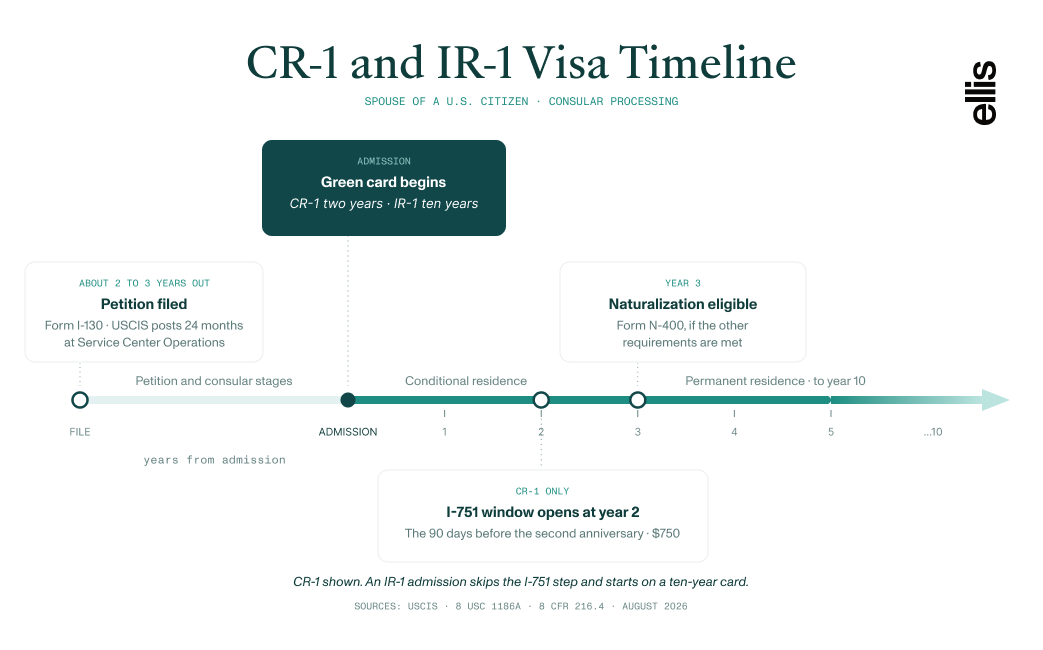
Roughly four to five years from the day the conditional card is issued, in current conditions. The math has two parts: the two-year conditional period itself, and then the processing time for the removal-of-conditions petition, which runs about 24 to 36 months for most 2026 joint filings.
The filing sits at the end of the first stretch, in the 90 days before the card expires, so a conditional resident who receives a card in March 2026 would file around early 2028 and could expect a decision somewhere between 2030 and 2031. Waiver cases generally run longer.
Nothing goes wrong during that wait as long as the petition was filed on time. The receipt notice keeps status and work authorization valid for 48 months, and approval converts the status to unconditional lawful permanent residence and produces a 10-year card.
What Happens When the Two Years Are Up?
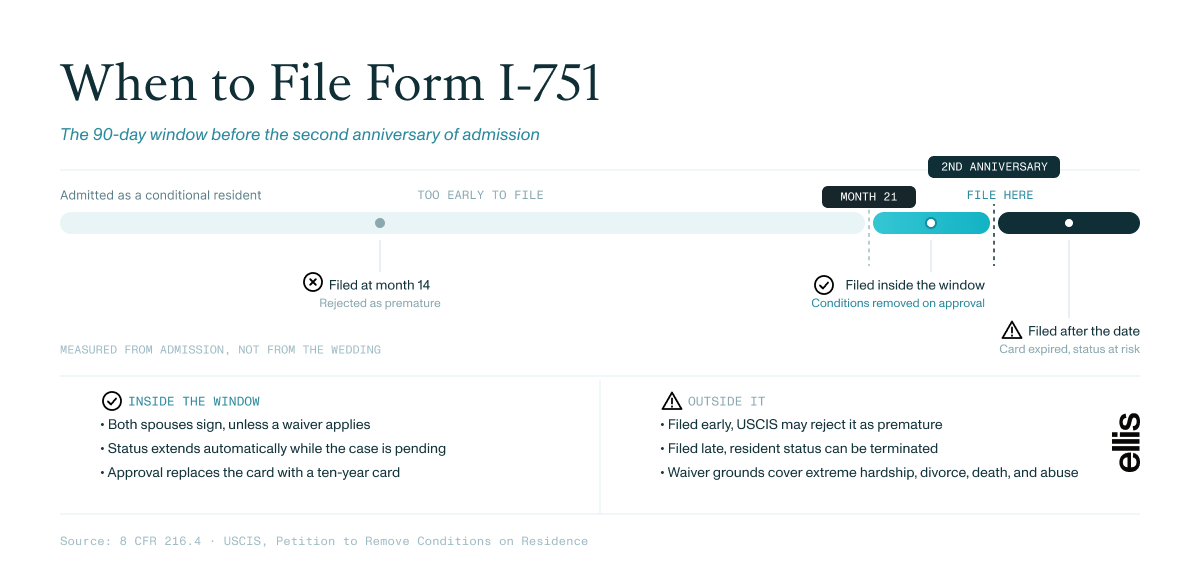
The conditions have to come off, and that is a separate filing with its own rules. The short version:
- Form I-751 removes conditions for marriage-based conditional residents. EB-5 investors file Form I-829.
- The filing window is the 90 days immediately before the card expires, according to USCIS. Earlier filings are generally rejected. Later ones are treated as late.
- Joint filing with the spouse is the default, with waivers available on the grounds described above.
- The fee is $750, biometrics included.
- Most 2026 joint filings take roughly 24 to 36 months, and waiver cases run longer.
- USCIS sends no reminder before the card expires.
The evidence standard is where these cases are won or lost, and quality matters more than volume. USCIS looks for proof of a real, ongoing marriage across the full two years, with joint financial records carrying the most weight. Our Form I-751 guide covers the filing mechanics, the evidence USCIS expects, requests for evidence, and interviews in detail.
Conditional Green Card to Citizenship
Time as a conditional permanent resident counts toward naturalization in full. The two-year conditional period is not a pause in the citizenship timeline, and holding a CR-category card rather than an IR-category one does not push the eligibility date back.
A spouse of a US citizen is generally eligible to file Form N-400 after two years and nine months of permanent residence, counting from the date conditional residence was granted. Because removal of conditions now takes longer than that in many cases, it is common for an N-400 to be filed while an I-751 is still pending. A pending I-751 does not by itself bar the naturalization filing, and USCIS may decide the two cases together. Whether filing early makes sense depends on the strength of the underlying case, which is a question for an attorney rather than a general rule.
How Ellis Can Help
Ellis attorneys handle the petition end to end: assessing the evidence and any RFEs, tracking the 90-day window, and providing guidance for any interview that follows. Schedule a free consult →
This article is for general informational purposes only and does not constitute legal advice.