

Key Takeaways
- Who files? Lawful permanent residents whose card is expiring, lost, stolen, damaged, or has errors.
- How much? $415 online or $465 by paper. Biometrics included.
- How long? Typically 6 to 13 months. Backlogs vary by service center.
- Important: If you have a 2-year conditional green card, you do NOT file I-90 to renew. You file Form I-751 (Petition to Remove Conditions) instead.
- Should I use an attorney? Not usually for routine renewals or replacements. Strongly recommended if you have a criminal record, were issued the card by mistake, or need to update biographic information. Free Ellis consult →
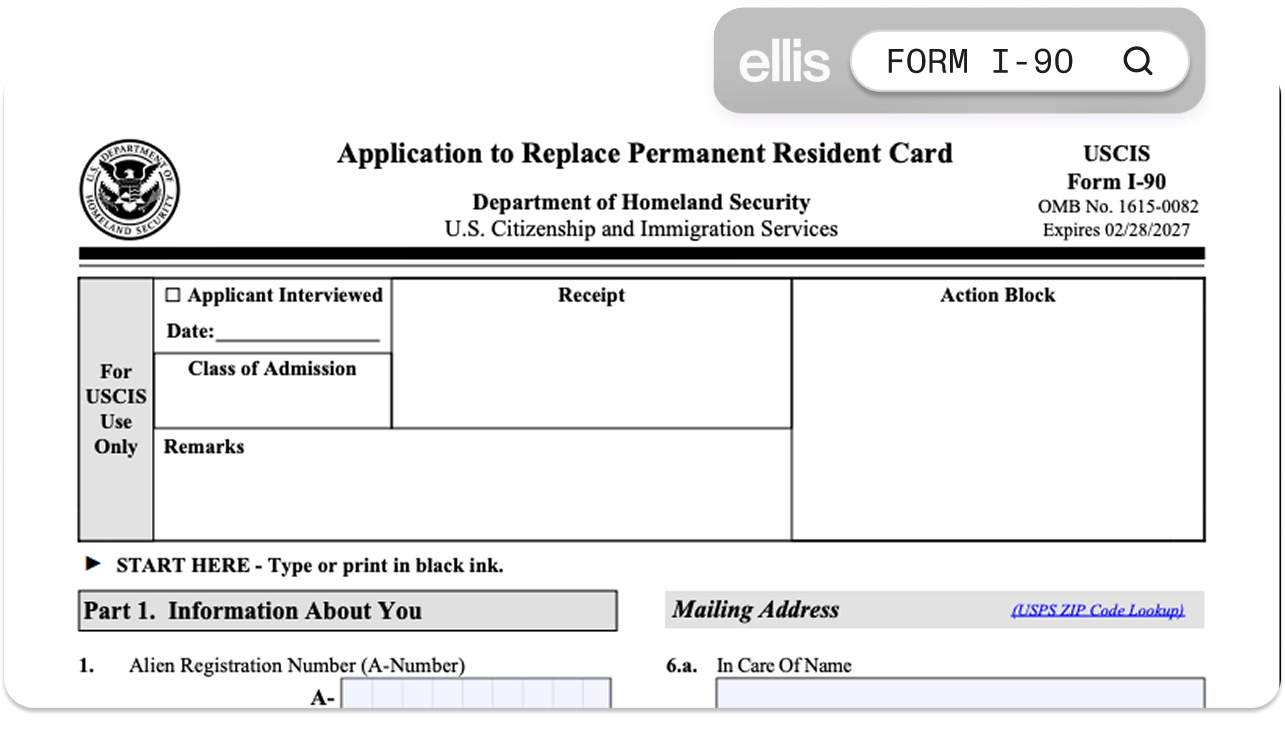
If your green card is about to expire, was lost or stolen, or has the wrong information on it, you'll file one form: Form I-90. Officially called the Application to Replace Permanent Resident Card, it's how lawful permanent residents (LPRs) get a new card without going back through the green card application process.
This guide covers what the I-90 is, who can file it, how much it costs, and what to do if you need proof of status while you wait.
What is Form I-90?
Form I-90 is the USCIS application legal permanent residents (LPRs) file to get a new green card (formally, the Permanent Resident Card). It does NOT renew your permanent resident status. Your status as an LPR doesn't expire. The physical card does.
The form is 7 pages and asks about you, your immigration history, and the reason for filing. You file it with USCIS, either online or by mail. If approved, USCIS mails you a new 10-year green card.
Filing the I-90 is one of the simpler USCIS applications. Many cases don't require an interview or attorney involvement.
Who Files Form I-90?
You file Form I-90 if you're a lawful permanent resident and any of these apply:
- Your 10-year green card has expired or expires within 6 months.
- Your card was lost, stolen, destroyed, or damaged.
- Your card has incorrect biographic information (name, date of birth) due to a USCIS error.
- Your name has legally changed since the card was issued.
- You were issued an old version of the card (pre-1989 Alien Registration Card or older).
- You never received the card USCIS mailed you.
- You're a commuter with a card who has taken up actual residence in the U.S.
You do NOT file I-90 if:
- You have a 2-year conditional green card about to expire. File Form I-751, or Form I-829 for EB-5 investors, to remove conditions.
- You want to apply for U.S. citizenship. File Form N-400 for naturalization. You don't need a current green card to apply.
- You haven't yet been approved for a green card. You'd need to complete that process first (Form I-485 for adjustment of status or consular processing).
What Does the I-90 Cost in 2026?
The 2026 filing fee structure for Form I-90:
Filing method | Fee | Notes |
|---|---|---|
Online | $415 | Faster receipt, biometrics included |
Paper | $465 | Mail to USCIS lockbox, biometrics included |
A fee waiver (Form I-912) is available for limited categories: LPRs over 75, those receiving means-tested benefits, or those experiencing financial hardship.
Note: USCIS rolled the previous $85 biometrics fee into the I-90 fee in April 2024. You no longer pay biometrics separately.
When to File Form I-90
Timing matters. The general rule:
- For renewals: file within 6 months of your card's expiration date. Filing too early can result in rejection.
- For lost or stolen cards: file as soon as possible. Don't wait.
- For name changes: file after the legal name change is finalized and you have a certified court order, marriage certificate, or divorce decree in hand.
If your card has already expired, you can still file I-90. You may have a harder time proving your LPR status to employers, airlines, and banks while you wait. The ADIT stamp (covered below) is the standard workaround.
The I-90 Process, Step by Step
- Confirm you need I-90. If you have a 2-year conditional card, you need Form I-751, not I-90.
- Gather your documents. Your current green card (if you have it), government-issued photo ID, and any supporting documents for a name change or biographic correction.
- File online or by paper. Online is faster and $50 cheaper.
- Pay the fee. $415 online or $465 paper.
- Receive your Form I-797C Receipt Notice within 2 to 4 weeks. This receipt extends your existing card's validity for 24 months as proof of status.
- Attend biometrics at an Application Support Center, usually 4 to 8 weeks after filing. USCIS captures fingerprints, photo, and signature.
- (If needed) Request an ADIT stamp at your local USCIS field office. This is a temporary I-551 stamp in your passport showing LPR status while you wait for the new card.
- Receive your new green card in the mail, typically 6 to 13 months after filing.
How long does the I-90 take?
I-90 processing times in 2026 typically run:
Filing reason | Typical processing time |
|---|---|
10-year card renewal | 6 to 13 months |
Lost, stolen, or damaged card | 6 to 13 months |
Biographic correction (name, DOB) | 8 to 15 months |
USCIS error correction | 4 to 10 months |
Wait times vary by service center. Check the USCIS processing times tool for current data on uscis.gov, or our USCIS processing times tracker for a plain-English summary.
Premium processing is NOT available for Form I-90. There's no way to pay extra for faster service.
Evidence of Status While You Wait
You're still a lawful permanent resident throughout the I-90 wait. The card is just paper proof. Your status doesn't depend on it. But practical things (work, travel, banking) require evidence. Three options:
- I-797C Receipt Notice + expired green card. Together, these extend your card's validity for 24 months and work for Form I-9 employment verification.
- ADIT stamp (Form I-551). A temporary stamp in your passport from a USCIS field office. The standard evidence of LPR status. Valid for up to 1 year, renewable.
- Online verification. USCIS may direct employers to verify your status via E-Verify if you don't have physical evidence.
To get an ADIT stamp, call USCIS to schedule an InfoPass appointment at your local field office. Bring your passport, the I-797C receipt, and any government ID. The stamp is added the same day.
I-90 vs. I-751 vs. N-400
These three forms get confused often. A quick comparison:
Form | Purpose | Who uses it |
|---|---|---|
Form I-90 | Renew or replace a 10-year green card | LPRs with a permanent (non-conditional) card |
Remove conditions on a 2-year green card | Conditional residents (usually via marriage) | |
Apply for U.S. citizenship | LPRs eligible for naturalization |
If your green card says CR1, CR2, or has a 2-year validity, you're a conditional resident. You file I-751, not I-90.
If your card is the standard 10-year version (IR1, IR2, F1, F2A, EB, etc.), you file I-90 to renew.
If you've been an LPR for 3+ years (spouses of U.S. citizens) or 5+ years and want to become a citizen, you file N-400. You don't need a valid green card to apply.
Common Reasons I-90s Get Rejected
Most I-90 rejections trace back to a handful of issues:
- Filing too early. USCIS rejects renewals filed more than 6 months before expiration.
- Filing the wrong form. Conditional residents who file I-90 instead of I-751 get rejected.
- Wrong fee. Sending the paper fee on an online filing, or vice versa.
- Missing supporting docs. Especially for name changes (need a certified court order, marriage certificate, or divorce decree).
- Wrong filing address. USCIS lockbox addresses change. Verify on uscis.gov before mailing.
Final Takeaway
Form I-90 is one of the easier USCIS applications. The form itself is short, the documentation is minimal, and most cases don't need an attorney.
A few clear rules:
- File within 6 months of expiration. Not earlier.
- File online when possible. $50 cheaper and faster.
- Get an ADIT stamp if you need proof of status. Especially for I-9, travel, or applying for benefits while waiting.
- Don't confuse I-90 with I-751. Conditional residents file I-751, not I-90.
Need help filing your I-90?
Ellis combines experienced immigration attorneys with a modern case management platform. Routine I-90 renewals usually don't need attorney involvement, but complicated cases (name changes, USCIS errors, criminal history) benefit from a legal review.
Schedule a free consult → and we'll walk you through your specific case strategy at no cost.
Disclaimer: This article is for informational purposes only and does not constitute legal advice. Immigration law changes frequently. For specific legal guidance regarding your case, please consult with a qualified immigration attorney.