


Your US visa number is the eight-digit number printed in red ink in the lower right-hand corner of your visa foil, the stamp a US embassy or consulate places in your passport. It is unique to your visa. It is not your passport number or your control number.
Key Takeaways
- Where is it? The lower right-hand corner of your visa foil, printed in red ink. It is usually an eight-digit number.
- What is it? A unique identifier for your specific visa, generated when your visa is issued. It links your physical visa to your digital immigration records.
- Not the same as: Your passport number, your control number, or your Alien Registration Number (A-number). Using the wrong one can delay your immigration applications.
- Important: Copy the number printed in RED ink. Do NOT use the black machine-readable text at the bottom of the visa. On some older visas the format varies slightly and may include a red letter.
What is a US visa number?
A visa number is a unique identifier for one specific visa. Every US visa has its own number, and no two are the same.
The number is generated when your visa is approved and issued. It links your physical visa document to your digital records in the US immigration system. That is why the number matters: it lets government agencies verify that your visa is real and tie it to your file.
Because it identifies one visa issuance, your visa number is useful any time you need to prove or reference your visa status.
Where is the visa number on a US visa?
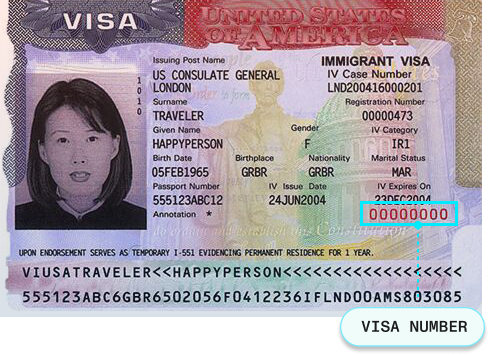
The visa number is in the lower right-hand corner of your visa. It is printed in red ink, which makes it easy to spot because the rest of the visa is printed in black.
Your visa is the stamp, also called the visa foil, that a consular officer places inside your passport when your visa is approved. The actual visa foil shows your photo, your visa category, the dates it is valid, and several numbers. The visa number is the red one in the bottom right.
It is usually an eight-digit number. On some older visas the placement or format can vary slightly, and a few include a red letter before the digits. If you see a red number in the lower right corner, that is the one.
Do not copy the long black number along the bottom of the visa. That is the machine-readable zone, not your visa number.
Visa number vs. passport, control, and alien numbers
Your documents carry several numbers, and they are easy to mix up. Here is how they differ.
Number | What it identifies | Where to find it |
|---|---|---|
Visa number | Your specific visa | Lower right of the visa foil, in red |
Passport number | Your passport | The photo page of your passport |
Control number | Your application, used by the Department of State | Top right of the visa, in black (about 11 digits) |
Alien Registration Number (A-number) | You, across your immigration history | On green cards, EADs, and many USCIS notices |
The visa number is not your passport number. Your passport number is on your passport data page, not on the visa. The visa number is also not the control number, which the Department of State uses internally to track your application. And the Alien Registration Number, or A-number, is different again. It follows you across your whole immigration history rather than identifying one visa.
Using the wrong identifier on a form can delay your case, so it is worth checking which number a form actually wants.
Why your visa number matters
Your visa number is often required when you are completing immigration forms or dealing with government agencies. Certain immigration forms ask for it directly.
Agencies like the Department of State, the Department of Homeland Security, and Customs and Border Protection use these numbers to pull up your visa information and confirm your current status. Immigration services rely on the number to connect your paper visa to your digital record.
Incorrect visa numbers can delay immigration applications. A single wrong digit can cause processing delays while someone sorts out the mismatch, so copy it carefully and double-check it against your visa.
Immigrant vs. nonimmigrant visas (and when you get your number)
US visas fall into two main categories: nonimmigrant and immigrant.
Nonimmigrant visas are for temporary stays. That includes tourism and business (B-1/B-2), study (F-1), and work (H-1B), among others. Immigrant visas are for people seeking permanent residence in the US, usually through family sponsorship or employment sponsorship.
When you get your visa number depends on your path. Nonimmigrant visa applicants usually receive their visa, with its number, shortly after a successful interview. Immigrant visa applicants may wait years for their visa number, because immigrant categories often have long queues before a visa becomes available.
Either way, the number is printed on the visa foil in red ink once the visa is issued.
How the US visa process works
The visa process starts with an application and usually ends with an interview at a US embassy or consulate. Here is the general path for a nonimmigrant visa.
You complete the DS-160, the online government form for nonimmigrant visa applicants. You pay the visa fee, then schedule and attend an interview at the embassy or consulate in your home country. (Immigrant visa applicants file the DS-260 instead.) Digital fingerprints are usually taken during the application process.
A consular officer decides your case and has discretion to approve or deny it. US law expects applicants to show strong ties to their home country and evidence of financial stability. Submitting inaccurate or inconsistent information can lead to a denial.
Some applications go through administrative processing, which is an extra round of security checks that adds time. Visa processing can take months, so start the application process early. You can review current requirements on the Department of State website at travel.state.gov before you begin.
Common mistakes with your visa number
The most common mistake is copying the wrong number. People often grab the black control number or the passport number instead of the red visa number. When in doubt, use the red number in the lower right corner.
Another mistake is using an old visa number after a new visa issuance. When you get a new visa, it has a new number. Once your old visa expires and a new visa is issued, use the number from the current visa, not the old one.
How Ellis can help
Copying a visa number is simple. Knowing which form needs which number, and getting the rest of an application right, is where things get complicated. Ellis pairs you with an immigration attorney and tracks your case from start to finish, so the right details land in the right fields. Whether you are on a temporary visa or working toward citizenship, having an attorney review your filing can save you from costly delays.
This article is for informational purposes only and is not legal advice.