Key Takeaways
- Who needs it: Anyone filing Form I-485 to adjust status to lawful permanent resident on the green card process. Refugees and asylees may use designated health departments instead of civil surgeons.
- Cost: $0 USCIS fee. Civil surgeon charges typically run $100 to $500, plus the cost of any missing vaccines or follow-up tests.
- Timing: I-693 is valid for 2 years from the date the civil surgeon signs it. You can file it with your I-485, in response to an RFE, or bring it to your interview.
- Attorney involvement: Most applicants don't need a lawyer for the exam itself. Legal help matters when there's a finding that could affect admissibility (communicable disease, mental health history, substance use, missing vaccines with no waiver path).
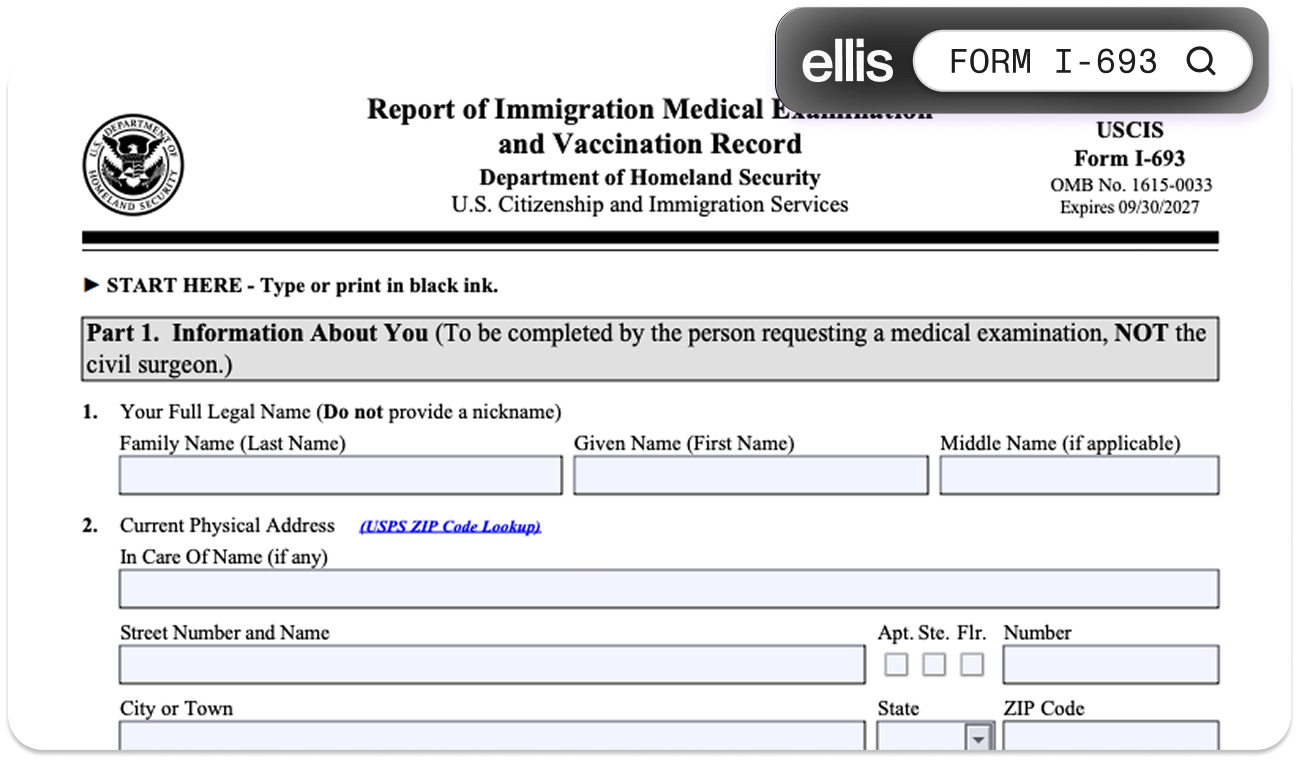
If you're applying for a green card through adjustment of status, you'll need Form I-693, the Report of Immigration Medical Examination and Vaccination Record. It's the form a USCIS-designated civil surgeon fills out after examining you, and it confirms you don't have a health condition that would make you inadmissible to the United States.
USCIS doesn't charge a filing fee for I-693, but the civil surgeon does. Costs usually fall between $100 and $500 depending on your location and which vaccines you still need. The form has its own quirks: it has to be signed by a designated civil surgeon, it's valid for 2 years from the date of signature, and it can be filed in several different ways alongside your Form I-485.
This guide walks through what's on the exam, what it costs, how long the results stay valid, and how to avoid the common timing mistakes that cause Requests for Evidence (RFEs).
What is Form I-693?
Form I-693 is the medical report USCIS uses to decide whether an adjustment-of-status applicant meets the health-related grounds of admissibility under section 212(a) of the Immigration and Nationality Act. It documents your medical history, results from a physical exam, required tests, vaccination records, and the civil surgeon's overall assessment.
Only USCIS-designated civil surgeons can complete and sign the form. Your regular doctor cannot, even if they're a U.S.-licensed physician.
The form is sealed in an envelope by the civil surgeon. Don't open it. USCIS only accepts I-693 results that arrive in the sealed envelope (or are filed directly by your attorney with the seal intact).
How do you find a USCIS-designated civil surgeon?
The fastest way is the official USCIS civil surgeon locator. You can search by ZIP code or city, and the tool only shows providers who are currently designated. Plug in your area, then call a few offices to compare pricing and availability.
When you call, ask: what does the visit cost, what does it cost with the vaccines you need, how soon they can see you, and whether they hand you the sealed envelope the same day. Prices and wait times vary a lot between private practices, urgent care chains, and county health departments.
Refugees and asylees can also use USCIS-designated health departments. Some military service members and their dependents can have the exam done by military physicians at no charge. Avoid any doctor who isn't on the USCIS list — even if they advertise immigration exams, USCIS will reject the form.
What does the immigration medical exam cover?
The immigration medical exam has four main parts, and each one matches a category of inadmissibility USCIS is screening for.
Section | What's involved | Why it's required |
|---|---|---|
Medical history & physical exam | Review of past illnesses, surgeries, and current symptoms. Basic physical exam: height, weight, blood pressure, eyes, ears, heart, lungs, skin. | Identifies any current condition with public-health significance. |
Communicable disease tests | TB screening (now done with an IGRA blood test, not the skin test). Syphilis blood test for applicants 18+. Gonorrhea test for applicants 18+. | Class A communicable diseases are an inadmissibility ground. |
Mental & physical disorders, substance use | Questions about history of drug or alcohol abuse, harmful behavior, and certain mental health diagnoses. | A condition with associated harmful behavior is an inadmissibility ground. |
Vaccinations | Review of vaccine records. Missing required shots are administered at the visit or scheduled. | Lack of required vaccinations is an inadmissibility ground. |
The required vaccine list is set by the CDC and updated periodically. As of 2026, the core required vaccines include MMR (measles, mumps, rubella), Tdap (tetanus, diphtheria, pertussis), varicella, polio, hepatitis A, hepatitis B, influenza (seasonal), pneumococcal, rotavirus, Hib, meningococcal, and others depending on your age. COVID-19 vaccination is no longer required as of 2025.
If you're missing a vaccine, the civil surgeon will offer to administer it on the spot or schedule a return visit. Vaccines you've had outside the United States count if you can show documentation. A waiver is available in limited cases (religious or moral objection, medical contraindication, vaccine not age-appropriate).
How much does Form I-693 cost?
USCIS does not charge a filing fee for Form I-693. The cost comes from the civil surgeon's office.
Item | Typical cost |
|---|---|
Civil surgeon office visit | $100 to $300 |
Vaccines (per shot, if needed) | $20 to $150 |
TB blood test (IGRA) | $50 to $150 |
Syphilis test | $20 to $50 |
Total range | $100 to $500+ |
Prices vary widely by location and provider. County health departments and community clinics tend to be cheaper than private practices. If you're missing multiple vaccines, costs can climb. Call ahead and ask for a flat-rate quote that includes everything.
Insurance usually doesn't cover the immigration medical exam, since it's not considered medically necessary. Some plans will cover the vaccines if you ask for them at a regular preventive visit before the exam.
How long is Form I-693 valid?
In 2024, USCIS changed the validity rule for Form I-693. The form is now valid for 2 years from the date the civil surgeon signs it. The old rule, which tied validity to when the form was filed with USCIS, no longer applies.
What this means in practice:
- You can complete the exam early in your adjustment process and the same I-693 stays valid for 2 years.
- If your I-485 is still pending when the 2-year window closes, USCIS will issue an RFE asking for a new I-693.
- The civil surgeon's signature date is what counts, not the date you submit the form.
A common mistake is doing the exam too early, then having the form expire while waiting for an interview. If your adjustment case is on a slow track, it can make sense to wait until you're closer to interview before scheduling. You can check current USCIS processing times to estimate where your case stands.
When and how should you file Form I-693?
You have three main filing options.
Option 1: File with your initial I-485 packet. This is the cleanest path. You include the sealed I-693 with the rest of your adjustment package, and USCIS has it from day one. Good if your interview is likely within 2 years.
Option 2: Respond to a Request for Evidence. USCIS will issue an RFE asking for I-693 if it's missing or expired. You usually have 87 days to respond. This is common for cases that move slowly.
Option 3: Bring it to the interview. Some applicants bring an unopened, recently-signed I-693 to the in-person interview. The officer can accept it on the spot. This works well if your interview is scheduled and you want a fresh form.
Your attorney can also submit the form directly to USCIS on your behalf, with the civil surgeon's seal intact. Some civil surgeons will mail a sealed copy straight to your lawyer rather than handing it to you.
How does I-693 work for refugees, asylees, and special cases?
Refugees and asylees follow a slightly different process. They can use designated civil surgeons or designated health departments, and many refugees complete part of the medical screening overseas through panel physicians. If you had an overseas medical exam less than 12 months before arrival, parts of the I-693 may carry over (vaccinations especially).
Applicants under 14 don't need TB testing unless there's a specific reason. Pregnant applicants can defer certain X-rays and tests. The civil surgeon will adjust the exam based on age, pregnancy status, and medical history.
What are the most common reasons for an I-693 RFE?
Most I-693 problems are timing or paperwork issues, not medical findings. The frequent RFE triggers:
RFE reason | Fix |
|---|---|
Form expired (over 2 years since signature) | Get a new I-693 from a civil surgeon. |
Envelope was opened | Civil surgeon must seal a fresh copy. |
Form was completed by a non-designated doctor | Redo with a designated civil surgeon. |
Missing vaccines without a waiver | Get the missing vaccines or file the appropriate waiver. |
TB blood test missing | Schedule the IGRA test and update the form. |
Civil surgeon signature missing or wrong page | Return to the civil surgeon to fix. |
If you get an RFE, read it carefully. USCIS will list exactly what's missing. Don't redo the whole exam unless they ask for a new form outright.
How is Form I-693 different from a panel physician exam?
If you're going through consular processing instead of adjustment of status, you won't use Form I-693. You'll have a different exam done by a panel physician at the U.S. embassy or consulate where you're applying. The exam covers the same things (communicable disease screening, vaccines, mental health, substance use), but the form and process are different.
Form I-693 | Panel physician exam | |
|---|---|---|
Used for | ||
Where it's done | USCIS civil surgeon in the U.S. | Panel physician abroad |
Who pays | Applicant pays civil surgeon directly | Applicant pays panel physician directly |
Filed with | I-485 packet, RFE, or at interview | DS-260 / consular interview |
Validity | 2 years from signature | 6 months (in most cases) |
Final Tips
A few things make the visit go faster:
- Bring your full vaccination records. Anything from childhood, anything from outside the U.S., anything you've had recently. Translated records are accepted. See our guide on gathering supporting documents if you're piecing records together.
- Bring a photo ID and your appointment confirmation.
- Eat normally beforehand. No fasting required for the standard exam.
- Bring a list of current medications.
- If you've had TB, syphilis, or hepatitis treatment in the past, bring documentation. This helps the civil surgeon explain any positive test results.
- Allow 1 to 2 hours. Some civil surgeons can return your sealed I-693 the same day. Others need a few days to finalize.
If you have a history of harmful behavior linked to a mental health condition or substance use, talk to an immigration attorney before the exam. A finding in this area can affect admissibility, and there are ways to address it that work better with legal guidance.
Need help with your I-485 medical exam?
Ellis pairs you with an immigration attorney who handles the timing, documentation, and any tricky findings on your I-693. Book a consultation to talk through your case.
The information in this article is for general guidance only and is not legal advice. Immigration rules change often, and your situation may have details that affect what applies to you. For advice specific to your case, consult a licensed immigration attorney.