

A digital nomad visa is a temporary residence permit that lets you live in a country while working remotely for employers or clients outside it. More than 50 countries offer one in 2026. Most require proof of steady remote income, typically between $2,500 and $5,000 per month, plus health insurance and a clean background check.
Remote work has made it possible to live in one country while earning income from another, and governments have responded with dedicated visa programs. The programs vary widely. Spain requires €2,849 a month and offers a path toward long-term residency. Japan requires ¥10 million a year and limits the stay to six months with no extension. Here is how digital nomad visas work, how the major programs compare, and what the options are when a country, like the UK or the US, does not offer one at all.
Key Takeaways
- What it is: A digital nomad visa lets you live abroad legally while working remotely for a foreign employer or your own clients. It does NOT let you take a job in the local labor market.
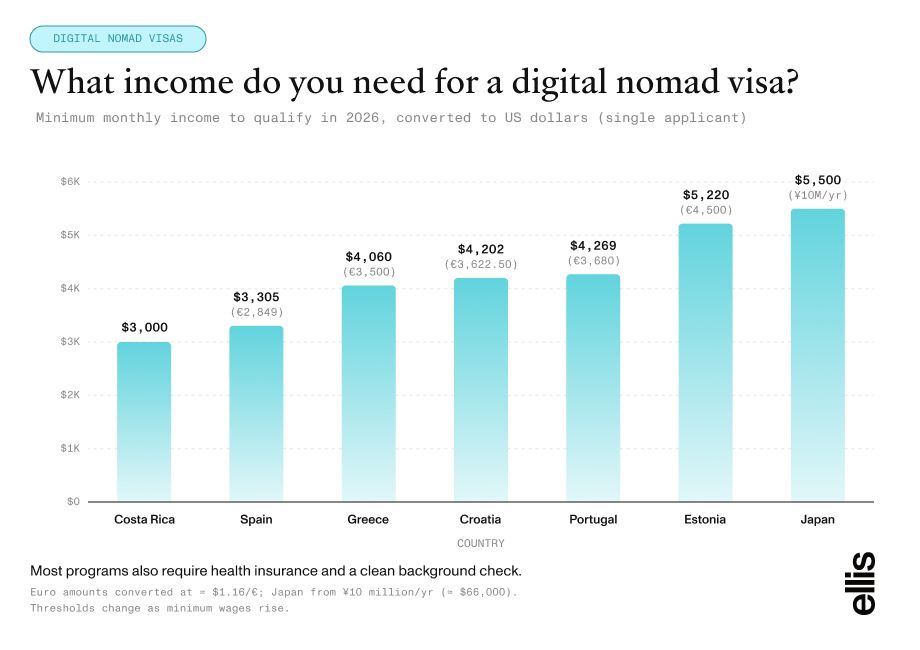
- How much income? Most programs set a minimum monthly income: Spain requires €2,849, Portugal €3,680, Croatia €3,622.50, and Japan ¥10 million per year (all 2026 figures).
- How long can you stay? Typically 6 months to 2 years. Croatia caps stays at 18 months with no renewal, while Thailand's DTV is valid for 5 years and Spain and Portugal can lead to permanent residency.
- Important: Income thresholds change every year as minimum wages rise. Portugal's requirement rose from about €3,040 to €3,680 in January 2026, and applications below the current threshold are NOT approved.
- Need help? Ellis is an immigration law firm with a platform that tracks your case start to finish. Start here →
What is a digital nomad visa, and who qualifies for one?
A digital nomad is someone who works remotely while living outside their home country, whether as a remote employee, a freelancer, or a business owner. A digital nomad visa is the legal framework for that arrangement: a temporary visa or residence permit designed for people whose income comes from outside the country they live in.
The distinction matters because a tourist visa does not permit any form of work, and a traditional work visa ties you to a local employer. Digital nomad visas sit in between. They let you live in the country and work remotely, but they do not let you take local employment.
Visa type | Can you work? | Who it is for |
|---|---|---|
Tourist visa | No work of any kind | Short visits, no income activity |
Work visa | Yes, for a local employer | People hired by a company in that country |
Digital nomad visa | Yes, remotely for foreign employers or clients | Remote workers paid from outside the country |
Who typically qualifies:
- Remote employees of companies based outside the host country
- Freelancers and contractors whose clients are outside the host country
- Business owners whose company is registered abroad
- In some programs, people with sufficient passive or investment income
Common disqualifiers are income below the threshold, income that comes from clients or employers inside the host country, a recent criminal record, and missing health insurance. Italy also requires a university degree or equivalent qualification and at least six months of remote work experience, and other countries are adding similar tests.
How do digital nomad visas work?
Most digital nomad visas run 6 to 24 months. What happens after that depends on the country, and it is the single biggest difference between programs.
Some visas are strictly temporary. Japan's runs six months with no extension. Croatia allows up to 18 months, then requires you to leave and wait six months before reapplying, with no path to permanent residency.
Other programs serve as a first step toward long-term residency. Spain's permit can be renewed toward the five-year threshold for long-term residence. Portugal's D8 route leads to a renewable residence permit and, after five years, eligibility for permanent residency or citizenship.
Two mechanics separate the programs:
- Visa vs residence permit. In many countries you first get an entry visa from a consulate, then convert it into a residence permit after you arrive. The permit is usually what gets renewed.
- Presence expectations. Some programs, like Spain's, expect the primary applicant to spend a minimum number of days per year in the country, while others, like Thailand's, are built around coming and going.
What are the requirements for a digital nomad visa?
Requirements vary by country, but almost every application asks for the same core proof. Typical requirements include:
- Proof of remote income above the country's threshold, usually 3 to 6 months of bank statements, pay stubs, or client contracts
- An employment letter confirming you can work remotely, or business registration documents if self-employed
- Health insurance covering your full stay, with minimum coverage set by the program (Japan requires ¥10 million in medical coverage; Costa Rica requires $50,000; Italy requires €30,000)
- A clean criminal background check, often from every country you have lived in recently
- A passport valid well beyond your intended stay
- In some countries, proof of accommodation (Italy asks for a lease or property deed)
Income requirements cluster into three tiers. Lower-threshold programs sit near $1,500 to $2,500 a month. Mid-tier programs like Spain and Greece sit near $3,000 to $4,000. Higher-threshold programs like Estonia (€4,500 net per month) and Japan (¥10 million per year, roughly $66,000) are designed for higher earners.
Which countries offer digital nomad visas in 2026?
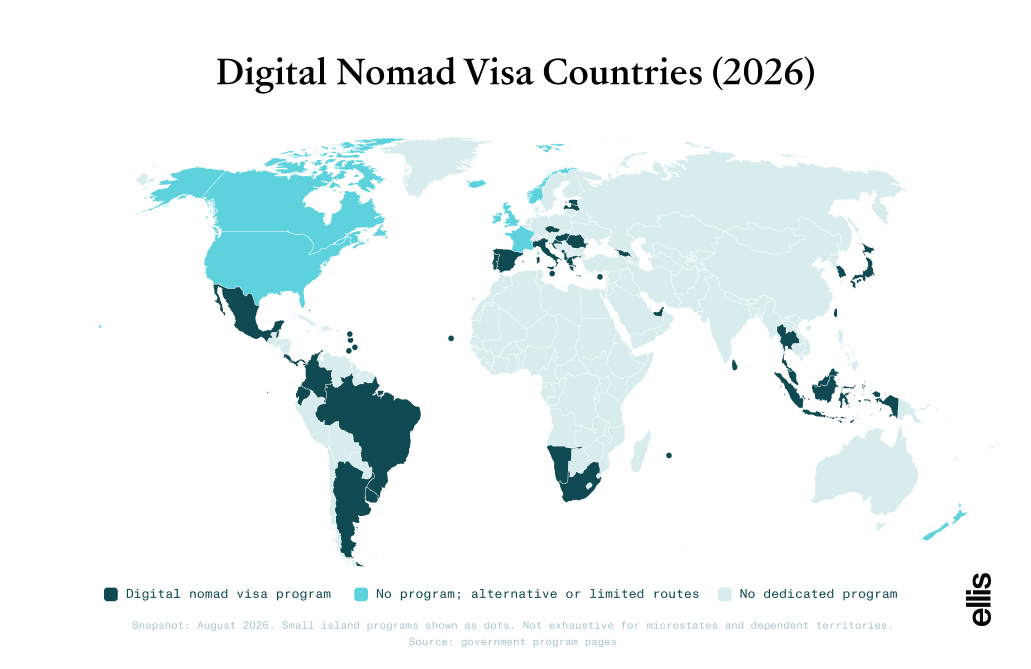
More than 50 countries now offer a digital nomad visa or an equivalent remote work permit. The table below compares the most popular programs using 2026 figures. Thresholds change often, and each program's official government page remains the authority on current numbers.
Country | Monthly income requirement | Max stay | Path to long-term residency? | Notes |
|---|---|---|---|---|
Spain | €2,849 | 3 years, renewable | Yes | Add €916/month for a spouse, €305 per additional dependent |
Portugal (D8) | €3,680 | 2-year permit, renewable | Yes, citizenship possible after 5 years | Threshold is 4x minimum wage and rises with it |
Italy | ~€28,000-30,000/year | 1 year, renewable | Yes, with renewals | Requires degree + 6 months remote experience; €116 fee |
Greece | €3,500 | 1 year + 2-year renewable permit | Yes, with renewals | Fast approvals reported |
Croatia | €3,622.50 | 18 months, no renewal | No | Must leave 6 months before reapplying |
Estonia | €4,500 (net) | 1 year | No | Highest threshold in Europe |
Japan | ¥10 million/year | 6 months, no extension | No | Insurance with ¥10M medical coverage required; family can join |
Thailand (DTV) | THB 500,000 in savings | 180 days per stay, 5-year visa | No | Multiple entry; each stay extendable once |
Costa Rica | $3,000 ($5,000 with family) | 1 year + 1-year renewal | No | $50,000 medical coverage and $100 deposit required |
Europe
- Spain
- Portugal
- Italy
- Greece
- Croatia
- Estonia
- Malta
- Hungary
- Latvia
- Czechia
- Albania
- Montenegro
A digital nomad visa in a Schengen country also simplifies travel across the rest of the Schengen area while your permit is valid. Norway and Iceland have narrow or limited routes rather than true nomad visas.
Americas
- Costa Rica
- Mexico
- Colombia
- Brazil
- Argentina
- Panama
- Uruguay
- Barbados
- Antigua and Barbuda
- The Bahamas
Latin American programs tend to have lower income requirements and simpler documentation than their European counterparts.
Asia and the Middle East
- Japan
- Thailand
- Malaysia
- Indonesia (Bali)
- South Korea
- Taiwan
- UAE (Dubai's remote work visa)
Programs in Asia range from high-income, short-duration routes like Japan's to longer, more flexible options like Thailand's DTV.
Africa and Oceania
- South Africa
- Mauritius
- Cabo Verde
- Namibia
New Zealand updated its visitor rules in 2025 to allow remote work for foreign employers during visits. Australia has no dedicated program.
What is the easiest digital nomad visa for US citizens?
The less complicated digital nomad visas for US citizens tend to combine a low income requirement, simple documentation, and fast processing. Based on 2026 requirements, the standouts are:
- Costa Rica for simplicity: $3,000 a month, a renewable one-year stay, and an application that can be completed after arriving as a tourist.
- Colombia and Argentina for low thresholds: both sit near the bottom of the income range among popular destinations.
- Croatia for straightforward paperwork in Europe, though the 18-month cap is firm.
- Greece for speed: approvals have been reported in as little as 10 days through some consulates.
The lowest threshold is not always the best fit. A low bar often comes with a short, non-renewable stay. For anyone whose goal is eventual permanent residency in Europe, for example, Spain and Portugal would justify their higher requirements.
How do the leading digital nomad visa programs compare?
Spain digital nomad visa
Spain requires €2,849 per month in 2026, which is 200% of the national minimum wage (SMI) and rises when the SMI does. Add €916 per month for a first dependent and €305 for each additional one. Income must come from outside Spain, documented with around three months of bank statements or salary slips, translated and apostilled where required. Applying in Spain yields a three-year residence permit; applying at a consulate yields a one-year visa you convert after arrival. Spain expects the primary applicant to spend at least 183 days per year in the country. The official program name is the telework visa.
Portugal digital nomad visa (D8)
Portugal's D8 visa requires €3,680 per month in 2026, four times the national minimum wage of €920. The threshold is indexed to the minimum wage and rose from about €3,040 in January 2026. The D8 leads to a two-year renewable residence permit, and five years of legal residence establishes eligibility for permanent residency or citizenship, which is why Portugal remains a leading option for long-term relocations despite the rising threshold.
Japan digital nomad visa
Japan requires proof of at least ¥10 million in annual income, roughly $66,000. The visa lasts six months, cannot be extended, and requires insurance with at least ¥10 million in medical coverage. Spouses and children can accompany the primary applicant. It is a designated activities visa rather than a residence permit, so holders do not receive a residence card. It functions as a premium extended stay rather than a relocation.
Italy digital nomad visa
Italy requires roughly €28,000 to €30,000 in annual income, a university degree or equivalent professional qualification, at least six months of remote work experience, proof of accommodation, health insurance with €30,000 coverage, and a clean record over the past five years. The visa costs about €116, lasts 12 months, and renews if you still qualify. Processing typically takes one to three months.
Greece digital nomad visa
Greece requires €3,500 per month. The initial visa runs 12 months and converts to a two-year renewable residence permit. Approvals are among the fastest reported in Europe, with some consulates deciding in under two weeks.
Croatia digital nomad permit
Croatia requires €3,622.50 per month in 2026, calculated as 2.5 times the average national salary and adjusted annually. The permit allows up to 18 months, cannot be renewed, and requires a six-month gap before reapplying. The documentation requirements are among the most straightforward in Europe, which keeps Croatia attractive despite the fixed time limit.
Estonia digital nomad visa
Estonia requires €4,500 in net monthly income, the highest threshold among major European programs, for a stay of up to one year. Estonia pairs the visa with its e-Residency program for running an EU-registered company, but the two are separate: e-Residency alone does not grant any right to live in Estonia.
Thailand DTV (Destination Thailand Visa)
Thailand's DTV is a five-year, multiple-entry visa allowing stays of up to 180 days at a time, each extendable once. Instead of a monthly income test, it requires proof of at least THB 500,000 (about $15,000) in savings. The structure suits people who split the year across several countries rather than settling in one.
Costa Rica digital nomad visa
Costa Rica requires $3,000 per month for a single applicant or $5,000 for a family. The visa extends a standard 90-day stay to a full year, renewable for a second year. The program requires medical coverage of at least $50,000 for the full stay plus a one-time $100 government deposit.
Which countries do not have a digital nomad visa?
Some of the most popular destinations do not offer a digital nomad visa at all. The current status of each, with the closest legal alternative:
Does the UK have a digital nomad visa?
No. The UK has no digital nomad visa. UK visitor rules permit some remote work incidental to a visit, but remote work cannot be the main purpose of a stay, and visitor status does not support living in the UK long term. The closest routes are the Global Talent visa for leaders and promising talent in technology, science, and the arts, the Youth Mobility Scheme for eligible nationals aged 18 to 35, and the Skilled Worker visa for those sponsored by a UK employer. Each is a full immigration route with its own requirements rather than a remote work permit.
Does the US have a digital nomad visa?
No. The United States has no digital nomad visa. Visiting on a B-1/B-2 or ESTA allows only limited business activities, not ongoing remote work from within the United States. Foreign professionals who want to live and work in the US instead use routes like the O-1 visa for individuals with extraordinary ability, the H-1B visa through employer sponsorship, or founder-focused options such as the International Entrepreneur Rule. Ellis works with each of these routes.
Does Canada have a digital nomad visa?
Not a dedicated one. Canada allows visitors to work remotely for a foreign employer for up to six months under visitor rules, which functions as an informal nomad allowance. For longer stays, options include International Experience Canada for eligible young nationals and standard work permits.
Does France have a digital nomad visa?
No. France has no dedicated digital nomad visa. The long-stay visitor visa requires applicants to undertake not to engage in professional activity in France, and whether remote work for a foreign employer falls within that restriction remains unsettled, so it is not a reliable remote work route. The Talent Passport covers qualifying professionals, founders, and investors.
Does Ireland have a digital nomad visa?
No. Ireland has no digital nomad visa, and short-stay rules do not permit remote work as a basis for living there. The main routes are the Critical Skills Employment Permit for in-demand occupations and Stamp 0 for people of independent means.
How do you choose a country and apply for a digital nomad visa?
The country decision matters more than the city decision. The practical filters, in order:
- Income threshold vs actual income. Programs look for documented income that sits consistently above the requirement, not income that occasionally reaches it.
- Length of stay and what comes after. A capped permit like Croatia's suits a sabbatical. Spain and Portugal suit a long-term move.
- Renewals and family rules. Most programs allow spouses and children, at a higher income threshold.
- Healthcare and insurance costs. Every program requires coverage; premiums vary widely by age and country.
The application itself usually runs 8 to 12 weeks end to end:
- Document gathering: bank statements, employment or client contracts, background check, insurance, and accommodation proof where required. The background check is often the slowest item.
- Translations and apostilles for anything not in the host country's language.
- Submission at the consulate or, where allowed (Spain, Costa Rica), from inside the country.
- Fees. Most run under a few hundred dollars: Italy charges about €116, Croatia about €60, and Costa Rica collects a $100 deposit.
- Conversion to a residence permit after arrival, where the program requires it, along with registration with local authorities.
When an employer is involved, early conversations help. Remote work from abroad can create payroll and employment law questions for the company, which is why many employers now run these requests through a global mobility review before approving a move.
This article is for informational purposes only and is not legal advice. At this time, Ellis only offers US inbound immigration services.