

The B-1/B-2 visa is a U.S. visitor visa for short trips. The B-1 part covers business purposes, and the B-2 part covers tourism and medical treatment. It does not allow you to work in the U.S. Most applicants get a combined B-1/B-2 visa, pay a $185 application fee, and can stay up to 6 months per entry.
If you are planning business trips, personal travel, or a visit to America for medical care, this is likely the visa category you need. This guide covers who qualifies, what it costs, how to apply, and the rules that apply once you arrive.
Key Takeaways
- The B-1/B-2 visa is a combined U.S. visitor visa that covers business purposes (B-1) and tourism or medical treatment (B-2), and most applicants receive a combined B-1/B-2 visa.
- Neither the B-1 nor B-2 visa allows holders to accept employment in the United States, so working for a U.S. company or getting a U.S. paycheck is strictly prohibited.
- B-1 and B-2 visas are valid for 10 years for many nationalities, and each entry on a B-1/B-2 visa allows a stay of up to 6 months, as set by the CBP officer at the port of entry.
- To apply, you complete the DS-160 form, pay the $185 application fee, attend a visa interview at a U.S. embassy or consulate, and show strong ties to your home country and enough money for the trip.
What is a B-1/B-2 visa?
The B-1/B-2 visa is the standard U.S. visa for short-term visitors. It combines two visa types into one: B-1 for business purposes and B-2 for tourism and medical treatment. It is also the most common U.S. visa. In FY 2024, the State Department issued about 6,498,006 combined B-1/B-2 visas worldwide, far more than B-1-only or B-2-only visas.
This visa is only for short, temporary visits. You must have a home abroad that you plan to keep, and you must plan to return home after your trip. The visa does not lead to permanent residency (a green card), does not allow long stays, and does not allow any kind of U.S. employment.
Common users include business travelers who meet with business associates or handle contract negotiations, tourists on vacation or visiting family and friends, and patients coming to the U.S. for medical care.
What is the key difference between a B-1 and B-2 visa?
The key difference is the purpose of your trip. The B-1 visa is for business purposes, and the B-2 visa is for tourism and medical treatment. In practice, most applicants receive a combined B-1/B-2 visa, so few travelers have to choose.
B-1 | B-2 | |
|---|---|---|
Purpose | Short-term business activities | Leisure, personal visits, and medical treatment |
Examples | Business meetings, conferences, negotiating contracts | Tourism, visiting family, social events, medical care |
U.S. work | Not allowed | Not allowed |
The B-1/B-2 does not cover full-time study, which requires an F-1 or M-1 visa. At entry, a Customs and Border Protection (CBP) officer admits you in B-1 or B-2 status based on the trip's purpose, which suits travelers who mix business related travel and personal travel.
Who is eligible for U.S. visitor visas?
To qualify for a B-1/B-2 visa, you must meet three visa requirements: a plan to stay only for a short time, a valid reason for the trip, and enough money to pay for it.
Under U.S. law, applicants must show:
- Nonimmigrant intent: You must show strong ties to your home country, meaning clear reasons you will return home after your visit. Ties include a steady job, owning property or a business, being enrolled in school, family members who depend on you, and past trips abroad where you left on time.
- A valid B-1/B-2 purpose: Your trip must fit the allowed business activities or tourism, not work or study.
- Money to cover the trip: Applicants must show strong financial support to cover all expenses while in the U.S. This includes travel, lodging, medical costs if any, and the trip home.
Citizens of Visa Waiver Program countries can use the Electronic System for Travel Authorization (ESTA) instead of a visa for short visits of up to 90 days. Some travelers from those countries still choose a B-1/B-2 visa when they need a longer stay or more flexible travel planning.
Note: If you are from a Visa Waiver Program country and can travel on ESTA, applying for a B-1/B-2 visa can be seen as a red flag at the consulate. The officer may ask why you need a visa when ESTA is available to you. It may be worth speaking to an immigration lawyer before you apply.
What is the stay duration on a U.S. tourist visa?
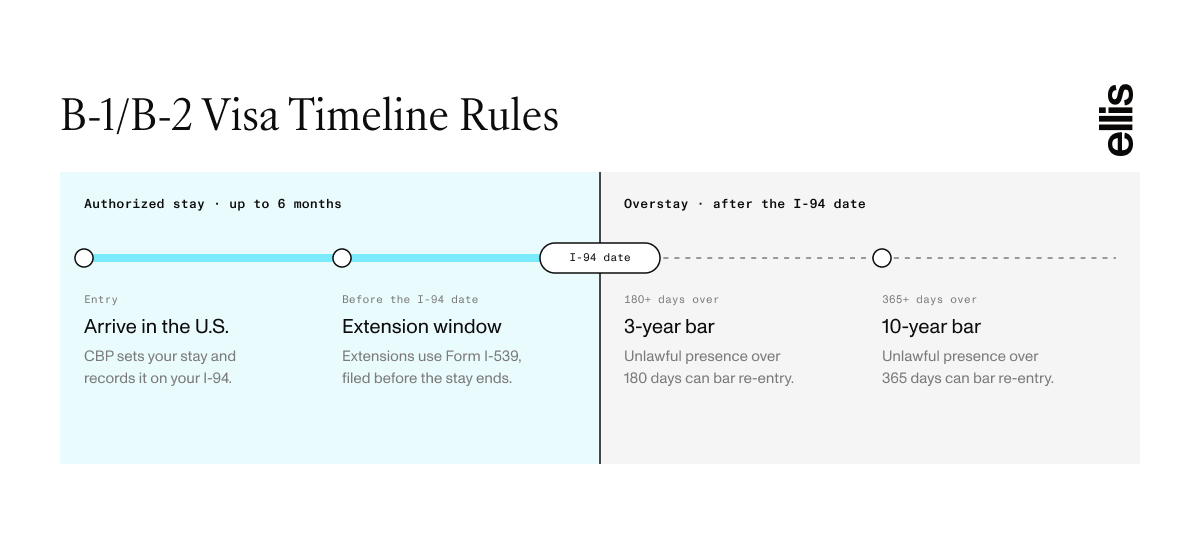
The CBP officer decides the duration of stay at entry, and it is usually up to six months. Many travelers mix up two different dates: how long the visa is valid and how long you can stay on each trip.
Visa validity is how long you can use the visa in your passport to travel to a U.S. port of entry, such as an airport or land border crossing. B-1 and B-2 visas are valid for 10 years for many nationalities, with multiple entries allowed. The actual length depends on agreements between the U.S. and your country of citizenship, and some consulates issue shorter visas based on a person's situation.
Authorized stay is how long you can remain in the U.S. on one entry. U.S. Customs and Border Protection typically grants an initial stay of up to six months. B-1 and B-2 visas allow stays up to 180 days per entry. In most cases, B-1 visa holders can stay for no more than 6 months, and B-2 visa holders can stay for no more than 6 months. CBP sometimes grants less, such as one to three months, based on the purpose of the trip. Always check your I-94 after you enter the US to ensure you admitted in the right category and to double check how long you were granted.
Your stay is recorded on your I-94 arrival/departure record, which you can look up online with your name and passport number. The end date on your I-94, not the date on your visa sticker, is the date you must leave.
Overstay warning: Staying even a few days past your I-94 date counts as "unlawful presence," which means time in the U.S. without legal permission.
Note: If you are on the West Coast, leaving in the afternoon on the last day of your validity date can also trigger and overstay as the CBP's systems may run on East Coast time.
It can hurt future visa applications. More than 180 days of unlawful presence can lead to a three-year ban on returning. More than 365 days can lead to a ten-year ban. Visitors on a B-1/B-2 visa are not guaranteed admission into the U.S. Immigration officers at the port of entry make that decision, and following the rules after you enter matters just as much.
What can you do (and not do) on a B-1/B-2 visa?
Keeping your B-1/B-2 status depends on staying within the visa's limits. Going past those limits, even by accident, can cause serious problems.
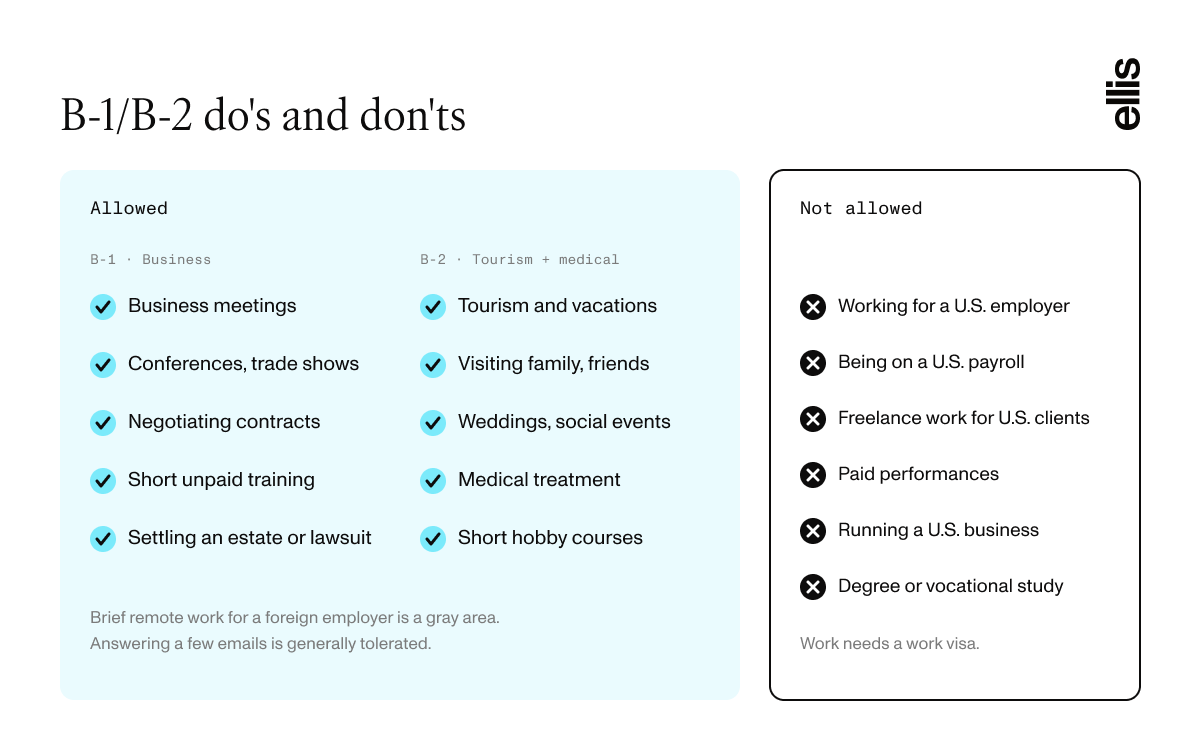
Allowed activities
B-1 (business):
- Attending conferences, trade shows, and seminars
- Meeting with business associates and business partners
- Negotiating contracts and exploring business opportunities
- Taking short training that a U.S. company does not pay for
- Settling an estate or taking part in a lawsuit
- Watching how a business runs without doing productive work
B-2 (tourism and medical):
- Tourism, vacation, and leisure travel
- Visiting family and friends
- Attending social events such as weddings or reunions
- Taking part in amateur sports or music events without pay
- Receiving medical treatment with proper documents
- Taking short hobby courses that do not earn credit
Remote work for a foreign employer while you are in the U.S. on a tourist visa is a common gray area. Quick, minor tasks, like answering a few emails, are generally tolerated. Working remotely for long stretches may raise questions. Because the answer depends on the facts, expert guidance from an immigration attorney can help.
Prohibited activities
The following are strictly prohibited on a B-1/B-2 visa:
- Working for a U.S. employer or being on a U.S. payroll
- Providing services to U.S. customers in a way that takes the place of U.S. workers
- Enrolling in a degree or job-training program (this requires an F-1 or M-1)
- Getting paid to perform or taking freelance jobs from U.S. clients
- Running a U.S. business with a day-to-day local presence
- Long-term study of any kind
Working in the U.S. generally requires a work visa, such as the H-1B, L-1, or O-1. Breaking the B-1/B-2 rules can lead to visa cancellation at the border, removal (deportation) proceedings, and serious trouble getting future U.S. visitor visas or changing to another status. CBP actively screens for these issues.
What are the required documents for a U.S. visa?
Each document you submit does one of three jobs: it proves why you are traveling, shows your ties to your home country, or shows you can pay for your stay.
Required documents for all applicants:
- A valid passport with a validity date extending at least six months beyond the intended period of stay. You need at least 2 blank pages in your passport.
- DS-160 confirmation page
- Visa application fee (MRV fee) payment receipt
- Interview appointment confirmation
- A visa photo that meets State Department rules
Consular officers may ask for documents such as conference registrations or medical appointment confirmations to prove the purpose of travel.
Supporting documents for B-1 (business):
- A letter from your employer explaining the business purpose, length of the trip, and who is paying
- Conference invitations or registration confirmations
- Meeting agendas, client emails, or company documents
Supporting documents for B-2 (tourism):
- Travel plans and hotel bookings
- Invitation letters from family or friends in the U.S.
- Financial records, such as bank statements or tax returns
- Proof of a job or business at home
Supporting documents for medical treatment:
- Letters from your doctor at home with the diagnosis
- A treatment plan from the U.S. medical provider
- Cost estimates for the procedure or care
- Proof you can pay all medical and living costs
How much does a U.S. tourist visa cost?
The application fee for a B-1/B-2 visa is $185. The application fee for US visitor visas is the same for business and tourism, and it is not refunded, even if the visa is denied. Some applicants pay more than the base tourist visa cost in 2026.
Fee | Amount | Notes |
|---|---|---|
Visa application (MRV) fee | Paid by all B-1/B-2 applicants. Not refunded. | |
$250 | Set by a 2025 law. As of late 2026, consulates have not collected it the same way everywhere, so each consulate's instructions control. | |
$750 | Optional pilot at select posts, July to December 2026. Guarantees an interview within ten business days. | |
$10,000 to $20,000 | Only for nationals of bond-list countries when the officer requires it. Refundable if the traveler follows the visa rules. |
Fees change often. The State Department's fee page is the official source.
How do you apply for a B-1/B-2 visa?
The application process is the same around the world, though scheduling and wait times differ by U.S. embassy or consulate. Processing time for a U.S. B-2 visa is typically 15 to 25 days, but it can take much longer at busy posts.
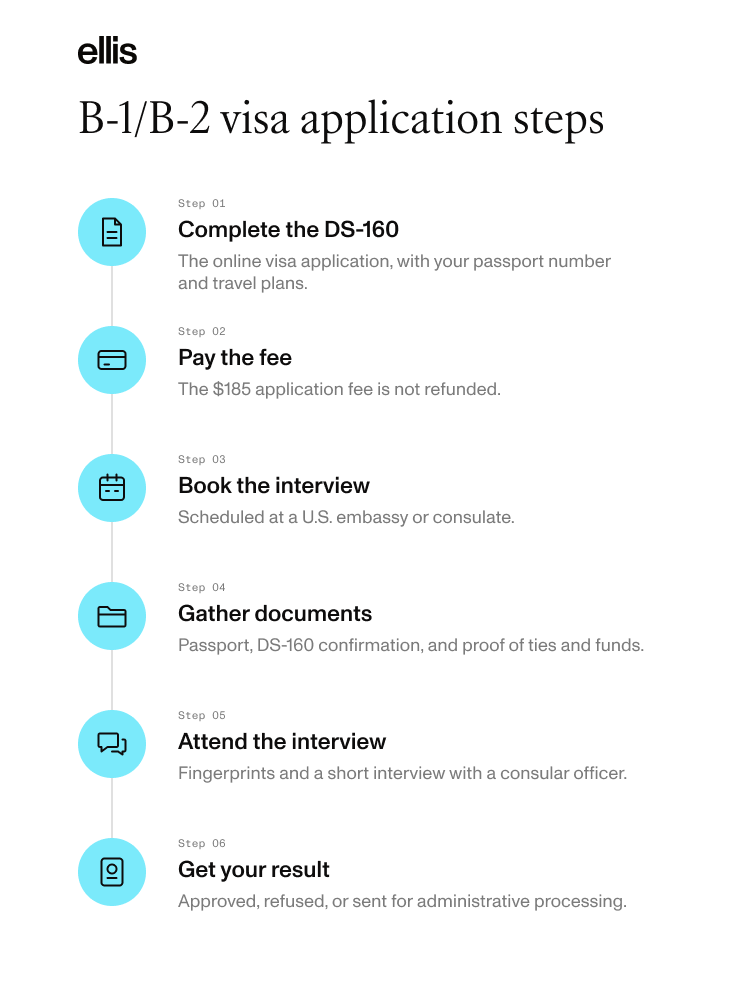
Step 1: Complete the DS-160
Completing the DS-160 online visa application is a typical step in the B-1/B-2 visa application process. The form asks for your personal information, passport number, travel plans, work history, and answers to security questions. Every answer must be accurate and match what you say at the interview. Differences between your DS-160 application details and your interview answers are a common reason for delays or denials.
Step 2: Pay the fee
You pay the $185 application fee, which is not refunded. Depending on your consulate and nationality, the other fees in the table above may also apply.
Step 3: Schedule your interview
You create a profile with the U.S. embassy or consulate and book your visa interview. Wait times range from a few days to many months, depending on the location and the time of year. Ellis tracks current appointment wait times by consulate.
Step 4: Gather documents and prepare your story
You collect your required documents and prepare a clear, short explanation of your trip: where you are going, why, who is paying, and why you will return home. This explanation should match your DS-160.
Step 5: Attend biometrics and the interview
Some posts take fingerprints at a separate appointment, and others take them at the interview. The interview itself is usually short, often just a few minutes of direct questions.
Step 6: Get your result
There are three possible outcomes: approval, refusal under INA § 214(b), or administrative processing, which is an extra security review that can add weeks or months. If approved, your passport with the visa comes back by courier or pickup, depending on the post.
How do you prepare for a tourist visa interview?
The visa interview has one goal: to confirm that your trip is temporary and your travel plan makes sense. Consular officers decide quickly, so preparation matters.
Common questions include:
- What is the purpose of your trip?
- Who do you work for, and what do you do?
- Who is paying for your travel?
- Do you have family in the U.S.?
- Have you traveled abroad before? Where?
- When do you plan to return home?
Strong answers tend to be short and direct, since officers have little time. They match the DS-160, focus on the purpose of the trip and the reasons to return home, and come with documents that are ready but shown only when the officer asks. Applicants who arrive early, dress professionally, keep their documents in order, and answer in the language the post requests usually have a smoother interview.
Red flags that raise concerns:
- Vague plans ("I'm not sure what I'll do there")
- Job or money stories that do not line up
- Past overstays or past denials without a clear explanation
- A pattern of very frequent or very long stays in the U.S.
Ellis has a full guide on how to prepare for your U.S. non-immigrant visa interview.
Why are B-1/B-2 visas denied?
Most B-1/B-2 refusals fall under INA § 214(b). This part of the law assumes every visitor plans to immigrate unless they show otherwise. A 214(b) refusal is not a permanent ban. It means the officer was not convinced your trip is temporary.
Common reasons for denial:
- Weak ties to your home country, such as no job, a recent job change, no property, or few family responsibilities
- An unclear or vague purpose of travel
- Not enough financial proof, or relying on a sponsor without a clear relationship
- Trouble explaining a clear travel plan
Past immigration history issues:
- Previous overstays, even short ones
- Past visa denials that are not addressed
- Unusual travel patterns, like frequent long stays that suggest you are not just visiting
- Misuse of a visa or false information in past applications
There is no formal appeal for a 214(b) refusal, but you can reapply if your situation or evidence changes. To avoid common mistakes, applicants and employers often focus on stronger documents: clear itineraries, detailed employer letters, and direct explanations of past problems. Expert advice from an immigration attorney can make a real difference in the approval process.
New in 2026: visa bonds
Nationals of about 50 countries on the visa bond list may need to post a refundable bond of $10,000, $15,000, or $20,000 at the visa interview. If the officer requires a bond and the applicant does not post it, the officer refuses the visa under INA § 221(g), even if the applicant otherwise qualifies. The Visa Bond Program started as a pilot in August 2025 and became permanent on August 3, 2026.
Can you extend or change your B-1/B-2 status inside the U.S.?
Yes, but it takes careful planning, and it is not a shortcut to a job or a long-term stay.
Extension of stay: To stay longer, you file Form I-539 with USCIS before your I-94 date ends. You must show a continued temporary reason, such as medical emergencies or ongoing treatment, and prove you can still pay for your stay. Late filings or weak reasons are likely to be denied and may lead to unlawful presence.
Change of status: You can switch from B-1/B-2 to another visa type, such as F-1 for school or H-1B for work, from inside the U.S. USCIS will look closely at what you planned when you entered. Entering as a tourist when your real plan was to study or work is called "preconceived intent." It may count as misrepresentation, meaning giving false information, even if USCIS approves the change of status.
Ellis attorneys can review these cases and help employers and travelers weigh whether a work or study visa from abroad is the better route than a status change.
How do B-1/B-2 rules apply to company business trips?
For HR and global mobility teams, visitor visas are a regular part of business planning. Each time a company sends a foreign employee to the U.S. for business meetings, onboarding, or conferences, the B-1/B-2 rules apply.
The most common mistake is treating real work as allowed "business meetings." If an employee from a London office spends two weeks in New York writing code with the U.S. team, that is employment, not a B-1 activity. Immigration services take this seriously, and violations can affect both the employee and the company's ability to sponsor future visas.
Internal policies companies commonly use:
- Pre-trip approval steps that check planned activities against B-1 rules
- Training for managers on what employees can and cannot do on a B-1/B-2
- Records of trip purposes, invitation letters, and itineraries
Costs are also harder to plan. Beyond the $185 tourist visa cost, HR teams budget for the possible $250 Visa Integrity Fee and, for nationals of bond-list countries, bonds of up to $20,000 per traveler. The optional $750 expedited interview fee may also make sense for urgent trips at eligible posts.
How Ellis can help
Ellis attorneys review B-1/B-2 trips for business activity risks, and the Ellis platform tracks every traveler's I-94 dates, fees, and documents in one place. Get in touch today.
This article is for general informational purposes only and is not legal advice.