


A visa and a green card are not the same thing. A visa is a document that lets you enter the U.S. for a specific purpose, and most visas are temporary. A green card gives you permanent resident status: the right to live in the U.S. indefinitely, work for almost any employer, and eventually apply for citizenship.
The confusion is understandable, because the two are connected. Some visas are temporary and never lead to a green card, while others (immigrant visas) are the first step to getting one. Here is how a visa and a green card differ, the main types of each, and how a visa can turn into permanent residence.
Key takeaways
- What's the difference? A visa is usually temporary permission to enter the U.S. for a set purpose. A green card (officially the Permanent Resident Card) lets you live and work here permanently.
- Is a visa the same as a green card? No. Most visas are temporary. A green card is permanent status and a path to citizenship.
- Do all visas lead to a green card? No. Only immigrant visas lead to a green card. Temporary (nonimmigrant) visas like tourist, student, and most work visas do not, by themselves.
- Can a visa become a green card? Yes. Many people enter on a temporary visa and later get a green card through family or an employer.
- Need help? Ellis pairs you with an immigration attorney and tracks your case from start to finish. Start here →
Green card vs. visa: the core difference
A visa gets you into the country's door. A green card lets you stay for good. That is the core difference: a visa is usually temporary and tied to a purpose, while a green card is permanent and broad.
With most visas, you can stay only for a fixed time and a specific reason, such as tourism, study, or a particular job. When the visa ends, you extend it, switch to another status, or leave. A green card holder can live in the U.S. permanently, work for almost any employer, and stay as long as they follow the rules of permanent residence.
Feature | Visa | Green card |
|---|---|---|
What it is | Permission to enter the U.S. | Permanent resident status |
Duration | Temporary for most visas | Permanent (does not expire as a status) |
Work rights | Only if the visa type allows it | Work for almost any employer |
Leads to citizenship | Only immigrant visas do | Yes, usually after 5 years |
What is a visa?
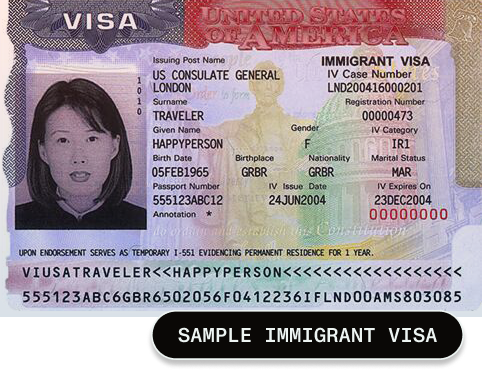
A visa is official permission to travel to the U.S. and ask to enter for a specific purpose. Visas fall into two families, and the difference matters a lot for your future.
A nonimmigrant visa is for a temporary stay. This covers tourist visas (B-2), student visas (F-1), and most work visas like the H-1B. These do not make you a permanent resident. An immigrant visa is for people coming to live in the U.S. permanently. An immigrant visa is issued abroad and becomes a green card once you arrive, so it is really the overseas version of getting permanent residence.
What is a green card?
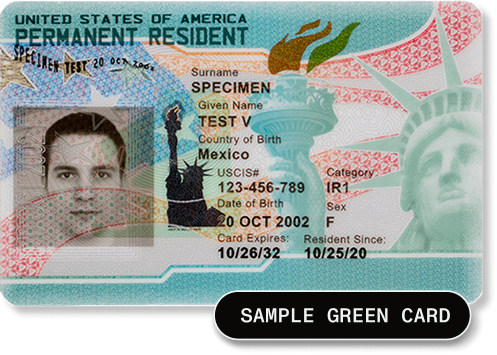
A green card gives you lawful permanent resident (LPR) status. It means you can live and work permanently in the United States.
As a green card holder, you can work at almost any legal job you qualify for, though a few positions are limited to U.S. citizens for security reasons. You are protected by U.S. federal, state, and local laws. You also take on responsibilities: you must file income tax returns and report your income, and you cannot vote in federal, state, or local elections.
A green card is also the main path to U.S. citizenship. Most people can apply for naturalization after holding a green card for at least five years. The physical card is valid for 10 years and is renewed, but your permanent resident status itself does not expire.
Immigrant visa vs. green card: two steps, same goal
An immigrant visa and a green card are not competing options. They are two steps in the same process.
If you apply for permanent residence from outside the U.S., you go through consular processing and receive an immigrant visa to travel with. When you arrive and are admitted, that immigrant visa becomes your green card. If you are already in the U.S. on another status, you skip the immigrant visa and apply to adjust status instead. Either way, the end result is the same: lawful permanent residence.
Where a work visa fits in
A work visa is one kind of nonimmigrant visa. It gives temporary permission to work in the U.S. for a set time and a specific employer, so it does not make you a permanent resident.
The best-known example is the H-1B for specialty occupations. Others include the L-1 for company transfers, the O-1 for people with extraordinary ability, and the TN for certain Canadian and Mexican professionals. Most require employer sponsorship, so your ability to stay is tied to your job. An H-1B worker is generally admitted for up to 3 years, extendable to 6 years total. You can sometimes go beyond 6 years if you have already started the green card process, for example if an immigrant petition has been approved for you.
Green card vs. work permit (EAD): not the same thing
A work permit is not a green card. This is one of the most common and costly points of confusion.
A work permit is an Employment Authorization Document (EAD), which you request with Form I-765. The EAD only proves you are allowed to work in the U.S. It does not give you a status by itself, it does not make you a permanent resident, and it is not a green card.
People often get an EAD while another case is pending. For example, someone applying for a green card can get a work permit under the C09 category while they wait for a decision. The EAD lets them work in the meantime, but it disappears once the underlying case is decided. Do NOT treat a work permit as proof of permanent status.
Can a visa lead to a green card?
Yes. Many people enter on a temporary visa and later become permanent residents. The two most common routes are family and employment.
An employment-based green card usually has three stages:
- Labor certification (PERM). For most cases, your employer proves to the Department of Labor that no qualified U.S. worker is available for the role. Some higher categories skip this step.
- Immigrant petition (Form I-140). Your employer sponsors you under a category like EB-1 (extraordinary ability, outstanding researchers, multinational executives), EB-2 (advanced degrees or exceptional ability), or EB-3 (skilled workers and professionals).
- Adjustment of status (Form I-485). Once a visa is available for you, you file to become a permanent resident without leaving the country. If you are abroad, you use consular processing on an immigrant visa instead.
There is a catch: timing. About 140,000 employment-based green cards are available each year, and they are limited by category and country. Your place in line is set by your priority date, which you can track in the monthly Visa Bulletin. Applicants from high-demand countries like India and China often wait years, which is why the green card process usually starts long before a temporary visa runs out.
Which is better for you?
It depends on your goal. A visa is faster to get and fine if you plan to visit, study, or work in the U.S. for a limited time. A green card is better if you want to settle permanently, work for any employer, or move toward citizenship.
For many people, the two work together. A temporary visa gets you into the country, and a green card is the long-term goal you build toward once you are here.
How Ellis can help
Going from a temporary visa to a green card involves several forms, strict timing, and often an employer or family sponsor, and a single missed deadline can set you back years. Ellis pairs you with an immigration attorney and gives you a case-management system that tracks every step, so nothing slips. Whether you are weighing a visa option or starting the green card process, it helps to have the legal guidance and the checklist in one place. Schedule a free consult →
This article is for informational purposes only and is not legal advice.