

On August 21, 2026, a federal court struck down the State Department's ban on immigrant visas for citizens of 75 countries, ruling in CLINIC v. Rubio that it violated the Immigration and Nationality Act. The court vacated the ban and set aside visa denials that were based only on it. The separate country travel restrictions were not part of this case and remain in effect.
The decision reopens a path that had been closed since January for tens of thousands of green card applicants abroad.
It also leaves many questions open, including whether the government will appeal and how quickly consulates will restart interviews. Here's what the ruling says, who it covers, and what is still up in the air.
Key takeaways
- What happened? A federal judge in the Southern District of New York vacated the 75-country immigrant visa ban on August 21, 2026, in CLINIC v. Rubio.
- Who did it cover? Only immigrant visas, meaning green cards processed at a U.S. consulate abroad, for nationals of 75 countries. It did NOT cover nonimmigrant visas like H-1B, F-1, or B1/B2.
- What about past denials? The court set aside visa denials based solely on the ban and ordered the State Department to restore case-by-case review.
- Important: This is a different policy from the country travel ban, which is still in force. This ruling does NOT mean every U.S. entry restriction has been lifted.
- Need help? Ellis attorneys track case status and handle the filing from petition to interview. Talk to an attorney →
What did the court decide in CLINIC v. Rubio?
On August 21, 2026, the U.S. District Court for the Southern District of New York found the State Department's 75-country immigrant visa ban unlawful and vacated it. Judge Jeannette A. Vargas ruled that the policy exceeded the Secretary of State's authority. It also conflicted with the Immigration and Nationality Act, which bars the government from discriminating by nationality when it issues immigrant visas.
Immigration law requires the government to judge each immigrant visa applicant on their own facts, including whether that specific person is likely to become a public charge. The judge reasoned that this policy skipped that step, refusing visas by nationality and then using a public-charge label to justify the result.
In concrete terms:
- The ban can no longer be used to refuse an immigrant visa.
- Any denial based solely on the ban was set aside.
The case, CLINIC v. Rubio (docket 1:26-cv-00858), was filed in February 2026. It was brought by the Catholic Legal Immigration Network and a coalition that included the National Immigration Law Center, Democracy Forward, and the Center for Constitutional Rights, along with U.S. citizens and immigrants whose family and employment cases had stalled.
What does the ruling change right now?
With the ban gone, immigrant visa processing for the 75 countries can move again:
- The State Department has to return to individual, case-by-case review, weighing each applicant on their own facts.
- Cases that were frozen go back into the normal queue instead of a categorical hold.
However, vacating a policy is faster than clearing the backlog it created. Consulates still have to reschedule interviews, work through cases that piled up over roughly seven months, and issue decisions, so the practical restart will take time.
Is the ban over, and what happens next?
For now the ban is off the books, but the litigation may not be finished. A few things could still happen next:
- The government can ask the Second Circuit Court of Appeals to review the decision.
- It can also seek to pause, or stay, the order while any appeal plays out.
What was the 75-country visa ban?
The ban was a State Department policy, effective January 21, 2026, that suspended immigrant visa issuance for nationals of 75 countries. The government framed it as a "pause" and justified it on public charge grounds, arguing these nationals were likely to rely on public benefits.
In practice, it froze green card cases at the consular processing stage. Applicants who had cleared their petitions and were waiting on an interview or decision at a U.S. embassy abroad were stuck, which is why it hit family-based and employment-based immigrant visas rather than temporary work or visitor visas.
Which 75 countries were on the visa ban list?
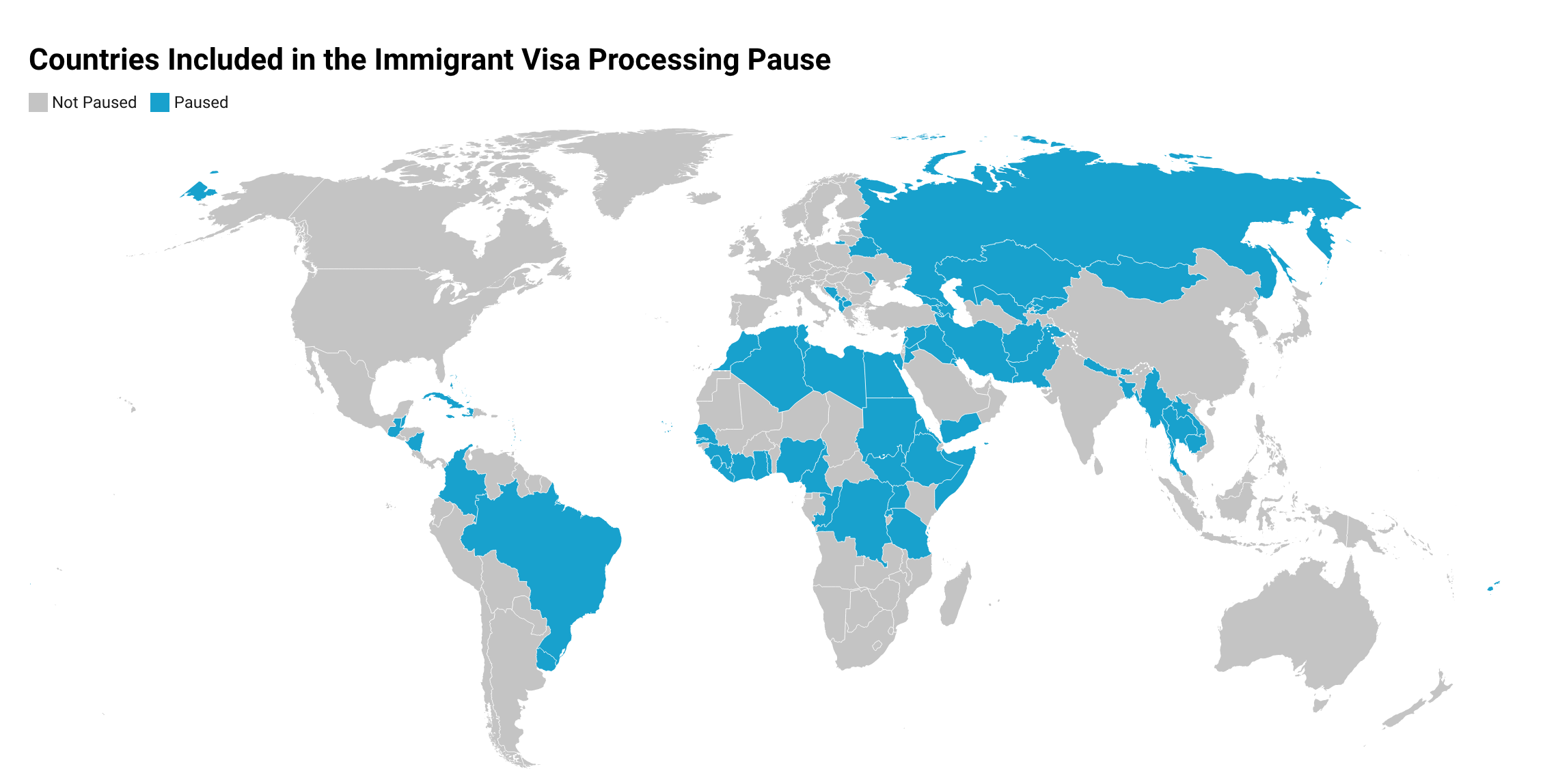
The ban applied to nationals of these 75 countries:
- Afghanistan
- Albania
- Algeria
- Antigua and Barbuda
- Armenia
- Azerbaijan
- Bahamas
- Bangladesh
- Barbados
- Belarus
- Belize
- Bhutan
- Bosnia and Herzegovina
- Brazil
- Burma
- Cambodia
- Cameroon
- Cape Verde
- Colombia
- Congo (Brazzaville)
- Congo (Kinshasa)
- Côte d'Ivoire
- Cuba
- Dominica
- Egypt
- Eritrea
- Ethiopia
- Fiji
- Gambia
- Georgia
- Ghana
- Grenada
- Guatemala
- Guinea
- Haiti
- Iran
- Iraq
- Jamaica
- Jordan
- Kazakhstan
- Kosovo
- Kuwait
- Kyrgyzstan
- Laos
- Lebanon
- Liberia
- Libya
- Moldova
- Mongolia
- Montenegro
- Morocco
- Nepal
- Nicaragua
- Nigeria
- North Macedonia
- Pakistan
- Russia
- Rwanda
- Saint Kitts and Nevis
- Saint Lucia
- Saint Vincent and the Grenadines
- Senegal
- Sierra Leone
- Somalia
- South Sudan
- Sudan
- Syria
- Tanzania
- Thailand
- Togo
- Tunisia
- Uganda
- Uruguay
- Uzbekistan
- Yemen
The ban is based on nationality, not where a person currently lives. Someone who is a citizen of a listed country generally fell under the policy even if they were applying from a third country.
Who did the ban affect, and who was exempt?
The ban reached immigrant visa applicants only. It did not touch most temporary visa categories. That distinction decided whether a given case was frozen.
Category | Covered by the ban? | Notes |
|---|---|---|
Immigrant visas (green cards via a consulate) | Yes | Family-based and employment-based cases at the interview or issuance stage |
Nonimmigrant visas (H-1B, O-1, TN, E-3, F-1, J-1, B1/B2) | No | Temporary work, study, and visitor categories were outside this policy |
Adjustment of status inside the U.S. (Form I-485) | Not directly | People already in the U.S. could generally keep filing, subject to separate rules |
Diversity visa lottery | Handled separately | The diversity visa program faced its own suspension |
People who were already in the United States and eligible to file adjustment of status with USCIS were generally able to keep moving, because that process runs domestically rather than through a consulate. The freeze was aimed squarely at cases finishing abroad. The diversity visa lottery was suspended under a separate action and is not resolved by this ruling.
How is this different from the travel ban?
This ruling is not about the travel ban, and the two are easy to mix up. The 75-country measure struck down here was an immigrant visa freeze. The separate country travel ban, which restricts entry for nationals of a different set of countries, is a distinct proclamation and was not part of CLINIC v. Rubio. It remains in effect. A person could be helped by this ruling and still be subject to the travel ban, or the reverse. They are governed by different rules and different court cases.
How can Ellis help?
Ellis attorneys handle the full case, from the underlying petition and the DS-260 to the consular interview, and the case-management system keeps every deadline and document in one place so nothing slips while the situation shifts. Schedule a free consult →
This article is for general informational purposes only and is not legal advice.