


In brief: The Immigration Act of 1965, also known as the Hart-Celler Act, is a landmark federal law that abolished the discriminatory national origins quota system. Signed by President Lyndon B. Johnson, it replaced old restrictions with a new policy favoring family reunification and skilled immigrants, fundamentally diversifying U.S. immigration and demographics.
Key Takeaways
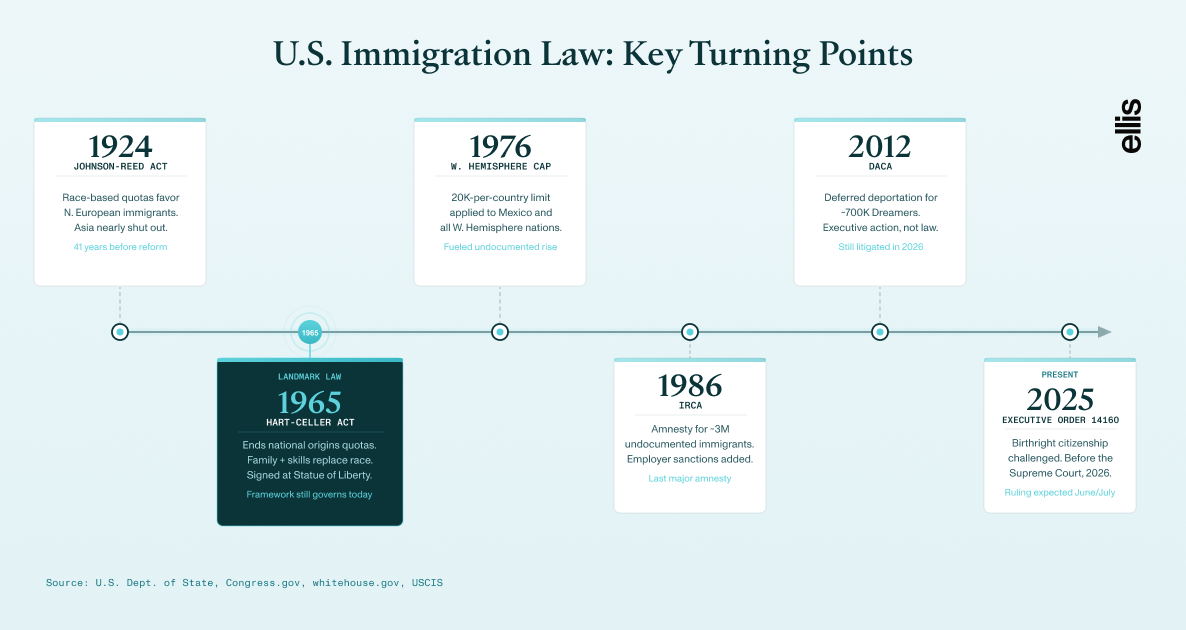
- What it is: A federal law signed by President Lyndon B. Johnson on October 3, 1965, that ended the national origins quota system favoring Northern and Western European immigrants since 1924.
- What it replaced: The Immigration Act of 1924 (Johnson-Reed Act), which severely limited immigration from Asia, Africa, and Southern and Eastern Europe.
- What changed: Visas shifted from national origin to a preference system based on family ties and job skills. That framework still controls legal immigration today.
- Unintended consequence: It capped Western Hemisphere immigration for the first time. Historians argue this directly contributed to the rise of undocumented immigration from Mexico and Central America.
- Why it matters now: The RAISE Act would cut family-based immigration by ~50% in favor of a merit-points system, challenging the 1965 framework. Executive Order 14160 (January 2025) on birthright citizenship is currently before the Supreme Court.
Why the Immigration Act of 1965 Is Back in the News
The Hart-Celler Act is 60 years old, but it sits at the center of three of the biggest immigration fights happening right now.
The merit-based vs. family-based debate
Since 2017, Congress has debated the RAISE Act (Reforming American Immigration for a Strong Economy), introduced by Senators Tom Cotton and David Perdue. It would cut family-based immigration by roughly 50% and replace it with a points-based merit system, ending the seven-category preference system the 1965 act created. As of 2026, the RAISE Act has not passed, but it remains a key proposal in immigration reform discussions.
The birthright citizenship case
On January 20, 2025, President Trump signed Executive Order 14160. It directed federal agencies to stop issuing citizenship documents to children born in the U.S. to undocumented parents or parents on temporary visas. Every federal court that reviewed the order blocked it, citing the Fourteenth Amendment. The Supreme Court heard oral arguments in Trump v. CASA (No. 24A884) on April 1, 2026. A ruling is expected by late June or early July 2026. Both the 1965 act and this case ask the same core question: what does the Constitution say about who gets to be American?
Undocumented immigration and border policy
The roots of unauthorized immigration from Mexico and Central America trace back to the Western Hemisphere caps the 1965 act introduced. Almost every current debate about border security connects, at least in part, to that 1965 policy decision.
What Was the Immigration Act of 1965?
The Immigration Act of 1965, also called the Immigration and Nationality Act of 1965 and known as the Hart-Celler Act after its Congressional sponsors, is a federal law that changed who could immigrate to the United States.
Before 1965, U.S. immigration was controlled by a strict quota system that openly favored white, Christian immigrants from Northern and Western Europe. The Hart-Celler Act ended that system completely. In its place, it created a ranking system based on family relationships and job skills. For the first time in American history, immigrants from every country were judged by the same rules.
President Lyndon B. Johnson signed the law on October 3, 1965, at the base of the Statue of Liberty, a symbolic choice that reflected the change it was meant to signal.
Historical Context: Immigration Before 1965
To understand why the 1965 act mattered so much, you need to know what it replaced.
The Immigration Act of 1924 (Johnson-Reed Act)
The main law controlling U.S. immigration before 1965 was the Immigration Act of 1924, also called the Johnson-Reed Act. It set annual limits on immigration from each country based on how many people of that nationality already lived in the U.S., using the 1890 census as its baseline.
The result was clear:
- Northern and Western Europe (the U.K., Germany, Ireland, Scandinavia) got the vast majority of available visas.
- Southern and Eastern Europe (Italy, Poland, Greece) were heavily restricted.
- Asia was almost entirely excluded through a rule called the "Asiatic Barred Zone."
- Africa was nearly shut out completely.
- The Western Hemisphere (Mexico, Canada, Latin America) had no numerical cap at all.
Immigration from Japan had already been cut off by the Gentlemen's Agreement of 1907. The 1924 act made that racial logic official across an entire continent.
What Pushed for Change
By the early 1960s, the quota system was under serious pressure from two directions.
First, the Civil Rights Movement made race-based immigration rules nearly impossible to defend. A country fighting for racial equality at home, in its schools, on its buses, and in its courts, could not justify an immigration system that ranked people by ethnicity.
Second, President John F. Kennedy pushed directly for reform. He called the quota system "nearly intolerable" and proposed new legislation before his assassination in 1963. President Lyndon B. Johnson picked up where Kennedy left off, making immigration reform part of his "Great Society" agenda and driving the bill to passage.
What Did the Immigration Act of 1965 Do?
The Hart-Celler Act made three major changes to U.S. immigration law.
1. It Ended National Origins Quotas
The biggest change was ending the quota system based on race and national origin. After 1965, where a person was born no longer determined whether they could immigrate. Someone from Nigeria, the Philippines, or Poland was judged by the same rules as someone from England or Germany.
2. It Created a Seven-Category Preference System
Instead of quotas by country, the act set up a ranked system for giving out visas. Applicants qualified through one of seven categories:
- Unmarried adult sons and daughters of U.S. citizens
- Spouses and unmarried children of lawful permanent residents
- Professionals, scientists, and artists of exceptional ability
- Married sons and daughters of U.S. citizens
- Brothers and sisters of U.S. citizens
- Skilled and unskilled workers in jobs with labor shortages
- Refugees from communist countries or the Middle East
Family ties to a U.S. citizen or permanent resident ranked highest. Lawmakers did not anticipate the ripple effects this would have on immigration patterns.
3. It Capped Western Hemisphere Immigration for the First Time
Before 1965, there was no limit on immigration from the Western Hemisphere (Mexico, Canada, and Latin America). The Hart-Celler Act set a cap of 120,000 visas per year for the Western Hemisphere and 170,000 for the Eastern Hemisphere. This change had the biggest unintended consequences of all.
What Did the Hart-Celler Act Abolish or Reverse?
Feature | Before 1965 (National Origins System) | After 1965 (Hart-Celler Act) |
|---|---|---|
Primary Selection Metric | National origin and ethnicity | Family ties to U.S. citizens and job skills |
European Immigration | Heavily favored (Northern/Western Europe dominated) | Subject to same per-country caps as all nations |
Asian Immigration | Virtually banned or severely restricted | Placed on equal footing with other nations |
African Immigration | Near-total exclusion | Equal access under the new preference system |
Western Hemisphere | Historically uncapped (no numerical limits) | Capped for the first time at 120,000/year |
Primary Beneficiaries | Immigrants from the U.K., Germany, and Ireland | Immigrants from Asia, Latin America, and Africa |
The Unintended Consequence: Western Hemisphere Caps and Undocumented Immigration
One of the biggest and least expected results of the 1965 act was what the Western Hemisphere cap did to immigration from Mexico.
Before 1965, Mexican workers had long moved back and forth across the border for agricultural and seasonal work. This was reinforced by the Bracero Program, a formal guest worker agreement between the U.S. and Mexico that ran from 1942 to 1964. When the 1965 act imposed a 120,000-visa cap on the entire Western Hemisphere, and Congress later added a per-country limit of 20,000 in 1976, the number of legal visas available was far lower than actual demand.
Many historians and scholars argue this gap directly fueled the rise of unauthorized immigration from Mexico and Central America in the decades that followed.
Why the Immigration Act of 1965 Matters: The Modern Impact
At the time, even the law's own sponsors said it would not change much. Senator Ted Kennedy, one of its key architects, said it "will not upset the ethnic mix of our society."
Demographic Transformation
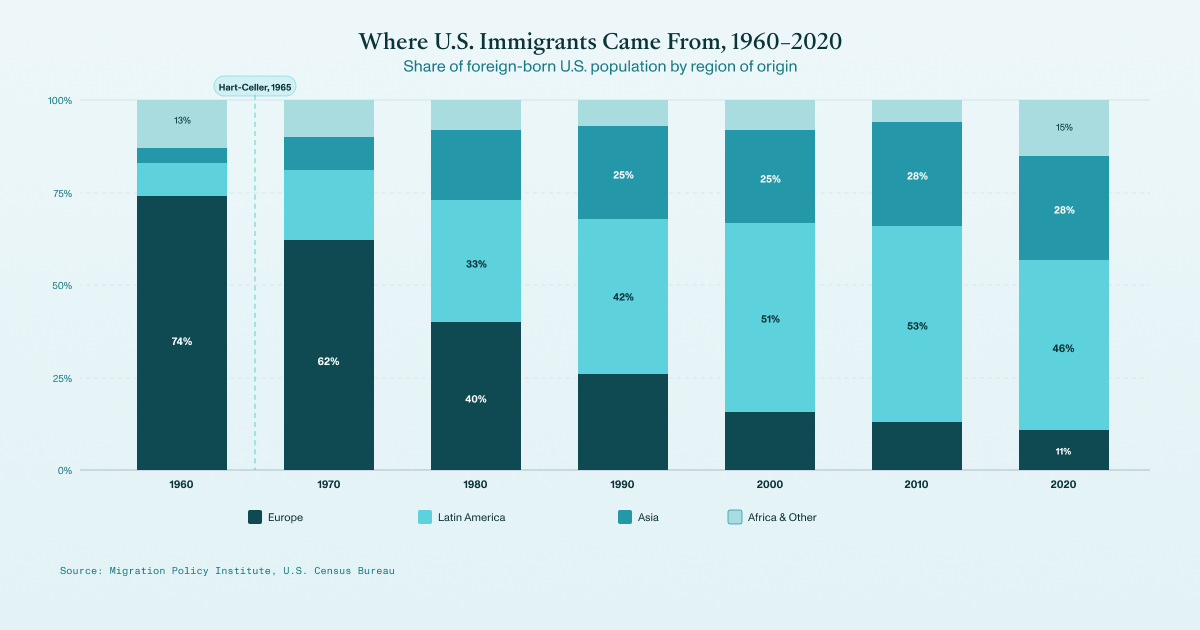
In 1965, roughly 84% of the U.S. population was non-Hispanic white, and most immigrants came from Europe. The Hart-Celler Act set off a demographic shift that has continued for six decades.
By the 2020 Census, non-Hispanic whites made up about 57.8% of the U.S. population. The makeup of the immigrant population changed just as dramatically: over 60% of immigrants came from Europe in 1960. By 2019, that number had dropped below 10%. The largest sources had shifted to Asia, Mexico, and Latin America.
The Rise of Asian and Hispanic Communities
The law's focus on family reunification had a snowball effect. Once a skilled immigrant from India or the Philippines became a U.S. citizen, they could sponsor family members. Those family members could later sponsor their own. This chain, sometimes called "chain migration," rapidly grew immigrant communities from countries that had almost no U.S. presence before 1965.
Today, Asian Americans are the fastest-growing racial or ethnic group in the United States. The Indian-American and Chinese-American communities, both tiny before 1965, are now among the most economically influential groups in the country.
Economic Impact: Skilled Immigration and American Industry
The employment-based categories in the 1965 act opened a steady path for highly educated immigrants into the U.S. workforce. That pipeline helped shape American technology and healthcare.
A 2018 National Academies of Sciences report found that immigrants and their children make up a disproportionate share of U.S. innovation, including patents, Nobel Prize winners, and founders of major companies. Many of the engineers, doctors, and researchers who built Silicon Valley came through pathways created or expanded by the Hart-Celler Act.
Conclusion
The Immigration Act of 1965 is one of the most important and most misunderstood laws in modern American history. A law its own authors said would change little ended up triggering one of the largest demographic shifts of any country in peacetime.
Its biggest contribution was as much moral as legal. It replaced a race-based immigration system with one that applied the same rules to everyone, the same principle the Civil Rights Act applied to who belongs as a citizen.
The debates it started are still unsettled: family-based vs. skills-based immigration, the consequences of Western Hemisphere caps, and the meaning of national identity. All remain central to American politics today.
Have questions about your U.S. immigration options? Book a consultation with Ellis.
The information in this article is for general informational purposes only and does not constitute legal advice.