
The H-4 visa lets the spouse and unmarried children under 21 of an H-1B worker live in the United States. On its own it does not allow work. To hold a job, an H-4 spouse needs an H-4 Employment Authorization Document, or EAD (Form I-765), which is available only if the H-1B holder has an approved Form I-140 or an AC21 extension.
For a family already here on an H-1B, the H-4 is what keeps everyone together. The parts that shape daily life the most are whether a spouse can actually work, how long it takes to get that permission, what the filings cost, and what the recent end of the automatic work-permit extension changes.
Key takeaways
- Who qualifies? The spouse and unmarried children under 21 of an H-1B worker (and some other H visa holders).
- Can you work? Not on H-4 status alone. Work comes only with an approved H-4 EAD, which means the H-1B spouse must have an approved Form I-140 or an AC21 extension.
- What kind of work? An H-4 EAD has no limits. It covers any employer, any field, part or full time, self-employment, and starting a business.
- The big 2026 change: The 540-day automatic EAD extension is gone for renewals filed on or after October 30, 2025. Work authorization now lapses unless the renewal is approved before the current EAD expires.
- Need help? Ellis pairs you with an immigration attorney and tracks your H-4 and EAD filings start to finish. Start here →
What is an H-4 visa?
The H-4 visa is for the close family of someone in H status, usually an H-1B specialty worker. It lets a spouse and unmarried children under 21 live in the United States for as long as the H-1B holder keeps valid status.
The H-4 is a dependent visa, so it borrows its life from the main visa. It is not a work visa or a green card on its own. When the H-1B holder extends, changes, or loses status, the H-4 family moves with them. That link is the single most important thing to understand about the H-4: almost everything about it, including the right to work, traces back to the H-1B.
Families usually enter H-4 one of two ways. From abroad, a family member applies for the H-4 at a U.S. consulate. Inside the United States, someone already in another status files a form to switch to or extend H-4.
Who qualifies for H-4 status?
Eligibility comes down to the relationship. A spouse qualifies, and so does an unmarried child under 21, as long as the H-1B holder keeps valid status. There is no separate job, degree, or income test for the H-4 itself.
Children are the part that trips families up. The moment a child turns 21 or gets married, they no longer count as a child under immigration law, and H-4 status ends for them. Many families move a child to an F-1 student visa or another status they qualify for on their own before that birthday, which is what keeps a gap from opening up.
Can H-4 visa holders work in the US?
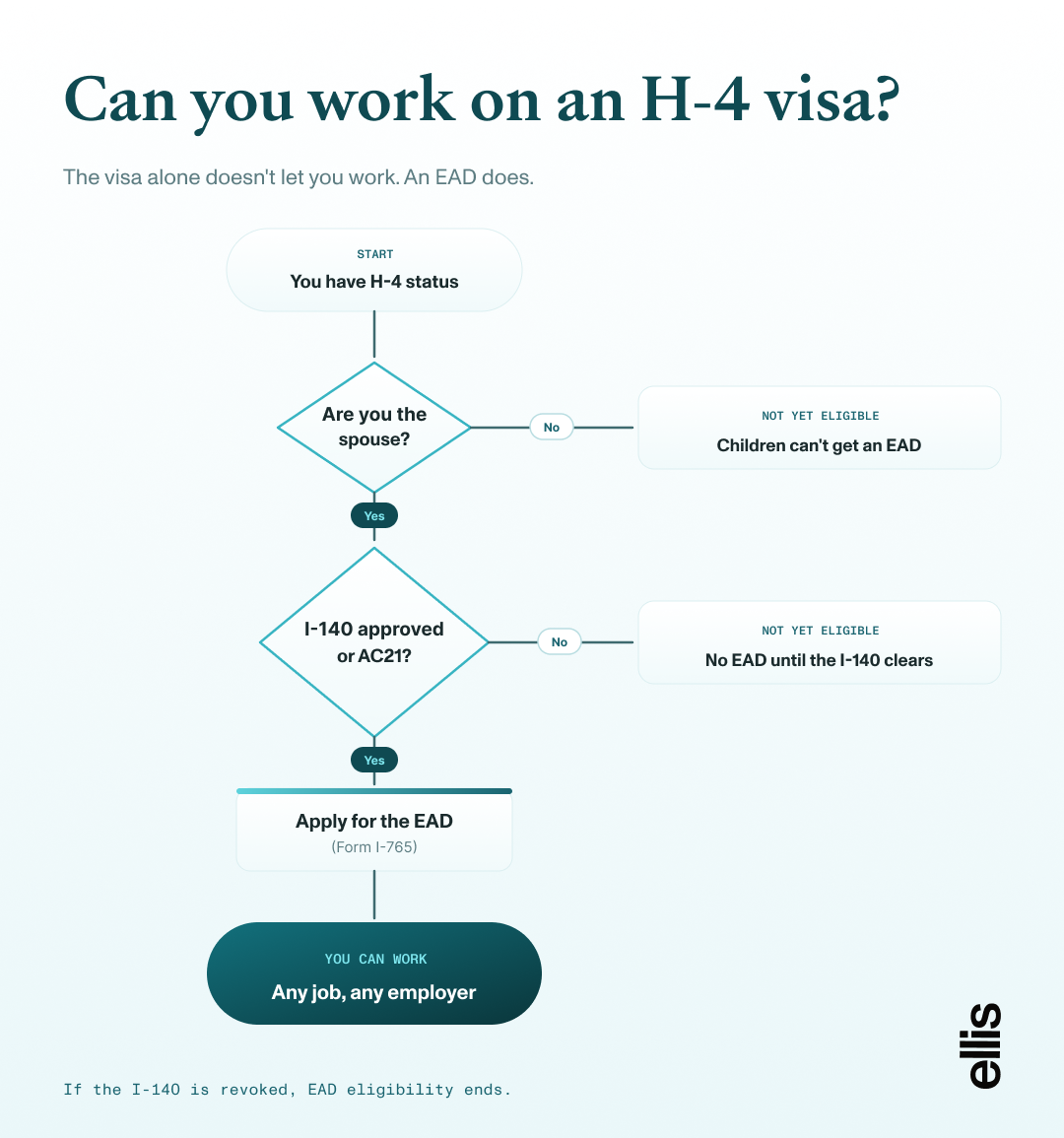
Not on H-4 status by itself. H-4 status does not carry the right to work; that right comes only with an H-4 EAD, the Employment Authorization Document (Form I-766), which an eligible spouse requests by filing Form I-765.
Not every H-4 spouse can get one. The EAD is available only when the H-1B spouse has reached one of these points in the green card process:
- The H-1B spouse has an approved Form I-140, the petition that starts the employment-based green card, or
- The H-1B spouse has H-1B time past the usual six-year limit under AC21.
H-4 children never qualify for an EAD, no matter their age or schooling. Only eligible spouses do.
When it does come through, the H-4 EAD is one of the most flexible work permits in the system. It is unrestricted, which means no sponsor, no tie to a single employer, and no limit on the field. The holder can take any job, switch jobs whenever they like, work part time or full time, freelance, or start a company. In practice it works much like open work authorization for as long as it stays valid.
How do you apply for the H-4 visa and H-4 EAD?
An H-4 case involves two forms, and often three once the H-1B is in the mix.
- Form I-539 gets or extends H-4 status for a family member already in the United States.
- Form I-765 requests the H-4 EAD, the work permit.
- Form I-129 is the H-1B spouse's own petition or extension.
Filing all three together, known as concurrent filing, tends to be the smoothest path. When they arrive as one package, USCIS is more likely to review them at the same time, which shortens the wait for the EAD. That joint review is no longer guaranteed, but a bundled filing still tends to move faster than an EAD sent on its own.
Order is built into the process. The I-765 can only be approved after the I-539, because a work permit assumes the person already holds valid H-4 status. An EAD filed alone while the H-4 extension is still pending waits until that extension clears.
How much do the H-4 visa and EAD cost in 2026?
These are the main 2026 filing fees. Amounts differ for paper and online.
Form | Purpose | Fee (2026) | Notes |
|---|---|---|---|
Form I-539 | Get or extend H-4 status | $470 paper / $420 online | Covers the primary applicant. Current amount is on the USCIS fee schedule. |
Form I-765 | H-4 EAD (work permit) | $520 paper / $470 online | No premium processing is available for this form. |
Form I-907 | Premium processing (H-1B I-129 only) | Optional add-on | Speeds the H-1B petition, not the EAD. Can help a bundled filing move faster. |
Fees change often, and the current figures are always listed on the official USCIS pages.
How long do the H-4 visa and EAD take in 2026?
How long the H-4 EAD takes depends heavily on how it is filed. As of mid-2026, these are the usual ranges.
How it is filed | Typical processing time | Notes |
|---|---|---|
Standalone H-4 EAD (I-765 only) | About 5 to 12 months | Varies by USCIS service center. |
Bundled (I-129 + I-539 + I-765) | About 2 to 5 months | Best chance of being reviewed together. Not guaranteed. |
H-4 extension (I-539) alone | Varies | The EAD is only processed after this is approved. |
USCIS accepts a renewal up to 180 days before the EAD expires. Since processing can run many months, that 180-day window is often the difference between an on-time renewal and a break in work authorization.
What happened to the 540-day EAD auto-extension?
For most H-4 families, this is the biggest recent change, and it is easy to overlook.
For years, filing an EAD renewal on time came with a bonus: work authorization continued automatically while the renewal was pending, most recently for up to 540 days. That cushion is gone. For renewals filed on or after October 30, 2025, there is no automatic extension. The renewal has to be approved before the current EAD expires, and if it is not, work has to stop the day the card ends.
In real terms, that turns EAD timing into a job-security question. A few facts shape how it plays out:
- USCIS accepts a renewal up to 180 days before the EAD expires, so the earliest filing window is now the safest one.
- USCIS does not send a warning before an EAD expires, and authorization ends on the printed date whether or not the renewal has been decided.
- When the H-1B spouse's extension is due around the same time, the H-4 and EAD can be bundled with it, which is often the fastest route to approval.
A slow renewal can mean weeks or months out of work with pay stopped, which is why the expiration date now functions as a real deadline rather than a soft one.
What happens if the H-1B spouse changes jobs or is laid off?
Because H-4 depends on the H-1B, a change to the main visa reaches the whole family. This is one of the most stressful situations H-4 households face, so it helps to know the basics.
If the H-1B spouse is laid off, they generally have a grace period of up to 60 days to find a new employer, switch to another status, or prepare to leave. H-4 family members share the principal's status, so their stay is tied to whether the H-1B holder lands a new role and keeps valid status within that window.
A job change is usually smoother. When the H-1B spouse moves to a new employer through H-1B portability, the H-4 status continues alongside it. An H-4 EAD based on an approved I-140 generally stays valid to its printed expiration date, since it rests on the I-140 approval rather than a specific employer, as long as that I-140 is not revoked and H-4 status is maintained. These situations get fact-specific quickly, which is where an immigration attorney tends to earn their keep.
How does the H-4 EAD connect to the green card?
An H-4 EAD is really a reflection of the family's green card progress. The rule ties the work permit to an approved I-140 or an AC21 extension, so the right to work tracks the H-1B spouse's employment-based permanent residence case.
That connection runs both directions. Once the I-140 is approved, the H-4 spouse becomes eligible for the EAD. If the I-140 is later revoked, or the green card case is dropped, the EAD can fall away with it. Changes to the main case flow straight through to the H-4 spouse's ability to work, which is why the two are worth watching together.
How Ellis can help
The H-4 and H-4 EAD process carries real deadlines and several moving parts, and with the automatic extension gone, a late filing can now cost a spouse their job. Ellis pairs you with an immigration attorney and keeps your H-4 status, your EAD, and your spouse's H-1B tracked in one place, so the filings line up and land on time. For a simple case, that is peace of mind. For a complicated one, it is an attorney who already knows your file. Schedule a free consult →
This article is for informational purposes only and is not legal advice.