

In short: INA §204(j) may allow you to change jobs during a pending green card case if your I-485 has been pending 180+ days and the new role is in the same or similar occupation. Filing Supplement J is generally required to notify USCIS of the change.
Key Takeaways
- INA §204(j) lets employment-based I-485 applicants change employers or roles without losing their approved I-140 or priority date
- Your I-485 must be pending at least 180 days, and the new job must be in the same or similar occupational classification
- An approved I-140 is generally preserved after 180 days, even if your employer withdraws it or shuts down
- File Supplement J to document the job change and notify USCIS
- Get in touch with Ellis today — we handle 180-day tracking, SOC mapping, and Supplement J for HR teams
What Is Job Portability?
In U.S. immigration, job portability means you can change employers or roles without losing the progress you've made on your green card. Without it, switching jobs during the green card process could mean starting over — new labor certification, new I-140, new wait. Job portability removes that risk for eligible applicants.
INA §204(j) of the Immigration and Nationality Act, part of the American Competitiveness in the Twenty-First Century Act (AC21) of 2000, lets certain employment-based adjustment applicants change jobs and keep their approved I-140 petition and priority date, as long as specific conditions are met. For foreign national professionals seeking to register for permanent residence, this offers greater career autonomy and higher earning potential without jeopardizing years of immigration progress.
This is separate from H-1B portability, which covers temporary visa status. INA 204(j) protects the underlying green card petition. USCIS policy guidance governs how USCIS evaluates portability requests today.
Core Eligibility Requirements
To qualify for job portability under INA 204(j), all five conditions must be met:
- Employment-based I-485 — You must be the principal applicant on an EB-2, EB-3 (PERM), or EB-1C adjustment case with a valid job offer. Self-employment generally does not qualify; the offer must come from a real employer outside yourself.
- Approved I-140 — Your immigrant petition must be approved.
- 180-day pending rule — Your I-485 must have been pending at least 180 days when the job change happens.
- Same or similar occupation — The new role must match the occupational classification in your original I-140 and labor certification.
- Visa availability at filing — An immigrant visa must have been available when you filed your I-485. It doesn't need to stay current after that.
Generally not eligible: EB-1A extraordinary ability, national interest waiver, family-based cases, consular processing, or nonimmigrant statuses like B-1/B-2 or F-1.
The 180-Day Rule
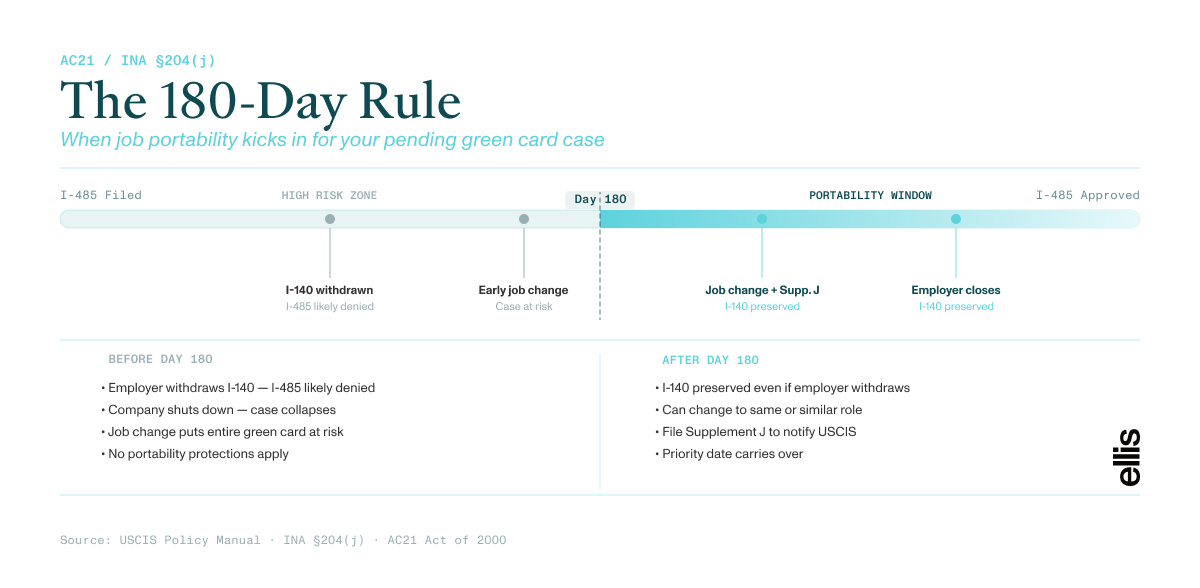
To use job portability, your I-485 must have been pending at least 180 days. That clock starts the day USCIS receipts your Form I-485 — count every calendar day, including weekends and holidays.
Before day 180: If your employer withdraws the I-140 or shuts down, USCIS will typically revoke the petition and deny the I-485. Status applicants experiencing delays in their adjustment of status case are especially at risk here. A job change too early can put the entire status application in jeopardy.
After day 180: The approved I-140 is generally preserved for portability and priority date retention, even if your employer pulls it back, unless there's fraud, misrepresentation, or an invalid labor certification.
Example: I-485 filed April 1, 2025 → day 180 = September 28, 2025. Any job change or I-140 withdrawal before that date is high-risk.
There is generally no legal limit on how many times you can port under AC21. Each new role just needs to meet the requirements.
Priority dates, usually the PERM filing date with the Department of Labor or the I-140 filing date if no PERM is needed, can generally carry over to future I-140s, as long as the earlier petition was approved and not revoked for fraud.
"Same or Similar" Occupational Classification
The "same or similar" occupational classification requirement is where most portability cases succeed or fail.
"Same" occupational classification means the new job matches the applicant's original position in all key ways: same core job duties, field, and level. "Similar" occupational classification means the original and new positions share essential qualities or have a clear, logical relationship. Two jobs share essential qualities when their respective jobs involve the same or similar functions, require comparable educational and training requirements, and fall within a related professional scope.
SOC codes in the portability determination process
USCIS uses Department of Labor Standard Occupational Classification (SOC) codes as a reference point, but SOC code matching is not the sole determining factor. The DOL assigns occupational codes to each job category based on the detailed occupational codes describing a role's core functions, skills, and requirements. Jobs with occupational codes assigned to the same broad occupation code are generally considered clearly similar. Distinct detailed occupation codes can still qualify as "similar" if the underlying duties overlap significantly, while roles in entirely different fields generally will not. When the SOC codes for the original and new positions differ but fall under the same broad category, USCIS looks past the labels at actual job duties and skills.
What USCIS reviews
USCIS compares the relevant positions using a totality of the circumstances approach, looking at all the relevant factors across the original and new positions:
- Job duties from each role, and the percentage breakdown of responsibilities
- Whether the respective jobs involve the same or similar functions
- Educational and training requirements, including certifications specifically required
- Seniority level, and whether the job duties arising from the change involve career progression or involve lateral movement within the same field
- Whether positions offer similar wages given market rates and geographic location
- Whether the applicant is primarily responsible for the same type of work in both the original and new positions
USCIS weighs all relevant evidence and treats such evidence favorably when the record supports it. The standard is preponderance of the evidence — more likely than not. No single factor is conclusive evidence on its own; minor differences in job titles or salary do not typically affect classification. Strong evidence of a completely different field will generally defeat portability. Evidence of occupational overlap and consistent career trajectory supports it.
Examples:
Scenario | Verdict |
|---|---|
Data Scientist → Senior Data Scientist (same field, similar duties) | ✅ Likely portable |
Software Engineer → Product Manager (duties shift from coding to product strategy) | ⚠️ Questionable |
Mechanical Engineer → Financial Analyst (different SOC codes, skills, and field) | ❌ Risky |
Geographic moves and remote arrangements generally don't disqualify portability if the occupation stays consistent. Career progression within the same field — say, individual contributor to team lead — is viewed differently than a shift to an unrelated discipline. The key question is whether a clear thread runs through his or her career trajectory from the original position to the new role.
Ellis can help HR teams map jobs to SOC codes, compare job descriptions side by side, and build evidence packages for each relevant factor.
When Employers Withdraw, Merge, or Close
What happens to your green card case when your employer pulls out depends almost entirely on where you are in the 180-day window.
Scenario | Before 180 Days | After 180 Days |
|---|---|---|
Employer withdraws I-140 | I-485 likely denied | I-140 preserved for portability |
Company shuts down | I-485 likely denied | I-140 preserved (unless fraud/invalid PERM) |
Merger or acquisition | Case-by-case analysis applies | Same 180-day thresholds |
Talk to immigration counsel before any business restructuring.
Filing Supplement J
Form I-485 Supplement J is how you document portability and tell USCIS about a job change. Supplement J confirms the applicant's intent to accept a new job offer from the new employer.
File it when:
- Responding to an RFE or Notice of Intent to Deny (NOID) related to employment
- You've started a new job after 180 days of I-485 pendency
- USCIS asks for it
Submit Supplement J after starting a new job or upon request from USCIS. It's optional if USCIS has not asked, but recommended; USCIS may not know about job changes without it.
Supplement J must include:
- Original I-140 receipt and approval information
- New job title, SOC code, duties, worksite/location, and salary
- Employer attestation of a permanent, full-time job offer
Supporting documents:
- New offer letter and job description
- Org chart showing reporting lines
- Wage documentation
- Counsel's cover letter with "same or similar" analysis and SOC code comparison
See Ellis's guide on how to gather supporting documents for USCIS applications for a full checklist.
USCIS reviews Supplement J under a more-likely-than-not standard, and USCIS processing times vary. Keep job descriptions specific and aligned with your original labor certification where possible.
H-1B Status and a Pending I-485
Many workers going through the green card process are also on H-1B status. H-1B portability is a separate rule that protects your ability to work while a transfer petition is pending — it operates independently of INA 204(j). If you have both an active H-1B and a pending I-485, keeping H-1B status active is generally recommended: it enables dual intent, easier international travel, and a backup if the I-485 is denied.
For a full breakdown of how H-1B transfers work, see Ellis's H-1B portability guide.
Real-World Scenarios
Here's how job portability plays out in practice — and where it can go wrong.
Scenario 1: Relocation + role change A software engineer with an EB-2 I-140 files her I-485 in March 2025. By October 2025, past the 180-day mark, she takes a senior software engineer role at a new employer in Austin, Texas. Same SOC code, overlapping job duties, modest salary increase reflecting normal career progression. This is a textbook portable case. Job-hopping can lead to salary increases of nearly 15%, and moving to a different geographic location doesn't hurt portability as long as the occupation stays the same. That said, relocation associated with job changes can incur substantial out-of-pocket costs, and employees may lose accrued vacation time or paid time off when leaving a company, worth factoring in alongside the immigration analysis.
Scenario 2: Startup acquired A research scientist's employer is acquired and the original entity closes. Her I-485 had been pending over 200 days, so the I-140 is protected. She moves to a similar R&D role at the acquiring company, files Supplement J with a detailed comparison of job duties at both the original and new positions, and the case is ultimately approved.
Scenario 3: Managerial promotion An H-1B worker with a pending EB-3 I-485 moves into a managerial or supervisory role over the same technical team. He uses both H-1B portability and INA 204(j), showing that the job duties arising from the promotion reflect normal career progression and that he remains primarily responsible for technical work in the same field. Highly portable benefits allow seamless transitions between jobs without significant coverage gaps, and changing jobs can lead to better work-life balance and mental health support according to employees. But for portability purposes, what matters is whether the new position is in the same or similar occupational classification as the original job.
Common pitfalls:
- Taking a very different role (e.g., engineering → sales) before or near the 180-day mark
- Gaps in employment where no valid job offer exists when the I-485 is adjudicated
- Employer pulling the I-140 just after an employee leaves, before day 180
- Changing jobs frequently without immigration review; this can raise questions at adjudication about continuity of the job offer
Best practices for HR teams:
- Track I-140 approval dates, I-485 filing dates, and 180-day milestones in one place
- Get immigration review before approving promotions, role changes, or transfers for employees with pending green cards
- Read Ellis's guide on how to maintain immigration status during job changes before any restructuring or M&A activity
How Ellis Helps
Ellis is a business immigration law firm and platform built for U.S. employers. Ellis's immigration services include automated 180-day tracking with alerts for HR and counsel, SOC code mapping and side-by-side job description analysis, and HRIS integration that flags immigration-sensitive events before they're finalized.
Get in touch today to see how Ellis keeps every case on track.