

Losing a job is hard. Losing one when your visa is tied to that job is even harder. If you've just been laid off while on an H-1B, the clock is already ticking, but you have more options than most people realize.
You're not alone. Tech and tech-adjacent layoffs have continued through 2024, 2025, and into 2026, hitting the H-1B workforce hard. Industry trackers like Layoffs.fyi have logged hundreds of thousands of tech job cuts over the last few years. However, the ecosystem of sponsors hiring from layoff pools remains highly active. The Ellis Visa Sponsors database, for example, lists 180,000+ companies that have sponsored H-1Bs and actively look for experienced talent.
This guide walks you through the 60-day grace period, the paths to stay in the U.S. legally, and what to protect if you're already in the green card process.
The Short Version: You have up to 60 calendar days from your last day of active employment to either find a new H-1B sponsor, change to a different status, or leave the U.S. in good standing. Acting fast matters, and so does knowing which option fits your situation.
Key Takeaways
- What you get: Up to 60 calendar days of authorized stay after your last day of work, called the H-1B grace period. It's discretionary, not automatic, but USCIS grants it in almost all cases.
- Your main options: Find a new H-1B sponsor and file a transfer, change to a different status (H-4, F-1, B-2, O-1), self-petition (EB-1A, EB-2 NIW), or leave the U.S.
- When the clock starts: The day after your last day of employment, not the end of your severance pay.
- Know your rights: If you are terminated while on H-1B status, your employer must offer you a one way return ticket home, your I-140 priority date stays with you, and you can transfer to a new employer sponsor without your old employer's permission.
- Get help fast: Ellis can map your options, file a transfer or change of status, and protect any green card progress you've already made. Book a consultation to talk through your situation.
What is the H-1B 60-day grace period?
The H-1B grace period is a window of up to 60 calendar days where you can stay in the U.S. after losing your job without falling out of status. It was created so H-1B workers wouldn't have to leave the country the same day they got laid off.
A few things to know about it:
- It's discretionary. USCIS can deny it in unusual cases (criminal issues, fraud findings), but in practice almost everyone gets the full 60 days.
- It's calendar days, not business days. Sundays and holidays count.
- You can only use it once per authorized stay. If you already used the grace period earlier in this H-1B stay, you may not get another.
- You cannot work during the grace period unless you've already filed a new H-1B petition that allows portability (more on this below).
The grace period applies to H-1B, H-1B1, E, L-1, O-1, and TN visa holders. Each gets up to 60 days under the same rule.
When does the H-1B 60-day clock start?
This is one of the most misunderstood parts of the rule. The clock starts on the day after your last day of employment, not the day your severance pay runs out.
If your last day of work is March 15, the 60-day grace period runs through May 14. Severance, PTO payout, or continued health insurance does not extend it. Even if your employer keeps paying you for two months after your last day, USCIS treats your status as ending on the last day of work.
Some employers will list a separation date in writing that helps clarify this. Ask for one. If your employer offers garden leave or a long notice period where you're still actively employed, that may extend the start date. But once your active employment ends, the clock starts.
If you signed an offer to stay through a transition period but aren't actively working, talk to an immigration attorney. The line between "still employed" and "in transition" can affect when your grace period begins.
What are your options after being laid off on H-1B?
You have four main paths. Most people qualify for more than one. The right choice depends on your timeline, your goals, and your green card progress.
Option | What it does | Timeline |
|---|---|---|
H-1B transfer | New employer files an H-1B petition on your behalf. You can usually start work as soon as the petition is filed. | Filing must happen within the 60 days. Premium processing gets a decision in 15 business days. |
Change of status | File Form I-539 to switch to H-4, F-1, B-2, or another nonimmigrant status. | File before day 60. Approval can take months, but timely filing protects your stay. (Consult with an immigration attorney before you go down this path as everyone's circumstances are different). |
Self-petition | File an H-1B for your own new company, or if eligible and EB-1A, EB-2 NIW, or O-1 for yourself. | Depends on category and your individual qualifications. Self-petitioned green cards can take a year or more to approve. |
Depart the U.S. | Leave before day 60. Re-enter later on a new visa. | Must be out of the country by the end of the grace period. |
Option 1: H-1B transfer to a new employer
If you find a new employer willing to sponsor you, they file a new Form I-129 H-1B petition. This is called an H-1B transfer, though there's no actual transfer involved — it's a new petition that uses your existing H-1B status.
Key things to know:
- Your new employer must complete an LCA first. This adds a few days. Plan for it.
- You don't need to wait for approval to start work. Once the new petition is filed with USCIS, you can begin working under H-1B portability rules.
- The petition has to be received by USCIS before day 60. Mail it with tracking. A late filing can mean falling out of status.
- Premium processing is available. It costs $2,965 (paid by the employer in most cases) and gets a decision in 15 business days.
- Cap-exempt employers can hire you any time of year. Universities, nonprofit research organizations, government research organizations, and nonprofits affiliated with universities (research hospitals, medical centers) are not subject to the annual cap or the lottery. Cap-exempt jobs aren't always academic. Many cap-exempt employers hire across software, data, engineering, marketing, and operations.
- Cap-subject employers can hire you any time if you've already been counted in the H-1B cap, which most current H-1B holders have.
If you've used H-1B time before, you keep that time. The clock doesn't reset just because you changed employers. Your remaining H-1B time (out of the 6-year maximum) carries over.
Where to find sponsors fast: The Ellis Visa Sponsors database lists 180,000+ companies that have sponsored H-1Bs, including a dedicated cap-exempt sponsors filter for universities, research orgs, and affiliated nonprofits. The USCIS H-1B Employer Data Hub is the official source.
Option 2: Change of status to a different visa
If you can't find an H-1B sponsor in time, you can file Form I-539 to switch to a different nonimmigrant status. The form must be filed (received by USCIS) before day 60 to protect your stay.
Target status | Who it fits | Catch |
|---|---|---|
H-4 | Spouse of an H-1B worker | Need to be the spouse of an on H-1B holder; can request H-4 EAD if eligible |
F-1 | People who get admitted to a U.S. school | Need a school's I-20 and proof of finances |
B-1/B-2 | Short-term visitor for business or pleasure | No work allowed; up to 6 months |
People with extraordinary ability | Need a sponsoring employer or agent and strong evidence | |
Canadian/Mexican citizens in qualifying occupations | Canadian/Mexican citizenship and job category restrictions apply | |
Intracompany transferees | Need a qualifying employer relationship |
The most common moves are H-4 (if you have a spouse on H-1B), F-1 (going back to school), and B-2 (buying time to figure out next steps). See our guide on how to switch visa types for the mechanics.
Important: Filing I-539 before day 60 protects your stay even while the application is pending. You can stay in the U.S. while you wait for a decision, but you cannot start working under the new status until it's approved.
Option 3: Self-petition for a green card
If you have strong credentials, you may be able to self-petition for permanent residence without an employer. The two main paths:
- EB-1A (Extraordinary Ability). For people at the top of their field with sustained national or international acclaim. Self-petitioned, no employer needed.
- EB-2 NIW (National Interest Waiver). For people whose work substantially benefits the United States. Self-petitioned, no PERM labor certification needed.
These take 8 to 18 months for I-140 approval and can be filed concurrently with I-485 if a visa number is available. They don't solve the immediate 60-day problem on their own, but they pair well with a change of status (like F-1 or B-2) that buys time.
Option 4: Leave the U.S.
If none of the above work, leaving the U.S. before day 60 keeps you in good standing. You can re-enter later on a new H-1B (if a new employer sponsors you and the petition is approved), or on a different visa.
Leaving voluntarily is far better than overstaying. An overstay of more than 180 days triggers a 3-year bar on returning. More than 365 days triggers a 10-year bar.
Need help evaluating your options? Reach out to Ellis for a quick case review.
What is the Compelling Circumstances EAD?
If you have an approved I-140 (employment-based green card petition) and your priority date isn't current yet, you may qualify for a Compelling Circumstances Employment Authorization Document. This is a 1-year work permit that lets you stay and work in the U.S. even after losing your H-1B job.
You typically need to show:
- You're the principal beneficiary of an approved I-140 in EB-1, EB-2, or EB-3.
- You're in valid nonimmigrant status (or in the 60-day grace period) when you apply.
- You don't have an immigrant visa available because of priority date backlogs.
- You're facing compelling circumstances. USCIS gives examples: serious illness, employer dispute, retaliation, substantial harm to the applicant, significant disruption to the employer.
The Compelling Circumstances EAD is renewable in 1-year increments as long as the circumstances continue. It does not let you adjust status, but it keeps you working while you wait for your priority date or work out a new path.
This is one of the most underused options after an H-1B layoff. If you have an approved I-140, ask an immigration attorney whether you qualify.
What if you have a pending or approved green card?
Your green card progress is preserved in most cases. The specifics depend on where you are.
Approved I-140, not yet current: Your I-140 stays approved. Your priority date is preserved. You can keep that priority date even if you find a new employer (it transfers). The Compelling Circumstances EAD may be an option (see above).
Pending I-140: A pending I-140 typically continues to be processed. If approved, your priority date is set. If your former employer withdraws the I-140 before approval, the petition is denied. Some employers withdraw petitions for laid-off workers; some don't.
Approved I-140 + pending I-485 for more than 180 days: This is the strongest position. Under INA §204(j) portability, you can change employers (to a same or similar occupation) without restarting the green card process. Your I-485 stays in line.
Approved I-140 + pending I-485 for less than 180 days: Portability doesn't apply yet. If the I-140 is withdrawn before 180 days, the I-485 may be denied. Talk to an attorney quickly.
Pending I-485 + EAD/Advance Parole: Your EAD lets you work for any employer while the I-485 is pending. Your Advance Parole lets you travel and re-enter. These are independent of H-1B status. Many H-1B workers with pending I-485s use their EAD to keep working through transitions, however these nuances should be discussed with a lawyer to remain compliant.
Can you travel internationally during the H-1B grace period?
Be careful. Travel during the grace period is risky and often creates more problems than it solves.
The basic problem: When you re-enter the U.S., you need to be admitted in a valid status. If your only basis for re-entry is the H-1B from your old employer, and you no longer work for that employer, a CBP officer may deny you entry or admit you for a shorter period.
What usually works: Traveling on a new approved H-1B from a new employer (with the new approval notice in hand). Traveling on Advance Parole if you have a pending I-485.
What usually doesn't work: Traveling on your old H-1B visa stamp without a new approval notice. CBP can refuse re-entry.
If you must travel, time it carefully. Get an attorney's input on the safest moment. See our guide on H-1B travel restrictions for more.
What happens to your H-4 spouse and kids?
Dependents on H-4 status get the same 60-day grace period you do. Their status is tied to yours, so when you lose H-1B status, they lose H-4 status, with the same grace period to either change status, become dependent on a new H-1B, or leave.
H-4 EAD holders: If your spouse has an H-4 EAD, that EAD remains valid through its expiration date. They can keep working while you sort out your status. Once your H-1B status ends and the grace period closes, the H-4 EAD becomes invalid.
Kids in school: If your kids are in school under H-4 status, they can finish out their grace period. If they're U.S. citizens (born here), this doesn't affect them.
Family change of status: Each family member needs their own I-539 filing if they're changing status. You can file them together or separately. Filing one bundled application for the family is common and saves time.
What your employer legally owes you: the "bona fide" termination
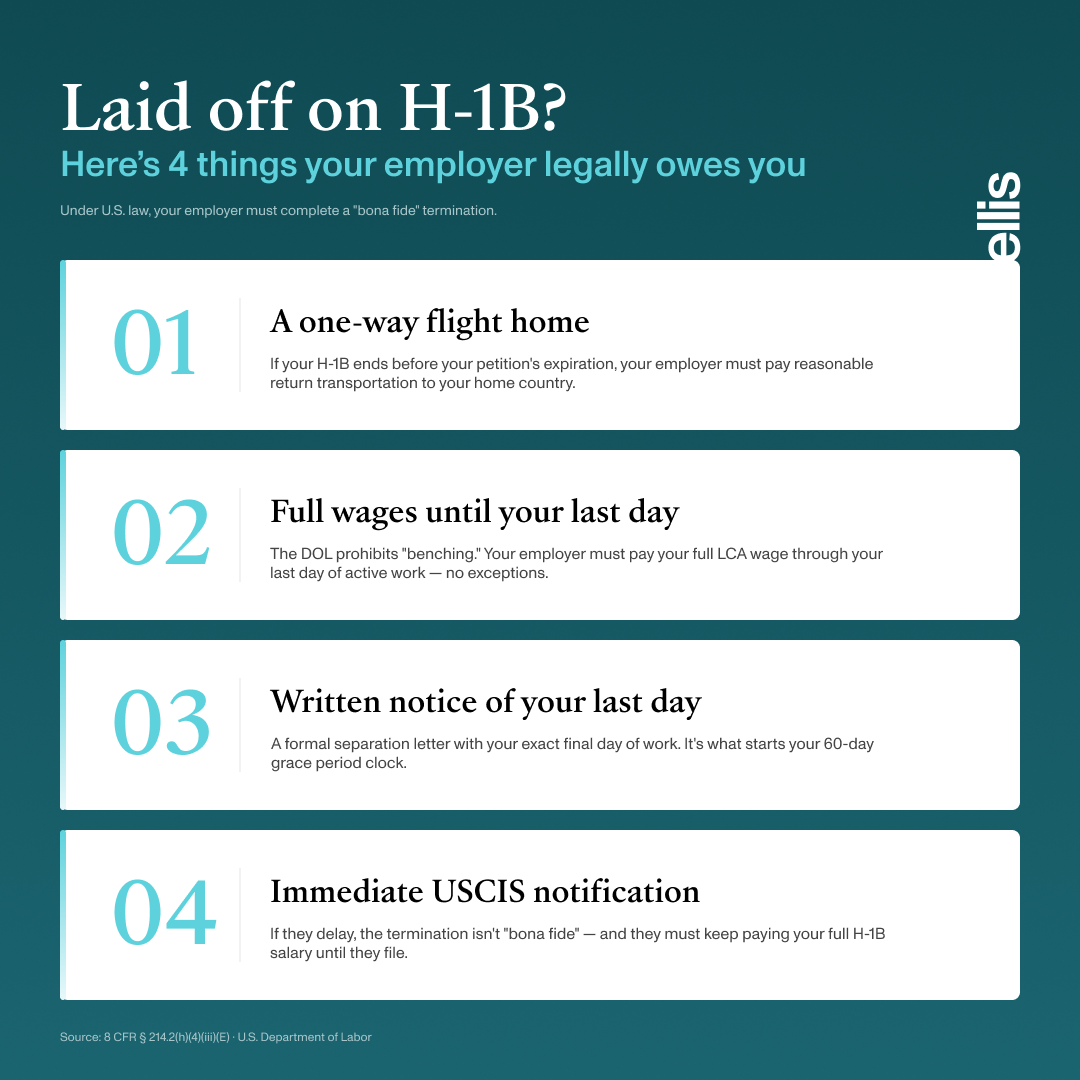
Under Department of Labor (DOL) and USCIS regulations, a company cannot simply say "you're fired" to an H-1B worker and walk away. To legally stop paying your wages and end their liability, an employer must execute what is called a bona fide termination. If a company fails to meet these federal compliance steps, they can be penalized and forced to pay back wages.
When you're laid off, your sponsoring employer legally owes you the following.
1. The cost of a one-way flight home
Under federal regulation 8 CFR § 214.2(h)(4)(iii)(E), if an employer terminates an H-1B worker before the expiration date on the approved visa petition, the employer is legally liable for the "reasonable costs of return transportation" to your last country of foreign residence.
- What they owe: Typically a one-way, economy-class plane ticket. They can either book it for you directly or reimburse you for the purchase.
- The limits: They are not legally required to pay for the relocation of your dependents (spouse, children) or your personal belongings and furniture.
Note: Many employers don't bring this up. Request this travel coverage explicitly in writing during your exit process. If you choose to stay in the U.S. to pursue a transfer, you waive this benefit.
2. Full required wages up to your final day
The Department of Labor strictly prohibits "benching" — the practice of placing an H-1B worker on unpaid status because of a lack of work or corporate funding. Your employer legally owes you your full salary (matching or exceeding the prevailing wage stated on your Labor Condition Application) up until your official last day of active work.
3. Written notice of your last day
An employer owes you a formal, written separation letter specifying your exact final day of active employment. This document is vital because it establishes the definitive paper trail for when your 60-day grace period officially begins.
4. Immediate notification to USCIS
To legally complete your termination, the employer must notify USCIS to withdraw your H-1B petition and cancel the corresponding LCA with the Department of Labor.
- The penalty for late notification: If an employer terminates you but delays notifying USCIS, the termination is not legally bona fide. Under federal case law, the employer is legally required to continue paying your full H-1B salary, even after your last day of work, until the exact date they officially notify the government.
Your other rights as a laid-off H-1B worker
Beyond what your employer owes you, you also have these operational rights:
- The 60-day grace period. USCIS will grant it in almost all cases, regardless of how the layoff happened.
- H-1B portability. You can start work with a new sponsor as soon as they file a non-frivolous H-1B petition. You don't have to wait for approval.
- Priority date preservation. Your approved I-140 priority date stays with you, even if you switch employers, as long as the I-140 wasn't revoked within 180 days of approval.
- Free choice of sponsor. No employer can hold your visa hostage. You can transfer to any cap-exempt employer at any time, and to any cap-subject employer that has been counted in the cap.
- No retaliation for filing. Employers cannot retaliate against you for filing or planning a transfer.
What documents should you keep after a layoff?
Save everything. You'll need most of it for filings and for proving your status history later.
- Termination letter or separation agreement. Shows the exact last day of work.
- Final paystub. Confirms the end-of-employment date.
- Severance agreement. Includes any non-compete or non-solicit clauses that could affect new job offers.
- Continued benefits paperwork (COBRA, etc.). Useful for health coverage planning during the gap.
- Your most recent H-1B approval notice (Form I-797). You'll need this for the new employer's transfer petition.
- Your I-94 record. Download from i94.cbp.dhs.gov or your I-94 record guide.
- Passport with current visa stamp.
- Most recent LCA and prior H-1B receipts from your old employer.
- Pay stubs from the past 12 months. Helpful for showing you maintained status.
- I-140 approval notice if you have one.
If you can, copy your work emails, performance reviews, and any documentation of your role before you lose access. Some of these matter for self-petitioned green card cases.
Need help figuring out your next steps?
Ellis can map your options, file a transfer or change of status fast, and help you protect any green card progress you've already made. Book a consultation to talk through your situation.
Final tips
A few things to do in the first week after a layoff:
- Get your termination date in writing. Your written separation letter is the most important document for measuring your 60-day clock.
- Update your resume and start outreach immediately. Many companies will sponsor a transfer if they want you. Be upfront about your status.
- Pull your I-94, I-797, and I-140 approval notices. Save them somewhere safe.
- Don't accept work as a contractor or 1099 without a new visa. That's unauthorized work and may damage future filings.
- If you have a spouse with H-4 EAD, lean on that income while you sort things out. Their EAD stays valid through the grace period.
- Avoid international travel unless you have a clear re-entry plan.
- Keep track of dates. Mark day 60 on your calendar. Mark earlier deadlines (day 30, day 45) as decision points to push toward a filing.
The 60-day window feels short, but most people get through it with a clear plan and quick action. The earlier you start, the more options stay open.
The information in this article is for general guidance only and is not legal advice.