

On September 18, 2026, President Trump signed an executive order directing the Departments of State, Labor, and Homeland Security to consider whether an H-1B sponsoring employer laid off workers in the past year or plans future layoffs. It applies to labor condition applications, petitions, visa applications, and admission at the border.
Key Takeaways
- What changed? Layoff history is now a factor in H-1B decisions, with a one-year lookback covering direct and indirect layoffs.
- Which filings? LCAs, Form I-129 petitions, consular visas, and admission at a port of entry. Extensions, amendments, and change of employer are included.
- What happens next? The Labor Department has 30 days to start reviewing LCAs already on file, so around October 18, 2026.
- Important: This is NOT a ban on filing after layoffs. Layoffs alone do not deny a petition, but they invite closer review of the wage and the role.
- Need help? Ellis attorneys prepare the petition, document the business reason for the role, and track every deadline in one place. Start here →
What is the new H-1B executive order?
President Trump signed the executive order on September 18, 2026. It does three things:
- Makes layoffs count. Three officials, the Secretary of State, the Secretary of Labor, and the Secretary of Homeland Security, now have to weigh an employer's layoff history when they decide H-1B cases.
- Pulls in outside data. Commerce, Education, and the Small Business Administration hand over figures on wages, jobs, schooling, industry, and the wider economy. An officer reviewing a petition can now put labor market numbers in the file.
- Leaves the details to the agencies. Each one can write its own rules and guidance. None have been published yet.
Which H-1B filings does the executive order affect?
The order reaches every stage of the H-1B process, not just the initial petition.
Stage | Agency | What the order adds |
|---|---|---|
Labor condition application (LCA) | Department of Labor | Layoff record becomes a factor before the LCA is certified |
Form I-129 petition | USCIS (DHS) | Layoff record becomes a factor in the petition decision |
Department of State | Consular officers weigh the sponsor's layoff record | |
Admission to the US | CBP (DHS) | Officers at a port of entry can consider it at the border |
The order names theLCA and the petition separately. H-1B extensions, amendments after a role or worksite changes, and change of employer petitions all run through those same two steps. So does H-1B consular processing for a worker applying from abroad.
What counts as a layoff under the executive order?
The order covers layoffs made "directly or indirectly," and are wider than a formal reduction in force. On its face it could reach:
- Contractor or vendor cuts
- The end of a client engagement
- A reorganization that removes roles
- Work shifted to another company or another country
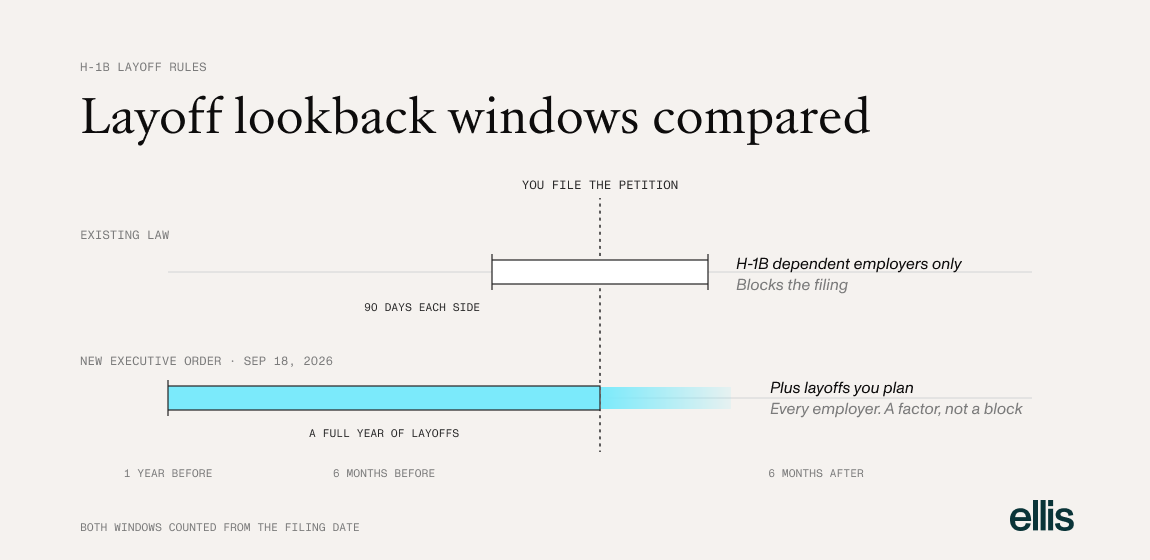
The window is one year, counted back from the filing date. The order also covers layoffs an employer "plans," so cuts that have not happened yet still count.
The key phrase is "similarly situated United States workers." A cut on the same team, doing the same work, is much closer to the H-1B role than a layoff in another department at another site. Details on this difference have not been clarified yet.
What is the Labor Department reviewing, and by when?
The Labor Department has 30 days to start, which ends up being around October 18, 2026. The Wage and Hour Division has to begin reviewing data from labor condition applications already on file, then decide whether to act against the employers who filed them.
This review lets the Labor Secretary open an H-1B investigation personally, with no worker complaint behind it. That is the same power behind Project Firewall, the enforcement push the Labor Department launched in September 2025. This order reads as the next phase of that effort, now aimed at LCA data employers filed months or years ago.
An LCA is a set of binding promises about the wage, the work location, and working conditions. The Wage and Hour Division can now review those promises well after the filing was made.
How is this different from the existing H-1B displacement rules?
Congress already wrote layoff rules into H-1B law, and they are much narrower than this order.
The law Congress wrote | September 2026 executive order | |
|---|---|---|
Who it applies to | H-1B dependent employers and willful violators only | Every H-1B sponsoring employer |
Time window | 90 days before and 90 days after filing | One year before filing, plus planned layoffs |
What counts | Displacement of a US worker from an essentially equivalent job | Direct or indirect layoffs affecting similarly situated US workers |
Effect | A legal bar on filing | A factor agencies weigh |
An H-1B dependent employer is one where H-1B workers make up a large share of the staff. The exact cutoff scales with company size. Congress also left out workers paid at least $60,000 or holding a master's degree, so hiring them does not trigger the dependent-employer duties. The executive order draws none of these lines.
That gap is also the order's weakest legal point. Critics say the President cannot add an eligibility rule that Congress never wrote. They also say the one-year lookback and the vague "indirect" layoffs go beyond what the law allows. No court has ruled on the order yet, so the rule is not settled law.
Is this the same as the $100,000 H-1B fee?
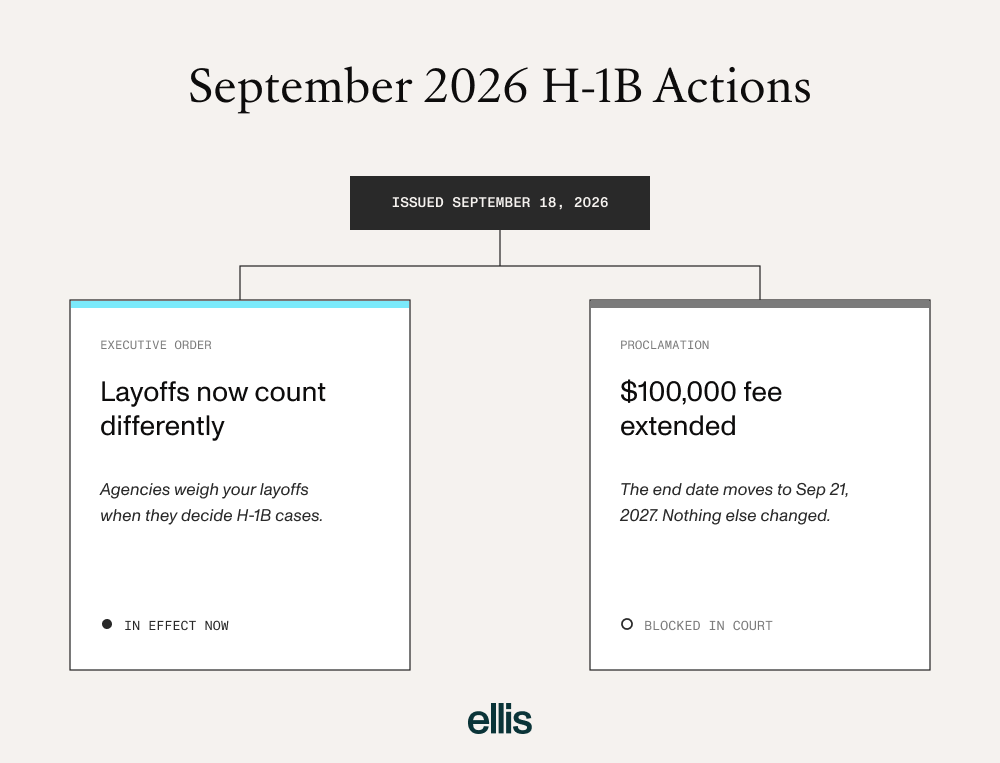
No. Two different H-1B actions were signed on September 18, 2026. The other is a proclamation on the $100,000 H-1B fee, which works differently and sits on its own litigation track. You can read about that separate order here.
What does this mean for H-1B workers if their company had layoffs?
This order is aimed at employers, not at the workers they sponsor. It does not change the 60-day grace period, and it does not change portability.
A worker whose employment ends still has the same options, and those run on their own timeline: the grace period, an H-1B transfer, or a change of status. Each of those is covered in more detail for workers who have been laid off on an H-1B.
What changes is the other side of the move. A new employer filing a change of employer petition is a sponsor too, so its own layoff record is in scope. A transfer into a company that recently cut staff may draw questions it would not have drawn before September 18.
What should employers do before filing?
No agency has issued guidance yet, so there is no checklist to follow. What employers can do is be ready to explain the hire if asked.
- Write down the business reason for the role before filing, not after a request for evidence arrives.
- Keep a record of any layoffs in the past year, including what was cut and where.
- Be able to show how the H-1B role differs from any position that was eliminated.
- Check that the LCA matches the actual wage and work location, since the Labor Department is now reviewing filings already on file.
Layoffs alone do not deny a petition. An employer that can explain the role in plain business terms is in a much better position than one reconstructing the reasoning months later.
Employers heading into the FY 2028 cap season have some runway. Registration does not open until spring 2027, and agency guidance may arrive before then, different from the cap season that just closed.
How Ellis can help
Employer H-1B petitions filed after a reduction in force are exactly the kind of case where the record really matter. Ellis attorneys build the petition, document the business reason for the role, and respond to any request for evidence, with every case and deadline visible in one system. Schedule a free consult →
This article is for general informational purposes only. It is not legal advice.