

CR-1 and IR-1 are the same immigrant visa for the spouse of a U.S. citizen. The category depends on how long the couple has been married when the spouse enters the United States. Under two years is CR-1, which grants conditional permanent residence. Two years or more is IR-1, which grants permanent residence with no conditions.
If you are married to a U.S. citizen and living in another country, this is the visa that brings you to the United States as a permanent resident. The two names cause most of the confusion, and the difference between them comes down to a single date. Below is what separates CR-1 from IR-1, what the process costs in 2026, how long each stage takes, and the follow-up deadline that CR-1 couples have to meet.
Key Takeaways
- What is it? The immigrant visa for the spouse of a U.S. citizen. CR-1 if you have been married under two years when your spouse enters, IR-1 if two years or more.
- How much? About $1,355 in government fees for one spouse in 2026, plus the medical exam.
- How long? Three stages in sequence: USCIS, the National Visa Center, then the embassy or consulate. USCIS republishes the Form I-130 range every month, so it is the only reliable place to read the current wait.
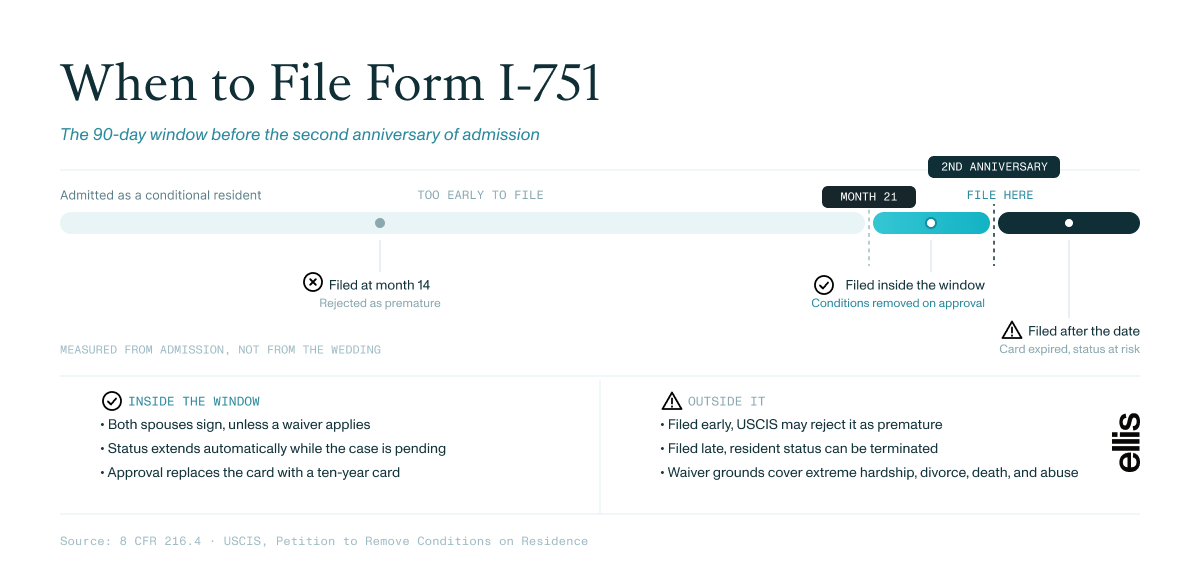
- Important: A CR-1 green card expires after two years and you do NOT renew it. The couple files Form I-751 together in the 90 days before the two-year anniversary of entry.
- Need help? Ellis attorneys handle the petition, the visa application, and the I-751, and keep every deadline in one place. Start here →
What is a CR-1 or IR-1 visa?
Both are immigrant visas for the husband or wife of a U.S. citizen who is living outside the United States. The visa is issued by a U.S. embassy or consulate abroad, a route called consular processing. The spouse arrives as a lawful permanent resident, and the green card, officially Form I-551, is mailed after admission.
The process starts with the U.S. citizen. They file Form I-130, Petition for Alien Relative, with USCIS. Once USCIS approves it, the case moves to the State Department, and the foreign spouse applies for the visa itself.
A spouse of a U.S. citizen is an immediate relative, and immediate relative visas are not capped by annual quotas. There is no priority date to wait for and no visa bulletin line, so the only wait is agency processing.
What does the CR-1 visa category mean?
CR stands for conditional resident. The spouse gets a green card that is valid for two years instead of ten, and the couple has to prove the marriage again before it expires.
What does the IR-1 visa category mean?
IR stands for immediate relative. The spouse gets a standard ten-year green card with no follow-up petition and no second review of the marriage.
When is a spouse visa CR-1 instead of IR-1?
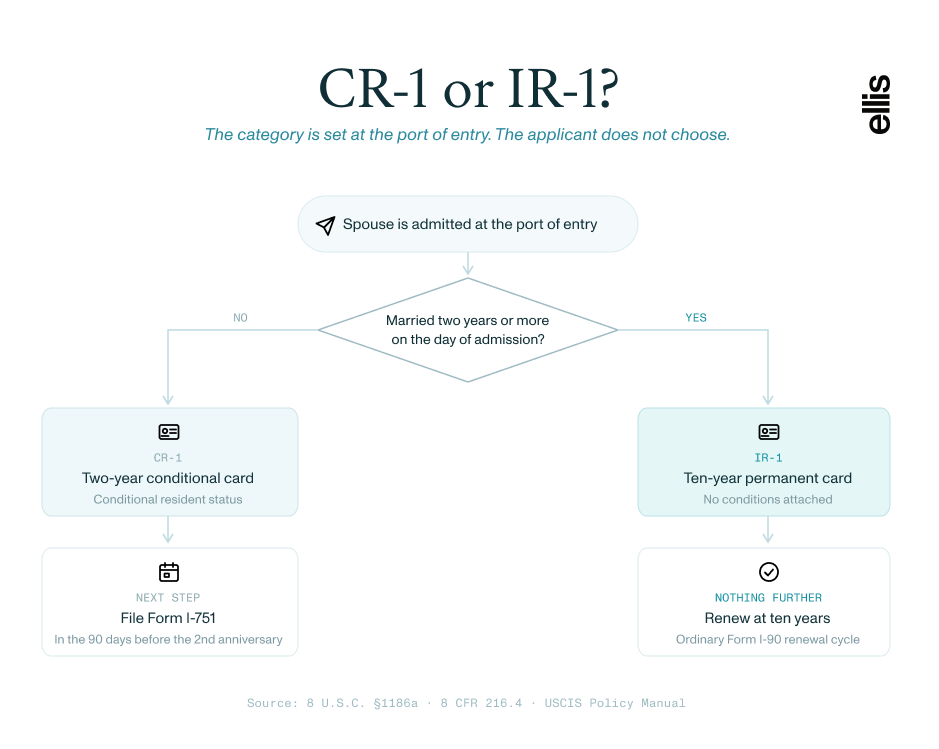
The category is set by how long you have been married on the day your spouse enters the United States. The State Department is specific about this: if you have been married less than two years when your spouse enters on an immigrant visa, the permanent resident status is conditional.
Category | Married at entry | Green card validity | Extra step |
|---|---|---|---|
CR-1 | Under 2 years | 2 years | File Form I-751 before it expires |
IR-1 | 2 years or more | 10 years | None |
U.S. Spouse Visa Requirements
Three things have to be true: the petitioner qualifies, the marriage is valid, and the foreign spouse is admissible. Each one is checked by a different office, USCIS for the first two and the consulate for the third.
The U.S. citizen has to:
- Be at least 18 years old.
- Keep a principal residence, called a domicile, in the United States. A citizen living abroad can still petition, but has to show they intend to re-establish a home in the U.S. by the time the spouse immigrates.
- Sign the Affidavit of Support and meet the income threshold for their household size.
The marriage must:
- Be legally valid where it took place. A common-law marriage can qualify depending on the law of the country where the couple lives.
- Be documented as genuine rather than arranged for immigration benefits. Joint finances, shared housing, and communication history carry the most weight.
- Be monogamous.
The foreign spouse must
- Pass a medical exam with the required vaccinations, done by an authorized panel physician.
- Not be inadmissible on grounds such as fraud, misrepresentation, drug trafficking, or certain immigration violations.
A previous overstay or a prior removal order does not automatically disqualify a spouse, but it can complicate a case, and the effect depends heavily on the individual history.
How much does a CR-1 or IR-1 visa cost in 2026?
Government fees for one spouse come to roughly $1,355, not counting the medical exam, translations, and travel.
Fee | Amount | Notes |
|---|---|---|
Form I-130 filing fee | $675 paper, $625 online | Paid to USCIS by the petitioner. $675 if filed at a consulate. |
Immigrant visa application fee | $325 per person | Paid to the State Department after NVC creates the case. |
Affidavit of Support review | $120 | Charged when the Form I-864 is reviewed in the United States. |
$235 | Paid after the visa is issued. Covers producing the green card. |
State Department fees are charged for each intending immigrant regardless of age, and they are not refundable. The USCIS Immigrant Fee is $0 for several groups, including K nonimmigrants, children entering under the orphan or Hague adoption programs, Iraqi and Afghan special immigrants, and returning residents on an SB-1.
The $250 visa integrity fee that took effect in October 2025 does not apply here. It is charged on nonimmigrant visa stamps, and people applying for an immigrant visa or for a green card inside the U.S. are not subject to it.
How long does the CR-1 and IR-1 process take?
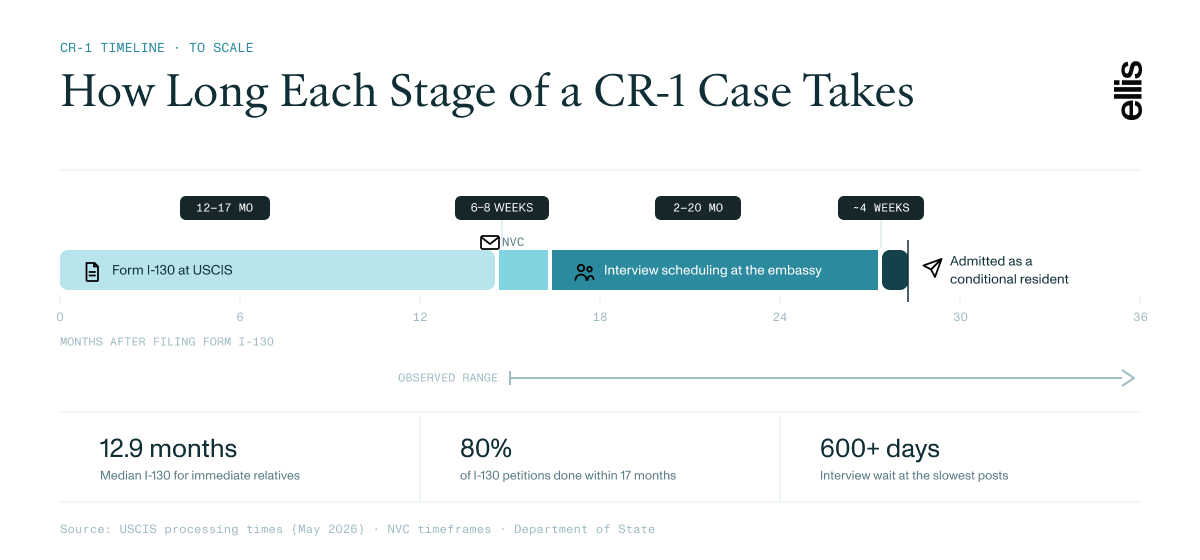
The total wait is the sum of three separate stages at three different agencies, which is why published estimates vary so widely.
Stage | Who handles it | Typical time |
|---|---|---|
Form I-130 review | USCIS | Republished monthly by USCIS, see the processing times tool |
Case creation and document review | National Visa Center | About 1 week to create the case, about 7 weeks to review documents |
Interview scheduling and issuance | U.S. embassy or consulate | Varies by post |
Interview waits are the least predictable part. They depend on the post, and a busy consulate can add months that have nothing to do with the strength of the case. The USCIS processing times tool shows the current range for a specific form and category.
How to apply for a CR-1 or IR-1 visa, step by step
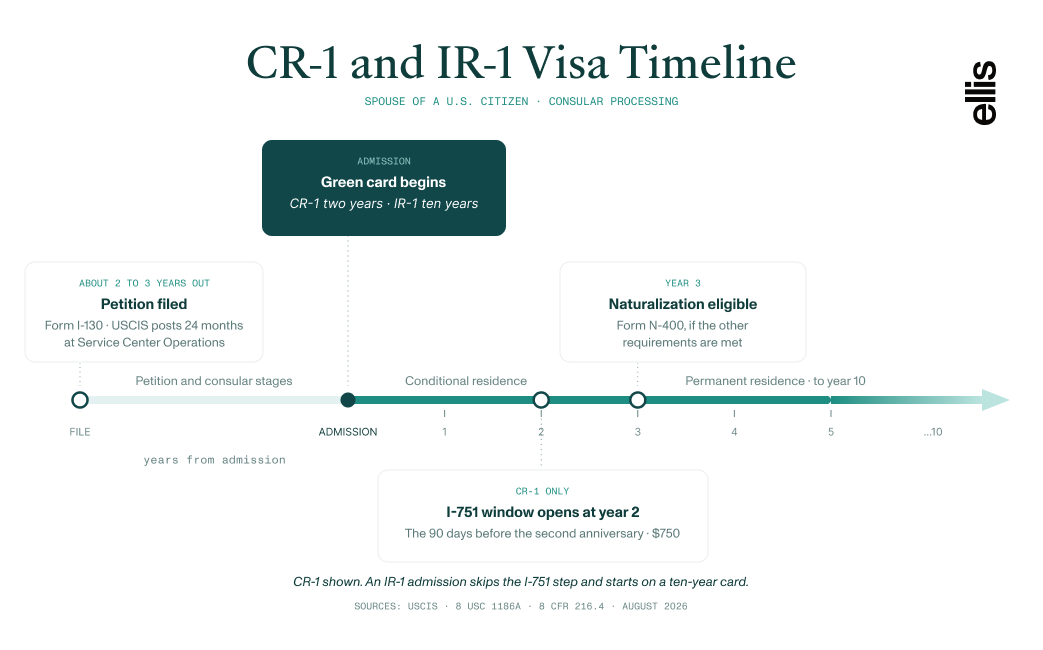
The sequence is fixed. Each stage has to finish before the next one starts.
- The petitioner files Form I-130. The U.S. citizen files with USCIS, along with Form I-130A for the spouse beneficiary and evidence of the marriage. On Part 4 of the form, question 61 or 62 asks whether the beneficiary will apply for a green card inside the United States or use consular processing abroad. USCIS instructs petitioners to answer one and only one of the two, not both and not neither. Changing that answer after approval can require Form I-824.
- USCIS approves the petition and sends it to NVC. Approval does not grant any status or benefit. It establishes the relationship.
- NVC assigns a case number. The applicant completes Form DS-261 to name an agent for the case.
- Fees are paid. The immigrant visa application fee and, where it applies, the Affidavit of Support review fee.
- Documents go to NVC. This is the Affidavit of Support on Form I-864, I-864A, I-864EZ, or I-864W, plus Form DS-260 and civil documents. Anything not in English needs a full English translation with a certification from the translator.
- The applicant completes the medical exam. An authorized panel physician performs the exam and the required vaccinations.
- The consular officer conducts the interview. At the U.S. embassy or consulate, with the passport, two 2x2 photographs, and the original civil documents.
- The visa is issued. It goes into the passport, and the spouse travels to the United States within its validity.
The passport has to be valid for at least six months beyond the intended date of entry. Civil documents means birth certificate, marriage certificate, and, where relevant, divorce or death certificates for any earlier marriage.
How much income do you need to sponsor a spouse?
The petitioner signs Form I-864 to promise financial support for the immigrating spouse. It is a contract with the U.S. government, not a formality, and it stays in force for years after arrival.
The threshold is tied to the federal poverty guidelines and the sponsor's household size. Sponsors who do not meet it on their own income can use assets, or a joint sponsor who does meet it can sign a second I-864.
The purpose of all of this is the public charge question: whether the immigrating spouse is likely to depend on public benefits.
After entry: conditional residence and Form I-751
Permanent resident status begins at admission. Work authorization and travel come with it, so there is no separate employment authorization document to apply for and no waiting period before starting a job. The physical green card arrives in the mail, which is what the USCIS Immigrant Fee pays for. The card carries an alien registration number, also called an A-number, which becomes the spouse's main identifier in every later filing.
For an IR-1, that is the end of the process. The card is valid for ten years and renews with Form I-90.
For a CR-1, there is one more step. The couple applies together to USCIS to remove the conditional status in the 90 days before the two-year anniversary of the spouse's entry. That filing is Form I-751, Petition to Remove Conditions on Residence. It costs $750 on paper and $700 online, and it is free for a conditional resident filing with a waiver of the joint filing requirement based on battery or extreme cruelty. Once USCIS approves it, the ten-year card replaces the two-year one.
The 90-day window is a hard deadline and it runs from the date of entry, not from the date on the card. Cases where the marriage has ended before that point are handled through a waiver rather than a joint filing, and the options there depend on the specific facts.
CR-1 vs K-1 vs adjustment of status
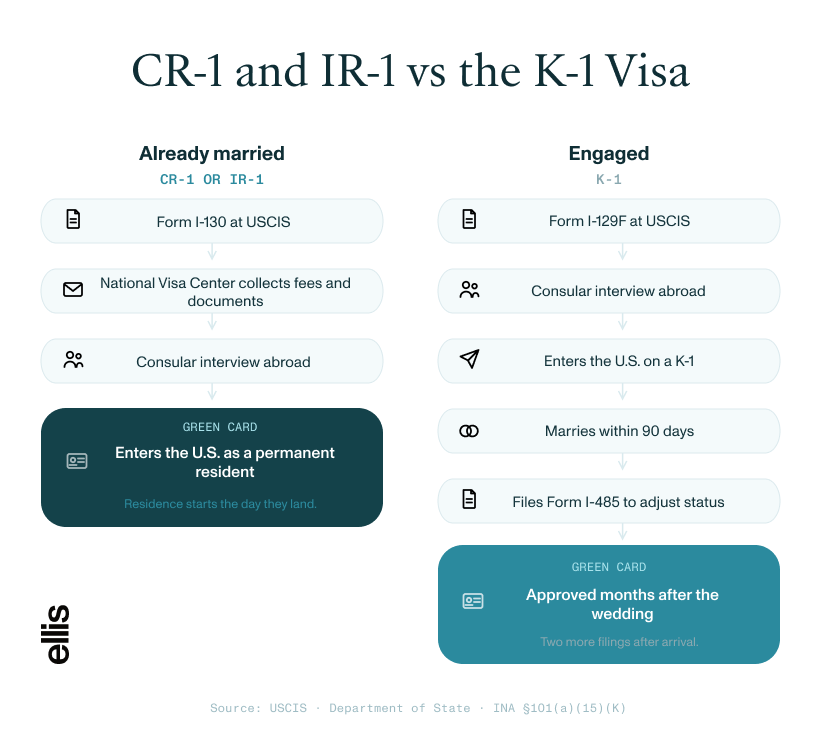
Three routes lead to a green card through marriage to a U.S. citizen, and they are not interchangeable.
Route | Who it is for | Status on arrival |
|---|---|---|
CR-1 or IR-1 | Already married, spouse is abroad | Permanent resident at entry |
K-1 | Not yet married, fiancé is abroad | Nonimmigrant, marries within 90 days, then files I-485 |
Adjustment of status | Already married, spouse is already in the U.S. lawfully | Applies for the green card without leaving |
A CR-1 or IR-1 spouse can work immediately. A K-1 fiancé arrives as a nonimmigrant, marries within 90 days, then files Form I-485 and waits for work authorization, which adds cost and a gap with no legal ability to work. The K-1 often reaches the U.S. sooner. It also has more steps after arrival.
IR-2 comes up in the same searches and is a different category. It is the immigrant visa for the unmarried child under 21 of a U.S. citizen, and a child immigrating alongside a parent on a CR-1 or IR-1 is usually a CR-2 or IR-2.
Why do CR-1 and IR-1 visas get denied or delayed?
USCIS issues a request for evidence when the marriage evidence is thin. Joint financial records, a shared lease, photographs across time, and communication history all carry more weight than affidavits alone.
At the consular stage, a case can come back as a 221(g) refusal, which usually means the officer wants a missing document rather than that the case is denied. Administrative processing is a separate hold for additional review, and it has no published timeline.
Other recurring problems: a medical exam that expires before the visa is issued, a name spelled differently across a birth certificate and a passport, civil documents submitted without a certified translation, and a petitioner abroad who cannot document U.S. domicile.
Refusals for marriage fraud are less common than the search volume suggests, but they carry lasting consequences, and a finding on the record follows both spouses into any future filing.
How Ellis can help
A spouse visa runs across two agencies, takes a year or more, and ends with a hard I-751 deadline that arrives two years after entry. A refusal or a poorly documented Affidavit of Support restarts a long wait. Ellis attorneys prepare the petition and the visa application, respond to any request for evidence, and track the I-751 deadline in one place.
This article is for general informational purposes only and is not legal advice.