


Consular processing and adjustment of status are the two routes to a green card, and the difference comes down to one thing: where you finish the process. Adjustment of status (Form I-485) is for people already in the United States, who become permanent residents without leaving. Consular processing is for people outside the United States, who complete their case at a U.S. embassy or consulate abroad.
Both routes end in the same place, lawful permanent residence, the green card. What differs is the cost, the timeline, the travel rules, and who qualifies for each. Here is how they compare.
Key Takeaways
- What's the difference? Adjustment of status keeps you in the U.S. and files with USCIS. Consular processing finishes at a U.S. consulate in your home country. Your location usually decides which one you use.
- How much? Adjustment of status costs $1,440 in USCIS filing fees for most adults, which now covers biometrics and, when filed together, your work permit and travel document. Consular processing government fees run about $680 for a family case, plus a medical exam abroad.
- How long? Both usually take about a year, but times swing widely by category, USCIS office, and consulate. Check current USCIS and State Department times before you plan around either.
- Important: You do NOT file both. Choosing the wrong path, or filing an I-485 when you're not eligible to adjust, can cost you months and money. Prior overstay or unlawful presence can block adjustment of status for some applicants.
- Need help? Ellis pairs you with an immigration attorney and tracks your case from petition to green card. Start here →
How the two paths compare
Factor | Adjustment of Status (I-485) | Consular Processing |
|---|---|---|
Where you are | Inside the U.S. | Outside the U.S. |
Where you file | USCIS | National Visa Center, then a U.S. consulate |
Main form | Form I-485 | Form DS-260 |
Interview location | Local USCIS field office | U.S. embassy or consulate abroad |
Can work/travel while waiting | Yes, with EAD and advance parole | You're abroad until the visa is issued |
What is adjustment of status?
Adjustment of status lets you become a green card holder without leaving the United States. You file Form I-485, the Application to Register Permanent Residence or Adjust Status, with USCIS. The path comes from section 245(a) of the Immigration and Nationality Act (INA 245(a)).
To qualify, you generally need to be in the U.S. in a valid status with an immigrant visa immediately available to you. Availability is set by your priority date and the monthly Visa Bulletin. You also need an approved or concurrently filed petition, usually Form I-130 for family cases or Form I-140 for employment cases.
Once you file, you give biometrics (fingerprints and a photo) and, in most cases, attend an interview at a local USCIS field office. While your I-485 is pending, you can request a work permit with Form I-765 and a travel document, advance parole, with Form I-131. That means you don't have to put your job or your travel on hold while you wait.
What is consular processing?
Consular processing is how you get a green card from outside the United States. Once USCIS approves your petition, the case moves to the National Visa Center (NVC), where you pay the fees, submit your documents, and file Form DS-260, the online immigrant visa application.
After the NVC signs off, it schedules your interview with a consular officer at the U.S. embassy or consulate in your home country. You complete a medical exam with an approved doctor beforehand. If the officer approves you, you receive an immigrant visa to enter the U.S., and your green card arrives by mail once you're in the country and have paid the USCIS Immigrant Fee.
Which path is cheaper?
The government fees differ, and each path carries a cost the other doesn't.
Path | Government fees | Notes |
|---|---|---|
Adjustment of status | $1,440 (most adults) | Covers biometrics. Work permit (I-765) and advance parole (I-131) are included when filed with the I-485. Applicants under 14 filing with a parent pay $950. |
Consular processing | About $680 (family case) | DS-260 fee $325, Affidavit of Support review $120, USCIS Immigrant Fee $235. Employment-based DS-260 fees differ and may skip the support fee. |
A couple of things narrow the gap. Both paths need the underlying petition first, so the I-130 or I-140 fee applies either way. And consular processing adds a medical exam abroad, paid to the doctor and priced differently by country, while adjustment of status has its own medical exam (Form I-693), usually at a higher U.S. rate.
The trade-off comes down to this. Adjustment of status charges more up front but folds in your work and travel permits. Consular processing costs less in government fees, but you can't live or work in the U.S. while your case is pending.
Which path applies to you
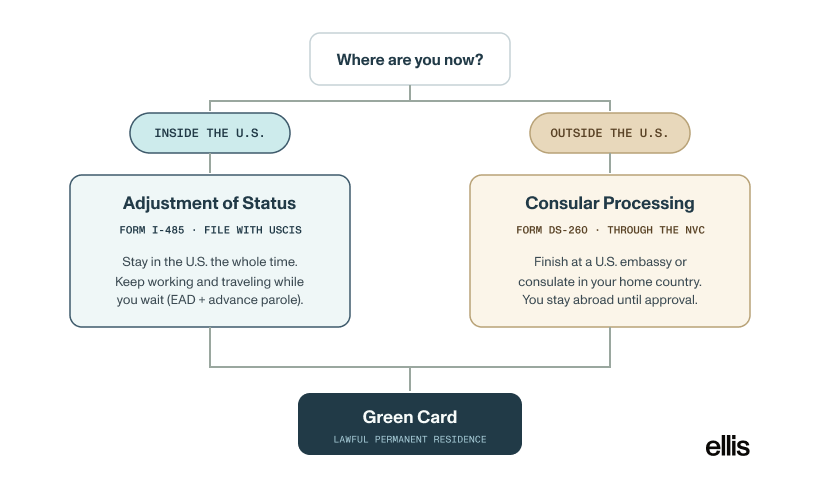
Your location is the starting point, but a few factors decide which path is actually available:
- Where you are now. If you're in the U.S. in valid status, adjustment of status is usually the natural choice. If you're abroad, consular processing is typically your only option.
- Travel and work needs. Adjustment of status lets you request a work permit and advance parole, so you can keep working and traveling while you wait. With consular processing, you stay abroad until the visa is issued.
- Immigration history. Unlawful presence, an overstay, or certain other violations can make you ineligible to adjust status, or can create a bar if you leave the country during consular processing. This is where cases go wrong most often, so get advice before you decide.
- Where your family is. If some relatives are in the U.S. and some are abroad, the two paths can split across your family, and timing matters.
Which path is faster?
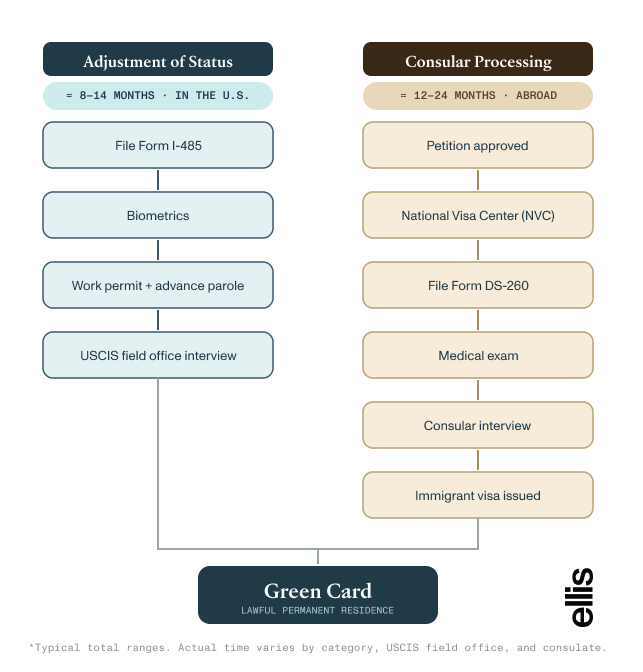
Neither path is reliably faster. Both usually run about a year, and the honest answer depends on your category, your local USCIS office, and the specific consulate.
Adjustment of status moves at the pace of USCIS field office backlogs. Consular processing depends on the NVC stage plus how long your consulate takes to open an interview slot, which varies a lot by country. Before you pick a path on speed alone, check the current USCIS processing times and the State Department's visa interview wait times for your post.
Can you switch from consular processing to adjustment of status?
Sometimes, yes. If you started consular processing but end up in the U.S. in a valid status with a visa available, you may be able to switch to adjustment of status, and the move can run the other way too. It isn't automatic, and it can reset your timeline, so confirm you're eligible before you change course. A wrong step here can trigger a travel bar or a denial, which makes it a smart moment to talk to an attorney.
How Ellis can help
Ellis's attorneys review your history, recommend the right path, and prepare your filing, while the case-management system keeps every form and deadline on track. Schedule a free consult →
This article is for informational purposes only and is not legal advice.