


A biometrics appointment is an in-person visit scheduled by USCIS for collecting physical and digital identifiers: fingerprints, a photograph, and a digital signature. USCIS uses this data to verify your identity and run security checks. USCIS schedules biometrics appointments 4 to 8 weeks after application, and the appointment usually takes about 20 minutes.
Key Takeaways
- What is it? A short visit to a USCIS Application Support Center where USCIS collects fingerprints, photos, and signatures at appointments. No interview or formal questioning occurs during the biometrics appointment.
- When? Biometrics appointments typically occur within a month of the receipt notice, or roughly 4 to 8 weeks after filing. Family-based green card biometrics are scheduled 5 to 8 weeks after filing.
- What to bring? Your appointment notice (Form I-797C) and valid photo identification, like a driver's license or passport.
- Important: If you miss your scheduled biometrics appointment without rescheduling, USCIS may consider your application abandoned and deny it. Online reschedule requests must be made at least 12 hours before the appointment time.
- Need help? Ellis attorneys handle the filing and track every appointment and deadline in one place. Start here →
What Is a Biometric Services Appointment and Who Needs One?
A biometric services appointment is required by U.S. Citizenship and Immigration Services (USCIS) for many immigration benefit requests. USCIS collects biometrics to confirm your identity, screen for criminal history, and run required background checks through federal databases, including the Federal Bureau of Investigation (FBI).
Not every filing needs one. Common forms that do include:
- Form I-485 (green card applications through adjustment of status)
- Form I-765 (work permits)
- Form I-131 (travel documents, in some cases)
- Form N-400 (naturalization and citizenship applications)
- Other filings where identity verification or security screening is required by law
If biometrics are needed for your case, USCIS sends the notice automatically after it accepts the request filed with the agency. There is nothing to ask for on your end.
USCIS can sometimes reuse data from a prior collection instead of scheduling a new appointment. Biometrics are generally valid for 15 months for immigration applications, measured from the fingerprint check results.
Photographs follow a separate rule. Under Policy Alert PA-2025-29, effective December 12, 2025, USCIS reuses a photo only if it was collected within the past 36 months, and self-submitted photos are no longer accepted. Forms I-485, N-400, I-90, and N-600 always require fresh biometrics and a new photograph, no matter how recent the last appointment was.
Why did you get a biometrics appointment?
USCIS schedules an appointment when a case needs identity or background checks it cannot run from records it already has, which is why two people filing the same form can be treated differently.
Three patterns come often:
- Green card applications almost always draw one. Form I-485 requires fresh biometrics and a new photo every time, so an earlier appointment rarely counts.
- Any past contact with the criminal justice system, including an arrest, a dropped charge, or a case sealed or expunged by a state court. Expungement clears the state record, not the federal one, so old matters still show up in the FBI results.
- Students with status problems, such as a gap in F-1 status or a reinstatement request. These can draw a closer look than a routine extension.
Since April 27, 2026, USCIS has also been running a strengthened screening process that re-checks fingerprints on many cases. People who gave biometrics for an earlier filing are being called back more often than they were a year ago.
A notice on its own does not mean something is wrong, and most people who get one are in an ordinary queue. When it follows a criminal record or a status violation, what the results mean depends on the details, which is worth asking an immigration attorney about.
When Will USCIS Send Your Biometrics Appointment Notice?
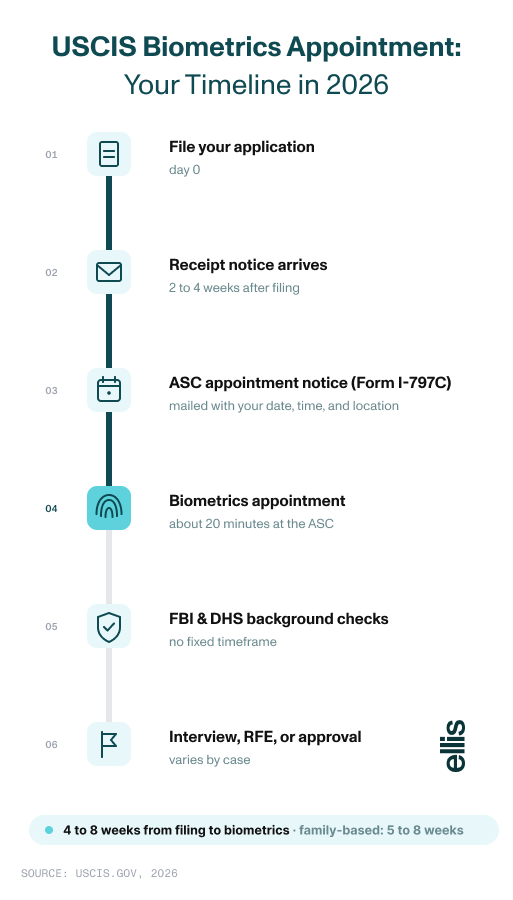
USCIS schedules biometrics appointments 4 to 8 weeks after application in most cases. The exact timing depends on your form type, your location, and the workload at your local application support center, but the pattern is generally:
- Biometrics appointments typically occur within a month of the receipt notice, which itself usually arrives a few weeks after filing.
- Family-based green card biometrics are scheduled 5 to 8 weeks after filing.
- Busier ASCs run longer. A delay of a few extra weeks at a high-volume location is normal and not a sign of a problem with your case.
Reading your ASC appointment notice
The ASC appointment notice arrives by mail as Form I-797C. Read the notice carefully. It lists the date, time, and location of your appointment along with any specific instructions for your case.
A few things worth knowing about the notice:
- USCIS assigns the location based on your mailing address, usually the nearest Application Support Center (ASC). An ASC is not the same as a USCIS office that handles interviews.
- An outdated mailing address is one of the most common reasons applicants never receive the notice. Address updates go through your USCIS online account.
- Since April 1, 2024, the biometric services fee has been included in the main filing fee for most benefit requests. A separate $30 fee still applies to Temporary Protected Status filings under 8 CFR 106.2, and certain cases in immigration court proceedings may also carry a separate fee.
What Happens During Your ASC Appointment: Fingerprints, Photo, and Digital Signature
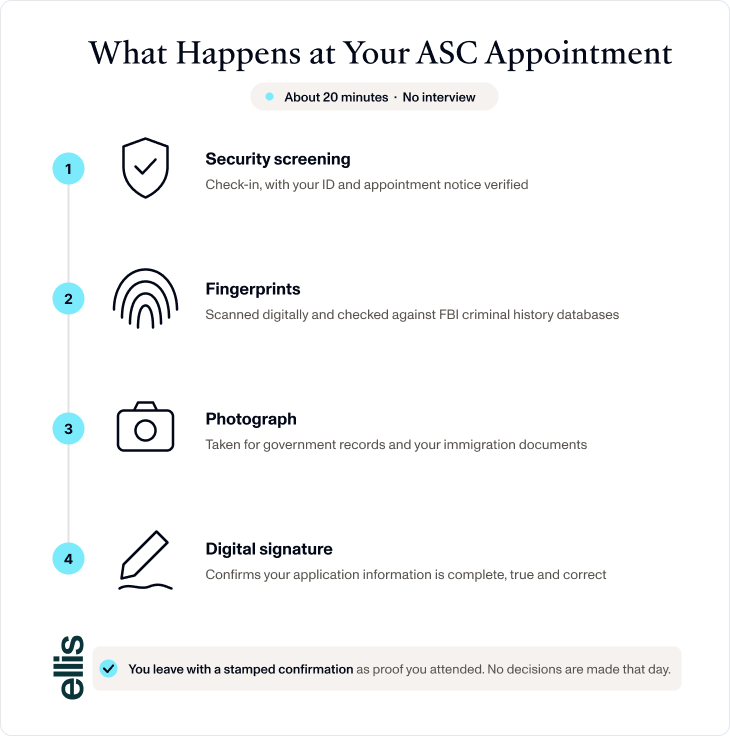
The appointment is short and procedural. The biometrics collection process typically takes under 30 minutes, and most applicants are done in about 20 minutes.
When you arrive for this in-person appointment, you pass through security screening, staff check your notice and identity, and you are called at or near your scheduled appointment time. Staff then collect biometrics in three forms:
- Fingerprints: each finger is scanned digitally, sometimes more than once for image clarity, and the prints are checked against FBI criminal history databases.
- Photograph: a digital photo taken for government records, immigration documents, and future identity matching.
- Digital signature: an electronic signature confirming that the information in your application is complete, true, and correct.
No interview or formal questioning occurs during the biometrics appointment. It is a data collection step, not a decision point, and nothing about your case is decided that day.
You will receive a stamped confirmation after your appointment. The stamp does not grant any immigration status, but it is your proof of attendance and belongs with your case records.
What to Bring: Read Your Appointment Notice Carefully
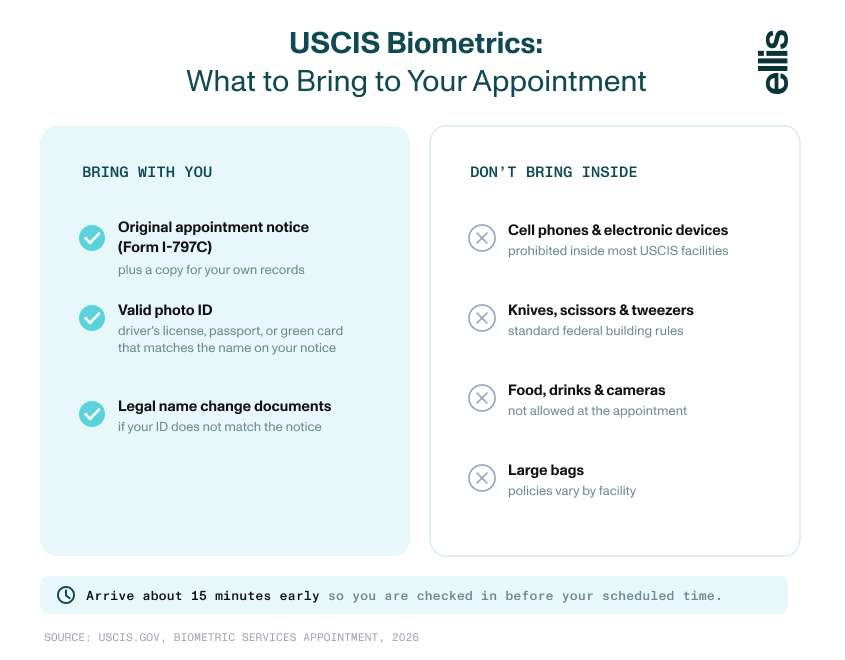
Your appointment notice will specify required documents. At a minimum, USCIS expects:
- The original appointment notice (Form I-797C). Bring a copy of your appointment notice as well, in case the original is stamped or collected, plus any supporting documents the notice lists.
- Valid photo identification. Bring a photo ID like a driver's license or passport. A green card also qualifies. The name and photo must match the information on your notice.
- Legal name change documents may be necessary if identification does not match the appointment notice.
If your primary ID has expired, renewal paperwork or a receipt showing a replacement is in progress can help, though acceptance of alternative IDs varies by facility. Arriving at least 15 minutes early is the standard guidance, so you are checked in before your scheduled time.
Items to leave outside the appointment
- Prohibited items include knives, scissors, and tweezers during the appointment, the same restrictions as other federal buildings.
- Most USCIS facilities prohibit cell phones and electronic devices inside, though policies vary by location.
- Do not bring food, drinks, or cameras to the appointment.
- Large bags may not be permitted, depending on the facility.
How to Reschedule Your Biometrics Appointment
USCIS allows rescheduling requests if made at least 12 hours in advance and supported by good cause. Life happens, and a timely request to reschedule protects your case when the original appointment date will not work.
What counts as good cause
USCIS has described good cause as including:
- Illness, medical appointments, or hospitalization
- Previously planned travel
- Transportation difficulties
- Employment constraints
- Significant life events
- A notice that arrived late
The standard is practical. To establish good cause, the reason should be specific to you and the date, and raised before the appointment passes rather than after.
Online or by phone
- Online: submit the request through your myUSCIS account. USCIS requires rescheduling requests at least 12 hours in advance of the scheduled appointment time. An attorney or accredited representative can also file the request through their own account.
- Phone: call the USCIS Contact Center at 800-375-5283 when the online tool is not an option. That includes an existing appointment that has already passed and any appointment that has already been rescheduled two or more times.
Each reschedule moves the new appointment weeks out, so keeping the original appointment where possible keeps the overall application process on schedule.
How a Missed Appointment Affects Your Immigration Application
Missing a biometrics appointment can delay your immigration case, and the risk goes beyond delay. USCIS may consider your application abandoned if you miss your appointment without a valid reason or a timely reschedule request, and a request abandoned this way can be denied on that basis alone. You must request to reschedule your appointment to avoid denial.
There is still a path if the date has already passed. You can call the USCIS Contact Center to reschedule a missed appointment, and applicants who act quickly and can show good cause are often accommodated. But there is no guarantee, and requests made before the original date are on much firmer ground.
Denials purely for failing to attend a biometrics appointment are relatively uncommon. They do happen, though, and they are entirely avoidable.
After Your Appointment: Background Checks and Security Screening
Once USCIS collects your biometrics, the data goes to the FBI and the Department of Homeland Security for the required background and security checks. The FBI checks fingerprints against criminal history databases, and results are shared across law enforcement agencies and immigration systems to screen for criminal records, immigration violations, and identity or security concerns. Biometric data helps prevent fraud in immigration applications, and USCIS conducts background checks using biometric data before deciding most benefit requests.
Depending on your immigration application, the next milestone after biometrics could be:
- An interview, which is common for I-485 and N-400 cases
- A Request for Evidence (RFE)
- A direct approval
- Issuance of a document, such as a green card or work permit
USCIS does not publish fixed timeframes for background checks. Checking your case status through your online account is the reliable way to catch updates or requests for additional documentation.
Criminal Record and Special Situations: When to Talk to an Immigration Attorney
- Criminal record: applicants with any criminal record, even a minor or decades-old one, generally benefit from speaking with an immigration attorney before the appointment. The FBI report generated from the fingerprints will surface past arrests and charges, and what those records mean for a case depends on the specific facts.
- Fingerprint waivers: certain medical conditions, such as severe burns or skin conditions, can make fingerprints impossible to capture. USCIS can grant waivers in those situations.
- Mobile biometrics: for applicants who are homebound or medically unable to appear, mobile collection may be available in extraordinary cases with documented medical evidence.
- Children and guardians: when a form requires biometrics, minors attend too. A parent or legal guardian appearing on a child's behalf should bring documents proving the relationship. Whether a family member can accompany an applicant inside depends on facility policy, and USCIS permits bringing someone for language assistance, including an attorney or accredited representative.
What Employers and HR Teams Should Know About Green Card and Naturalization Timelines
For employers sponsoring a green card or supporting an employee's naturalization, the biometrics appointment is a small step that can move the whole timeline. A few points make it easier to manage:
- Scheduling: biometrics appointments typically occur within a month of the receipt notice, so employees usually have a few weeks of warning. ASC-level backlogs vary.
- Time away from work: the appointment itself takes about 20 minutes, but travel, check-in, and waiting can consume a half day, which matters for workforce planning.
- Complex cases: a criminal record, prior immigration violations, or name discrepancies warrant early coordination with counsel.
- Validity windows: fingerprint results are generally valid for 15 months, and photos can only be reused within 36 months. HR teams that track collection dates and plan ahead can anticipate when a repeat appointment will be needed for the next filing.
How Ellis Can Help
A missed notice or a mishandled reschedule can undo months of waiting. Ellis attorneys prepare the filing, track every deadline that follows, and manage rescheduling and follow-up when plans change, whether you are an individual applicant or an HR team running workforce immigration. Schedule a free consult →
This article is for general informational purposes only and is not legal advice.