


Administrative processing, sometimes called admin processing, is extra review a U.S. consular officer runs on a visa application after the interview, usually under section 221(g) of the Immigration and Nationality Act. It is a temporary refusal, not a denial. Most cases are resolved within 60 days of the interview, though security checks can also take several months.
Leaving your visa interview with a slip instead of a decision is unsettling, but it rarely means something is wrong. Administrative processing is one of the most common steps in the U.S. visa process, and one of the most misunderstood. This guide explains what it means, why it happens, how long it really takes, and what to do while you wait.
Key Takeaways
- What it is: A temporary hold for extra review under INA section 221(g). Your visa is refused for now, not denied.
- How long? Most cases clear within 60-90 days of the interview. Document-only cases can resolve in days. Security clearances can run several months, and there is no fixed minimum.
- Is it normal? Yes. It is common, and it does not mean you did anything wrong.
- Important: Do NOT rebook a new interview or reapply. Wait for the case to move, and respond fast if the officer asks for documents. You have one year from the refusal date to submit them.
- Need help? Ellis pairs you with an immigration attorney and tracks your case from start to finish. Start here →
What is administrative processing?
Administrative processing is additional review of your visa application after the interview, before the consular officer makes a final decision. The officer has decided they need more time or more information before they can approve or refuse the visa outright.
You may also see it written as "admin processing." It means the same thing. Many applicants hear the phrase for the first time at the interview window, when the officer hands over a colored slip and says the case needs further review.
The key point is that administrative processing is a pause, not an ending. Your application is still alive. The officer is doing extra checks, waiting on another agency, or waiting on a document before finishing the case.
Is administrative processing the same as a 221(g) refusal?
Yes, in most cases they are the same thing. When a case goes into administrative processing, the officer refuses it under section 221(g) of the Immigration and Nationality Act and holds it open for more review.
A 221(g) refusal is not a denial. It means you have not yet established that you qualify for the visa, and the officer needs something more before deciding. That "something" might be a document from you, or it might be an internal check the officer runs without your involvement.
This matters because a refusal and a denial are different outcomes. A denial closes the case. A 221(g) refusal keeps it open. If the officer asked you to provide documents or information, you have one year from the date of the refusal to submit them. If you provide nothing within that year, you generally have to start over with a new application and a new fee.
Sometimes the officer asks for no documents at all and simply tells you the case needs administrative processing. In that situation there is nothing to submit. The case is under internal review, and your job is to wait.
Why is my visa in administrative processing?
Your visa is in administrative processing because the officer wants to confirm something before issuing the visa. In practice, this happens for two broad reasons.
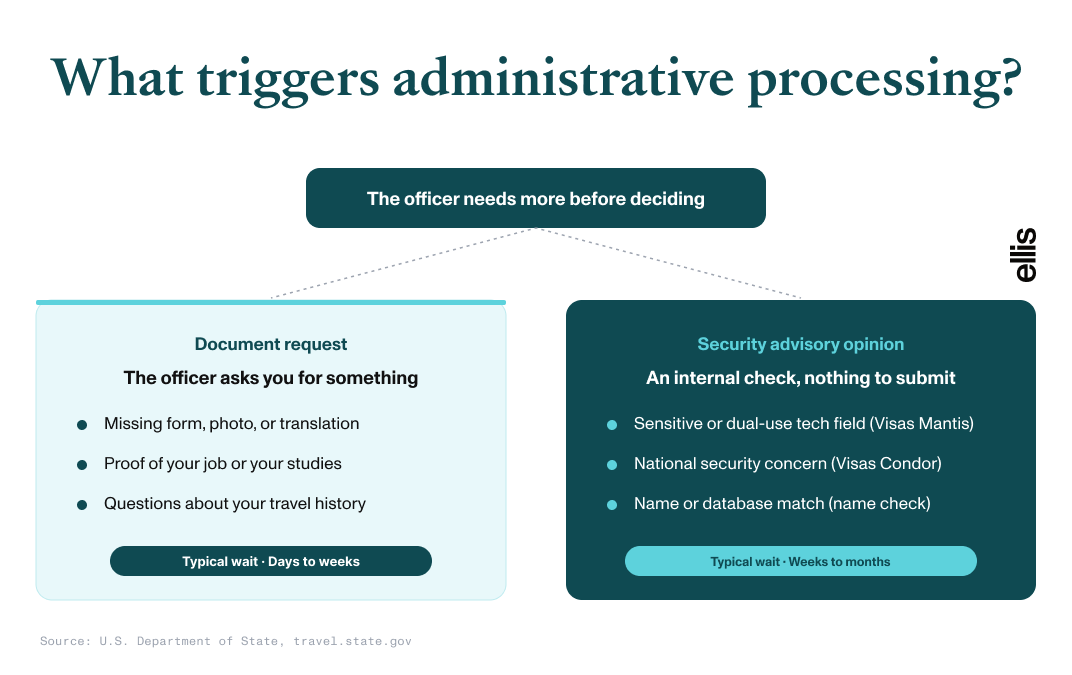
The first is a document or information request. The officer may need a missing form, a translation, proof of your work or studies, or clarification about your travel history. These cases usually move quickly once you respond.
The second is a background check, formally called a Security Advisory Opinion. This is an internal review that the consular officer sends to other U.S. agencies. Applicants rarely see it happening, and there is nothing to submit. Security checks are commonly triggered by an applicant's field of work or study, name matches in government databases, or country of birth or citizenship (For example, under 25 years old, male applicants from certain high-profile countries will almost invariably be put into administrative processing). In practice these reviews are known informally by names such as Visas Mantis, for sensitive or dual-use technology and science fields, Visas Condor, for national security concerns, and name-check reviews that resolve when an applicant's biographic data matches a database entry.
A case going into administrative processing does not mean the officer thinks you did something wrong. Many applicants in fully approvable cases still go through it.
How long does administrative processing take?
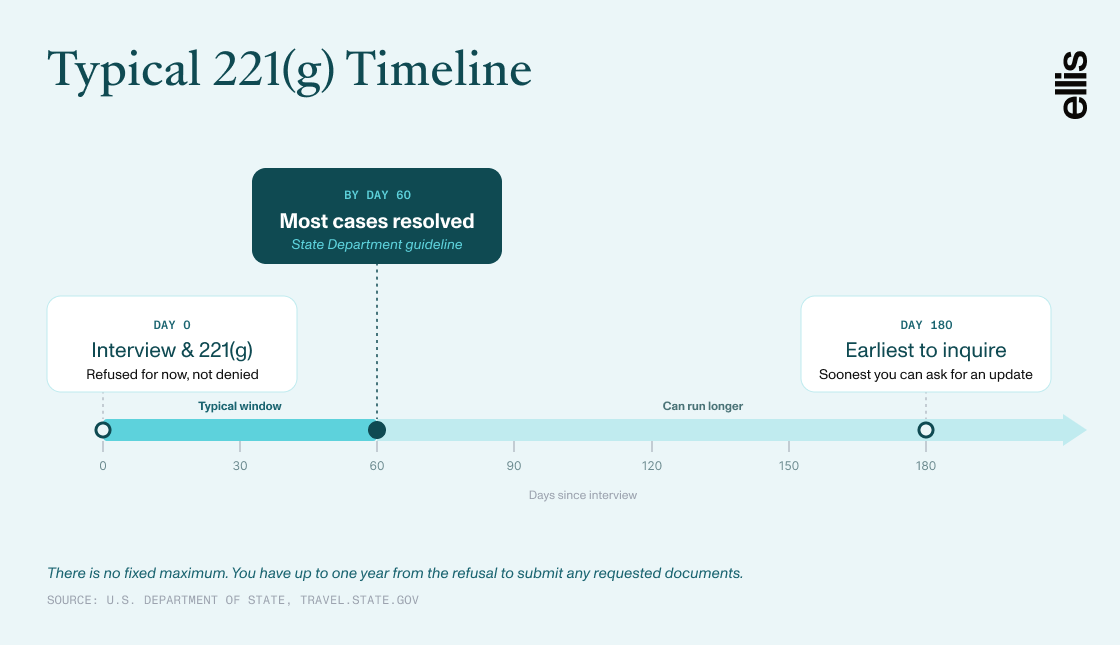
Most administrative processing is resolved within 60 days of the visa interview, according to the State Department. That 60-day figure is a general guideline, not a promise, and the real time depends on the type of case.
Document-only cases are usually the fastest. Once you submit the missing item, the case often resolves within days to a few weeks. Security checks take longer. Some run several months, and a few stretch to six months or a year.
There is no fixed maximum time for administrative processing. If you are searching for a hard cap, there is not one written into the law. What the State Department does set is a waiting period before you can ask about your case. You should wait at least 180 days from your interview, or from the day you submitted requested documents, whichever is later, before making an inquiry. The main exception is a genuine emergency, such as a serious illness, injury, or death in your immediate family.
What your CEAC status message means
You can track your case on the CEAC visa status check tool using the case or application number on your interview slip. The status line changes as your case moves, and the wording can be confusing. Here is what the common messages mean.
"Administrative processing" or "your visa case is currently undergoing necessary administrative processing" means the case is still under review. No action is needed unless the officer asked you for documents.
"Ready" usually means the consulate is ready for the next step, often the interview or a document review, not that the visa is finished.
"Issued" means the visa has been approved and is being printed or is on its way. This is the outcome you want, and it often follows an "administrative processing" status once the review clears.
Some applicants also see the status flip while their passport is involved. If your passport was returned during administrative processing, it usually means the consulate is done holding it for now, not that the case is decided. If the status shows administrative processing but your passport is ready for pickup, the visa may already be approved and placed in the passport, so check with the consulate before assuming the worst.
Administrative processing by visa type
Administrative processing works the same way across visa categories. It is always a 221(g) hold for extra review. What differs is how often it happens and how long it tends to last.
For H-1B and other work visas, administrative processing often relates to the employer, the job, or a technology-related background check, so these cases can take longer. For F-1 student visas, it often ties to the field of study, especially in science and engineering. It can also relate to social media background checks, especially if content was posted that the U.S. government may find offensive. For immigrant visas, administrative processing can add weeks or months on top of an already long process, and the same 60-day guideline and 180-day inquiry rule apply.
No matter the visa type, the steps are the same. Respond to any document request, then wait for the review to finish.
What to do while you wait, and when to get help
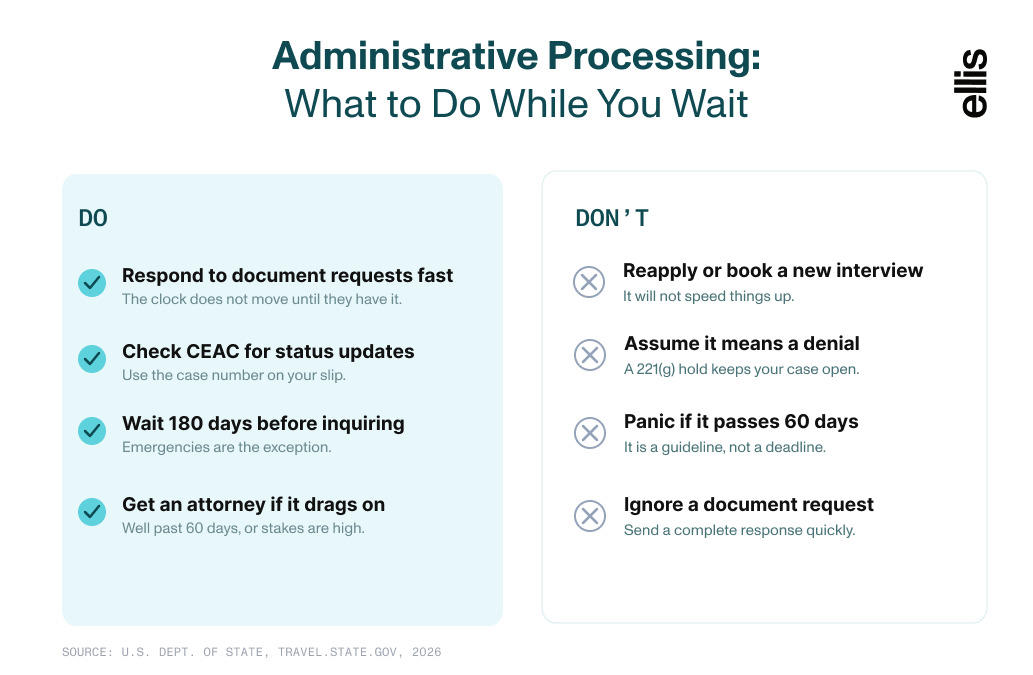
The single most important rule is simple. Do NOT reapply or book a new interview while your case is in administrative processing. A new application does not speed anything up, and it can cost you another fee and create confusion in your file.
Here is what actually helps. If the officer requested documents, send a complete response as fast as you can, because the clock does not start moving until they have what they asked for. Keep your case number and check CEAC for status changes. Wait the full 180 days before submitting an inquiry, unless you have a true emergency. In some cases the consulate may call you back for a second interview after administrative processing. If that happens, treat it as a normal step and bring anything they ask for.
If your case has stretched well past the 60-day guideline, if you keep getting vague answers, or if the delay is putting your job or your family plans at risk, this is the point where an immigration attorney can help. A lawyer can review your notice, confirm whether anything is still outstanding, and press the case through the right channels.
How Ellis can help
Administrative processing is one of those situations where good guidance makes a real difference, because the wait is stressful and the rules are easy to misread. Ellis pairs you with an experienced immigration attorney and tracks every step of your case in one place, so you always know what is happening and what comes next. If your case is stuck or the stakes are high, it is worth having a professional in your corner. Schedule a free consult →
This article is for informational purposes only and is not legal advice.