

Key Takeaways
- Who files? The U.S. employer, not the worker. The worker is the beneficiary of the petition.
- How much? $780 filing fee for most employers, $390 for small employers (25 or fewer FT). Plus separate asylum program and visa-specific fees.
- Want it faster? Premium processing is $2,805 and gets you a decision in 15 business days for almost every I-129 category.
- What visas? H-1B, H-2A, H-2B, H-3, L-1A, L-1B, O-1, O-2, P-1, P-2, P-3, Q-1, R-1, TN, E-1, E-2, and E-3.
- Should I use an attorney? Almost always yes. I-129 petitions are complex, often require an LCA, and the wrong evidence can sink the case. Free Ellis consult →
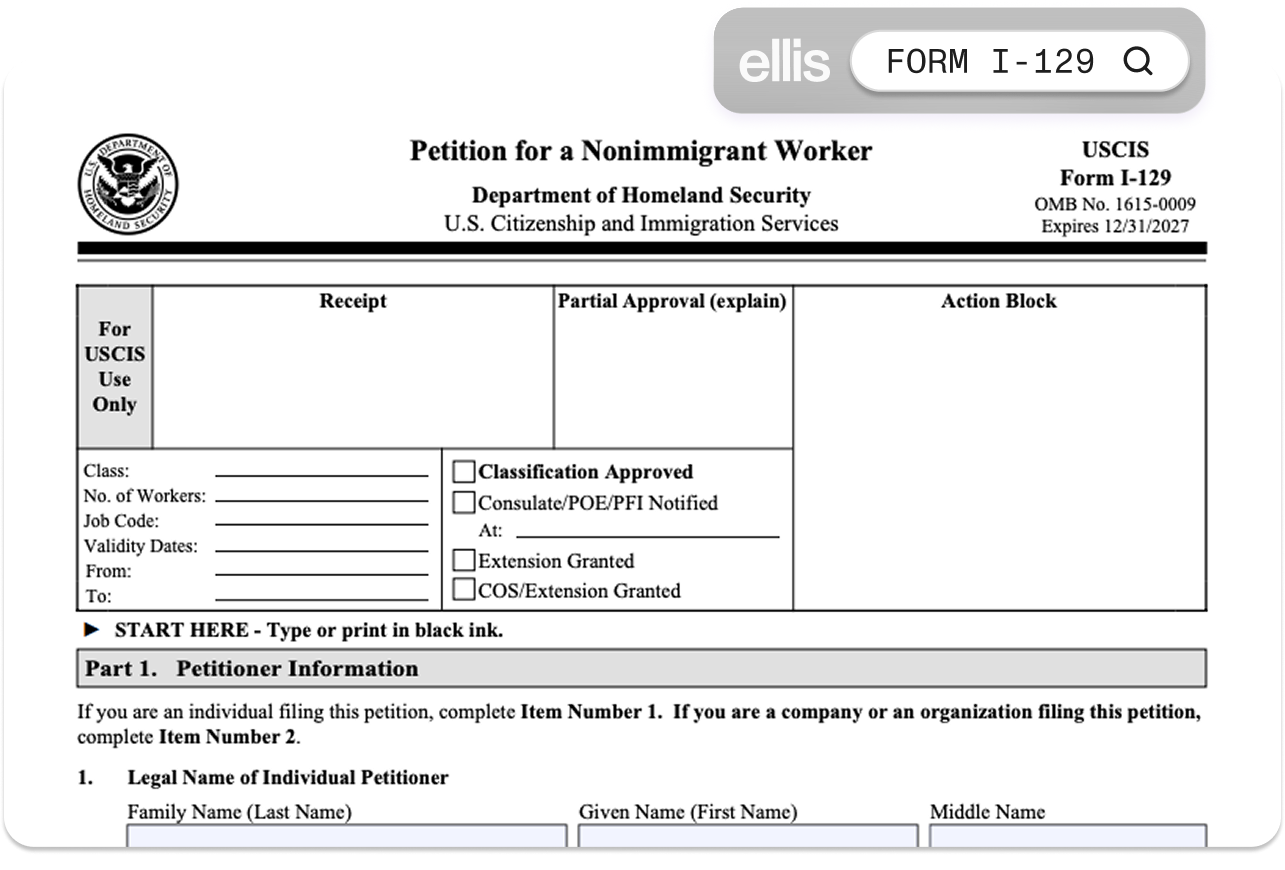
If a U.S. employer wants to sponsor a foreign worker for a temporary work visa, the case runs through one form: Form I-129. Officially called the Petition for a Nonimmigrant Worker, it's the gateway petition for H-1B, L-1, O-1, TN, and most other employment-based temporary visa categories.
This guide covers what the I-129 is, who can file it, how much it costs, and how premium processing can speed it up.
What is Form I-129?
Form I-129 is the USCIS petition U.S. employers file to sponsor a foreign worker for a temporary (nonimmigrant) work visa. It's the workhorse form for nearly every employment-based visa that isn't a green card.
The base form is 36 pages and asks about the employer, the offered position, the worker's qualifications, and the visa category. Most categories also require a visa-specific classification supplement (H, L, O/P, Q, R, E, TN). You file the petition with USCIS, either online or by mail.
An approved I-129 doesn't automatically give the worker a visa. It establishes that the worker is eligible for the requested category. The worker then either:
- Applies for the visa stamp at a U.S. consulate abroad (consular processing), or
- Changes status from inside the U.S. if the I-129 was filed with a change-of-status request.
Who Files Form I-129?
In almost every case, the U.S. employer is the petitioner. The worker is the beneficiary. The employer takes responsibility for the petition, the offered position, and ongoing compliance.
A few narrow exceptions allow self-filing:
- E-1 or E-2 treaty trader/investor cases where the worker is also the principal investor.
- E-3 Australian specialty occupation workers in some scenarios (rare).
For everyone else: H-1B, L-1, O-1, TN, and so on, the employer files and signs the petition.
Visa Categories Worth Knowing
Form I-129 covers a long list of categories. The most common in 2026:
Visa | Who it's for | Cap? |
|---|---|---|
Specialty occupation worker (bachelor's degree or equivalent in a specialty field) | Yes — annual cap with lottery | |
H-2A | Temporary agricultural worker | No |
H-2B | Temporary non-agricultural worker | Yes |
H-3 | Trainee | No |
Intracompany transferee, executive or manager | No | |
L-1B | Intracompany transferee, specialized knowledge | No |
Workers of extraordinary ability in sciences, arts, business, education, athletics | No | |
P-1, P-2, P-3 | Athletes, entertainers, artists | No |
Q-1 | International cultural exchange visitor | No |
R-1 | Religious worker | No |
USMCA professional (Canadian or Mexican citizen in qualifying field) | No | |
E-1 / E-2 | Treaty trader / investor | No |
E-3 | Australian specialty occupation worker | Yes — annual cap, rarely hit |
Picking the right category matters. H-1B requires winning the annual lottery. L-1 requires a foreign affiliate. O-1 requires substantial evidence of extraordinary ability. The wrong category sinks the petition before it's reviewed on the merits.
What Does the I-129 Cost in 2026?
The 2026 fee structure for Form I-129 stacks several fees together, depending on the visa category and the employer's size.
Base fees (all I-129 categories):
Fee | Amount | Notes |
|---|---|---|
Filing fee (large employer, 26+ FT) | $780 | Required for every I-129 |
Filing fee (small employer, 25 or fewer FT) | $390 | Small employer discount |
Asylum program fee (large employer) | $600 | Required on most filings |
Asylum program fee (small employer) | $300 | |
Asylum program fee (non-profit 501(c)(3)) | $0 | Waived |
Premium processing (optional) | $2,805 | 15 business days |
H-1B-specific fees (in addition to the base fees):
Fee | Amount | Notes |
|---|---|---|
ACWIA Education and Training Fee (26+ FT) | $1,500 | $750 for 25 or fewer FT |
Fraud Prevention and Detection Fee | $500 | Initial H-1B and certain change of employer petitions |
Public Law 114-113 Fee | $4,000 | Employers with 50+ workers and 50%+ on H-1B or L-1 visas |
$100,000 | Active per the September 2025 proclamation; applies to consular processing for employees outside the U.S. |
For a typical H-1B from a 100-person employer, you're looking at roughly $2,880 to $6,880 in USCIS fees, before premium processing. Add $2,805 for PP if you need it fast.
L-1, E, and other categories have their own fee patterns. The USCIS fee schedule has the full picture.
Can I speed it up? Premium processing for I-129
Premium processing is available for almost every I-129 category. The fee is $2,805, paid using Form I-907, and guarantees a USCIS decision within 15 business days.
Available for:
- H-1B, H-2B, H-3 (not H-2A)
- L-1A, L-1B
- O-1A, O-1B, O-2
- P-1, P-2, P-3, P-1S, P-2S, P-3S
- Q-1
- R-1
- TN
- E-1, E-2, E-3
If USCIS doesn't decide within the 15-business-day window, the premium processing fee is refunded and the case continues to receive expedited treatment.
For H-1B, premium processing is most useful when:
- A worker's H-1B start date is approaching October 1 (the FY start) and the regular timeline won't make it.
- An H-1B transfer is time-sensitive due to a job change.
- The case affects a cap-gap extension for an F-1 OPT graduate.
For more on H-1B PP specifically, see our H-1B premium processing guide.
What You'll Need to File
A complete I-129 package usually includes:
- The completed I-129 form (36 pages)
- The relevant classification supplement (H, L, O/P, Q, R, E, or TN)
- Filing fee, asylum program fee, and any visa-specific fees
- For H-1B, H-2B, and E-3: an approved LCA (Form ETA-9035) from the Department of Labor
- Employer documents: business registration, federal tax returns, evidence of ability to pay
- Worker qualifications: degrees, transcripts, professional licenses, experience evidence
- Position evidence: signed offer letter, detailed job description, occupational code
- For H-1B: USCIS lottery selection notice
- For L-1: evidence of qualifying foreign and U.S. corporate relationship plus the beneficiary's 1-of-3-years foreign employment
- For O-1: an extensive evidence binder showing extraordinary ability
For practical guidance on putting the binder together, see our supporting documents guide.
The I-129 Process, Step by Step
- Determine the visa category. H-1B for specialty occupations, L-1 for intracompany transfers, O-1 for extraordinary ability, and so on.
- (For H-1B) Win the lottery selection. USCIS runs a wage-weighted lottery each March. Selected workers can file I-129 between April 1 and June 30.
- (For H-1B, H-2B, E-3) File and obtain an approved LCA from the Department of Labor. LCA processing usually takes 7 days.
- Gather supporting evidence. Employer financials, worker qualifications, position evidence, and category-specific documentation.
- File Form I-129 with USCIS along with the classification supplement and all fees. Some categories support online filing; most still require paper.
- (Optional) File Form I-907 for premium processing. Adds $2,805 but cuts processing to 15 business days.
- Receive Form I-797C Receipt Notice within 2 to 4 weeks.
- Respond to any Request for Evidence (RFE) within the deadline. RFEs are most common in H-1B and L-1 cases.
- Receive a decision. If approved, USCIS issues a Form I-797 approval notice. The worker is now eligible to pursue the visa.
- Worker pursues the visa. The worker applies at a U.S. consulate (consular processing) or changes status from inside the U.S. if the I-129 was filed with a change-of-status request.
How long does the I-129 take?
I-129 processing times in 2026 typically run:
Category | Standard processing | With premium processing |
|---|---|---|
H-1B (cap-subject) | 2 to 6 months | 15 business days |
H-1B (transfer or extension) | 2 to 4 months | 15 business days |
L-1A, L-1B | 3 to 8 months | 15 business days |
O-1A, O-1B | 2 to 5 months | 15 business days |
TN (change of status) | 2 to 4 months | 15 business days |
E-1, E-2, E-3 | 2 to 5 months | 15 business days |
Wait times vary by service center. Check the USCIS processing times tool for current data, or our USCIS processing times tracker for a plain-English summary.
For workers entering at a port of entry (TN at the border, L-1 from a Blanket L petition), no I-129 is filed and processing happens at the border.
After Approval: Next Steps
An approved I-129 unlocks the visa, but it's not the visa itself. Two paths from here:
If the worker is outside the U.S. (consular processing):
The worker takes the I-797 approval, schedules a visa appointment at a U.S. consulate, attends the interview, and receives the visa stamp. With the stamp, the worker can enter the U.S. and start work as of the I-129's approved start date.
If the worker is in the U.S. (change of status):
If the I-129 was filed with a change-of-status request, USCIS approves the status change as part of the petition decision. The worker's new I-94 reflects the new status and can start work on the start date.
In both paths, the worker should also confirm:
- I-94 record matches the new status and authorized period.
- A-Number is assigned (used for future filings).
- Dual intent considerations for the visa category. Some I-129 categories (H-1B, L-1) allow dual intent for future green card filings. Others (TN, O-1) are more nuanced.
Common reasons I-129s get denied
Most I-129 denials trace back to a handful of issues:
- Specialty occupation challenges (H-1B). USCIS questions whether the position truly requires a bachelor's degree in a specialty field.
- LCA issues. Wrong wage level, wrong job code, or LCA filed for a different location than where the worker will actually work.
- Employer-employee relationship problems. Especially in H-1B third-party placements and L-1 cases.
- Insufficient evidence of qualifications. Worker doesn't clearly meet the category's requirements.
- Foreign affiliate issues (L-1). USCIS doesn't accept the qualifying foreign-to-U.S. corporate relationship.
- Beneficiary criteria gaps (O-1). Evidence doesn't meet the "extraordinary ability" threshold.
A Request for Evidence isn't a denial. Most I-129 RFEs point to fixable issues if you respond promptly with the right evidence.
Final Tips
Form I-129 is the workhorse petition for almost every U.S. temporary work visa. The form itself is long, but the real complexity is in the classification supplement and evidence packet.
A few clear rules:
- Pick the right visa category. Each has different evidence standards and timelines.
- File the LCA first for H-1B, H-2B, and E-3. The LCA must be approved before the I-129.
- Use premium processing when timing matters. $2,805 for 15 business days often pays for itself.
- File concurrently with change-of-status request when the worker is already in the U.S. and you want them to start working without leaving the country.
- Get attorney help. I-129 categories are technical, the evidence bar is high, and a denial usually means the worker can't start work.
Need help filing your I-129?
Ellis combines experienced immigration attorneys with a modern case management platform. Every I-129 we handle goes through structured workflows, automated checks, and full attorney review.
Schedule a free consult → and we'll walk you through your specific case strategy at no cost.
Disclaimer
This article is for informational purposes only and does not constitute legal advice. Immigration law changes frequently. For specific legal guidance regarding your case, please consult with a qualified immigration attorney.