


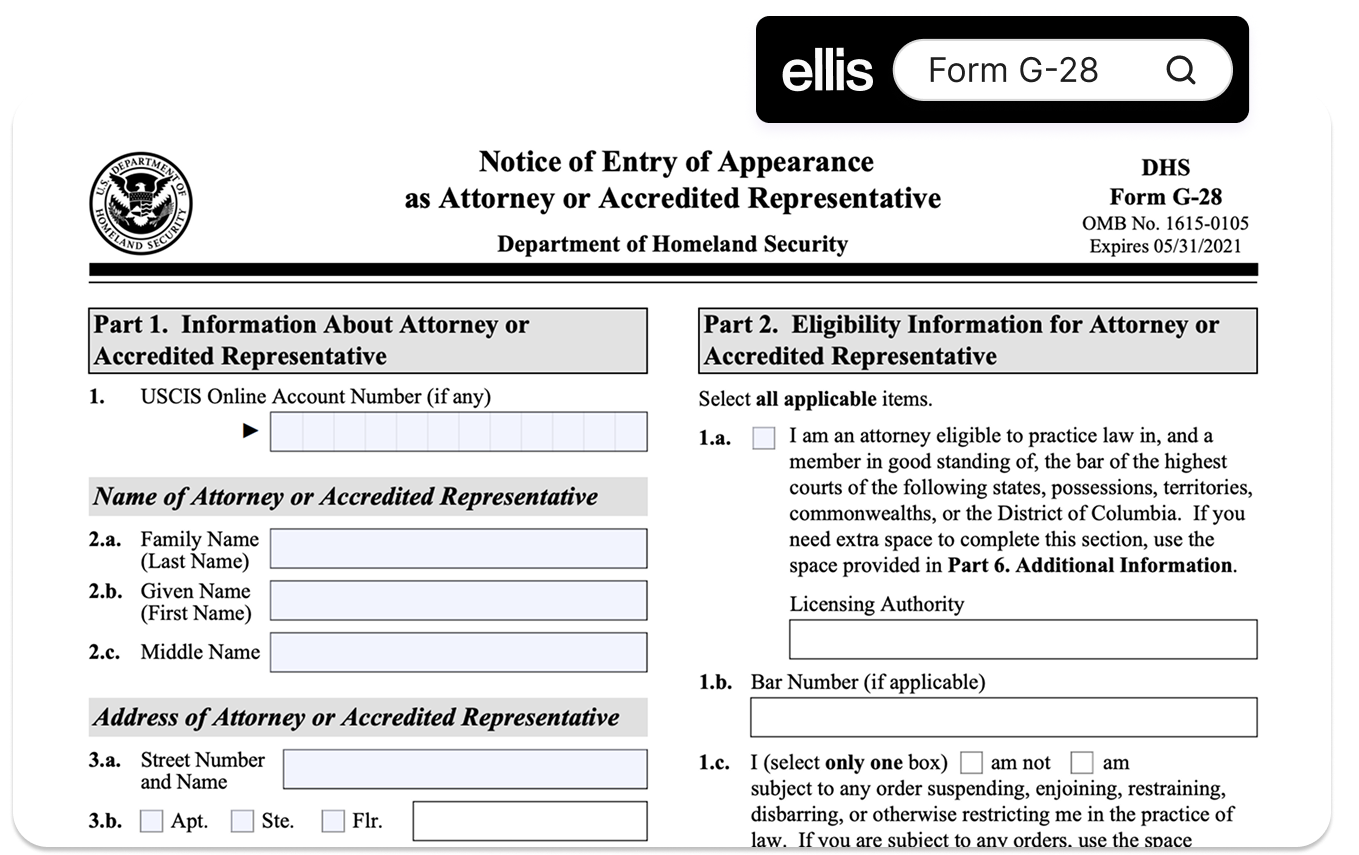
Form G-28, the Notice of Entry of Appearance as Attorney or Accredited Representative, is the Department of Homeland Security form that lets a licensed attorney or BIA-accredited representative act on your behalf and receive notices about your immigration case. It covers the three DHS immigration agencies, USCIS, ICE, and CBP. There is no separate filing fee, and you file it together with your main application or petition, not on its own.
Key Takeaways
- What is it? Form G-28 tells a DHS immigration agency, USCIS, ICE, or CBP, that an attorney or accredited representative is representing you, so the agency communicates with them about your case.
- Who files? Applicants, petitioners, or respondents using a licensed attorney or a BIA-accredited representative. No representative means you do not need it.
- How much? There is no separate filing fee for Form G-28.
- Important: You do NOT file Form G-28 by itself. File it with the related application, petition, or appeal. USCIS rejects unsigned forms, so both you and your representative must sign.
- Need help? Ellis pairs you with an immigration attorney and files your Form G-28 with your case, start to finish. Start here →
What is Form G-28?
Form G-28 is a Department of Homeland Security (DHS) form that authorizes a legal representative to act for you on an immigration matter. Its full name is the Notice of Entry of Appearance as Attorney or Accredited Representative.
Once it is on file, the agency can:
- Share information about your case with your representative
- Send your representative copies of notices and decisions
- Treat that person as your official point of contact
Form G-28 works across all three DHS immigration agencies. On the form, your representative indicates whether they are appearing before:
- USCIS, U.S. Citizenship and Immigration Services, for applications and petitions
- ICE, U.S. Immigration and Customs Enforcement, for enforcement and detention matters
- CBP, U.S. Customs and Border Protection, for issues at ports of entry and the border
The form is four pages, with a separate five-page instructions document. You can download both from the official USCIS Form G-28 page.
What is Form G-28 used for?
Form G-28 puts your attorney or accredited representative on the record for one specific case. It does three things:
- Confirms the representative is eligible to appear before USCIS, ICE, or CBP.
- Gives that agency permission to communicate with your representative about your case.
- Directs where the agency sends notices and secure documents.
It does not grant an immigration benefit by itself. It is a supporting form that travels with the actual request you are filing, such as a family petition (Form I-130), a green card application (Form I-485), or a naturalization application (Form N-400).
Who needs to file Form G-28?
You file Form G-28 if you are using a legal representative for your USCIS case. That includes applicants, petitioners, requestors, and respondents. If you are handling your own case with no representative, you do not need it.
Only two types of people can be named as your representative:
Representative type | Who they are | Typical setting |
|---|---|---|
Licensed attorney | A lawyer in good standing with any U.S. state bar | Private law firms, legal-tech platforms |
BIA-accredited representative | A non-attorney accredited by the Board of Immigration Appeals | Recognized nonprofit organizations |
How to fill out Form G-28
Your representative usually completes the form, but you sign it too. It has four parts:
- Your representative's information and eligibility
- Your information as the client
- Consent and signatures
- Mailing preferences for notices and secure documents
A few rules keep the form from being rejected:
- Sign it. USCIS will REJECT any unsigned Form G-28. Both the representative and the client must sign.
- Use a black pen if you are signing on paper.
- Match the edition on every page. All pages must be from the same form edition, with the edition date visible at the bottom.
- Add your receipt number if you already have a pending case, so USCIS attaches the form to the right file.
Where and how to file Form G-28
File Form G-28 with the related application, petition, or appeal. It is not a standalone filing.
- Filing on paper? Include the signed Form G-28 in the same package as your main case.
- Filing online? Your representative submits their appearance electronically as part of that case in the USCIS account.
Form G-28 fee, edition, and processing time at a glance
Question | Answer | Notes |
|---|---|---|
Filing fee | No separate fee | You pay only the fee for the underlying application, if it has one. |
Current edition | Printed at the bottom of each page | Confirm the accepted edition on USCIS.gov before filing. Right now, the most recent version is the form dated 09/17/18. |
Processing time | None on its own | Tied to your main application's USCIS processing time |
Because USCIS revises this form periodically, always check the edition date on the official USCIS page right before you file. Using an outdated edition can get your form rejected.
How to change or withdraw your representative
To change or withdraw your legal representative, file a new Form G-28. The most recent valid form on file controls who USCIS treats as your representative.
If you are mailing a new Form G-28 to change representation:
- Write "ATTN: G-28" on the line above the P.O. Box on the envelope.
- Include the receipt number for your pending case so USCIS can match it to your file.
Download Form G-28 (PDF)
Download the current Form G-28 and its instructions as free PDFs directly from USCIS. Always use the official source so you know you have the accepted edition:
How Ellis can help
Form G-28 is simple on its own, but the case it attaches to usually is not. Ellis pairs you with an immigration attorney and prepares and files your Form G-28 as part of your application, then tracks the case from filing to decision. Schedule a free consult →
This article is for informational purposes only and is not legal advice.