

On August 6, 2026, President Trump signed two executive orders on birthright citizenship. The first says some children born in the U.S. will not get automatic citizenship when neither parent is a citizen. The second tells federal agencies to stop birth tourism. Neither order is in effect yet, and generally children of H-1B, F-1, and green card holders are not affected.
Six weeks ago, the Supreme Court struck down the White House's first try at ending birthright citizenship. Now two new executive orders are taking a narrower run at the same goal. Here is what each order says, who it covers, what changes for visitor visas, and what happens next in court.
Key Takeaways
- What happened? President Trump signed two executive orders on August 6, 2026: one limiting who gets birthright citizenship, and one directing the State Department and DHS to stop birth tourism. Agencies have 30 days to issue guidance.
- Who is affected? The citizenship order only applies when neither parent is a U.S. citizen and a parent is a designated terrorist, works for a foreign government in the U.S., or paid to arrange a birth here.
- Who is NOT affected? Generally children of H-1B workers, F-1 students, green card holders, and ordinary visitors keep birthright citizenship. This order is much narrower than the one the Supreme Court struck down in June.
- Important: Nothing changes today. Babies born in the U.S. right now still get citizenship under current law, and both orders face immediate legal challenges.
- Questions about your family's status? Ellis pairs you with an immigration attorney and tracks your case start to finish. Start here →
What did Trump's two new executive orders do?
President Trump signed two executive orders on the evening of August 6, 2026. This is the White House's second try at narrowing birthright citizenship, and this time the orders are built around exceptions the Supreme Court left open.
The first order, Continuing to Protect the Meaning and Value of American Citizenship, says certain U.S.-born children are not citizens at birth when neither parent is a U.S. citizen. It lists specific groups, covered in detail below. It gives the State Department, the Attorney General, the Department of Homeland Security, and the Social Security Administration 30 days to explain how they will apply it. The Social Security Administration matters here because a Social Security number is often the first citizenship document a newborn gets.
The second order, Ending Birth Tourism, defines birth tourism as entering the U.S. on a nonimmigrant visa specifically to give birth, or helping someone do so. It tells the Secretary of State and the Secretary of Homeland Security to block these visas, cancel ones already issued, permanently bar people who enter this way, and go after the businesses that sell these trips.
How is this different from the January 2025 order the Supreme Court struck down?
The new citizenship order is far narrower, on purpose. The January 2025 order, Executive Order 14160, tried to deny citizenship to U.S.-born children of undocumented parents and parents on temporary visas. That would have covered hundreds of thousands of births a year.
The Supreme Court rejected that approach. On June 30, 2026, the Court ruled 6 to 3 in Trump v. Barbara that the 2025 order violated the 14th Amendment. The 14th Amendment's Citizenship Clause says everyone born in the U.S. and "subject to the jurisdiction thereof" is a citizen, and the Supreme Court has read that broadly since United States v. Wong Kim Ark in 1898. This rule is often called jus soli, or right of the soil. About 30 countries grant unconditional birthright citizenship, and the U.S. is the largest of them.
The new order tries to work inside the ruling instead of against it. The White House describes its categories as "historical exceptions" to birthright citizenship that the Court acknowledged in Barbara, like children of diplomats, who have never gotten citizenship at birth. Whether the new categories really fit those exceptions is what the lawsuits ahead will test.
Who is actually affected?
Very few families. The order applies only when neither parent is a U.S. citizen and at least one parent falls into a listed group. Here is what that means by parent status:
Parent's status | Is your U.S.-born child's citizenship affected? |
|---|---|
No | |
No | |
No | |
Undocumented | No. This order does not cover undocumented parents. The struck-down 2025 order did. |
B-1/B-2 visitor | No, unless the trip was a paid birth tourism arrangement |
Part of a paid birth tourism or surrogacy arrangement | Yes |
Foreign government employee or official working for that government in the U.S. | Yes |
Member of a designated Foreign Terrorist Organization or Specially Designated Global Terrorist | Yes |
Three details worth knowing. First, the order defines "alien enemy" narrowly: a member of a designated Foreign Terrorist Organization under 8 U.S.C. 1189 or a Specially Designated Global Terrorist. Early news coverage made this group sound bigger than it is. Second, the paid-arrangement group covers any "commercial transaction to purchase or access birthright citizenship," and the order says that includes paid surrogacy arrangements involving foreign parents, a detail most early coverage missed. Third, the order covers births in U.S. territories where no law grants citizenship, such as American Samoa. Puerto Rico, Guam, the U.S. Virgin Islands, and the Northern Mariana Islands all have citizenship written into law, so births there are not affected.
Children of accredited foreign diplomats were already excluded from birthright citizenship before this order. That has been true for over a century.
What the birth tourism order changes for visitor visas
The order builds on a rule that already exists. Since January 2020, State Department rules have said that coming to the U.S. to give birth so the child gets citizenship is not a valid reason for a B visitor visa. That rule was published in the Federal Register, and it lets visa officers say no when they believe giving birth is the main purpose of the trip.
The new order goes further. It lets officials revoke visas, permanently bar people who enter to give birth, remove people involved in birth tourism schemes, and act against the companies that sell these trips. It also allows exceptions, case by case, for humanitarian or national interest reasons.
If you are pregnant and have a real reason to visit the U.S., travel is still allowed. Being pregnant is not, by itself, a reason to be turned away. Expect more questions at visa interviews and ports of entry, and be ready to show why you are traveling, your ties back home, and proof you can cover medical costs.
How common is birth tourism?
It is a very small share of U.S. births. CDC data recorded fewer than 10,000 births to mothers with foreign home addresses in 2024. The Migration Policy Institute estimates 22,000 to 26,000 birth tourism births per year. Either figure is under 1 percent of the roughly 3.6 million babies born in the U.S. each year.
What happens next: lawsuits and what to watch
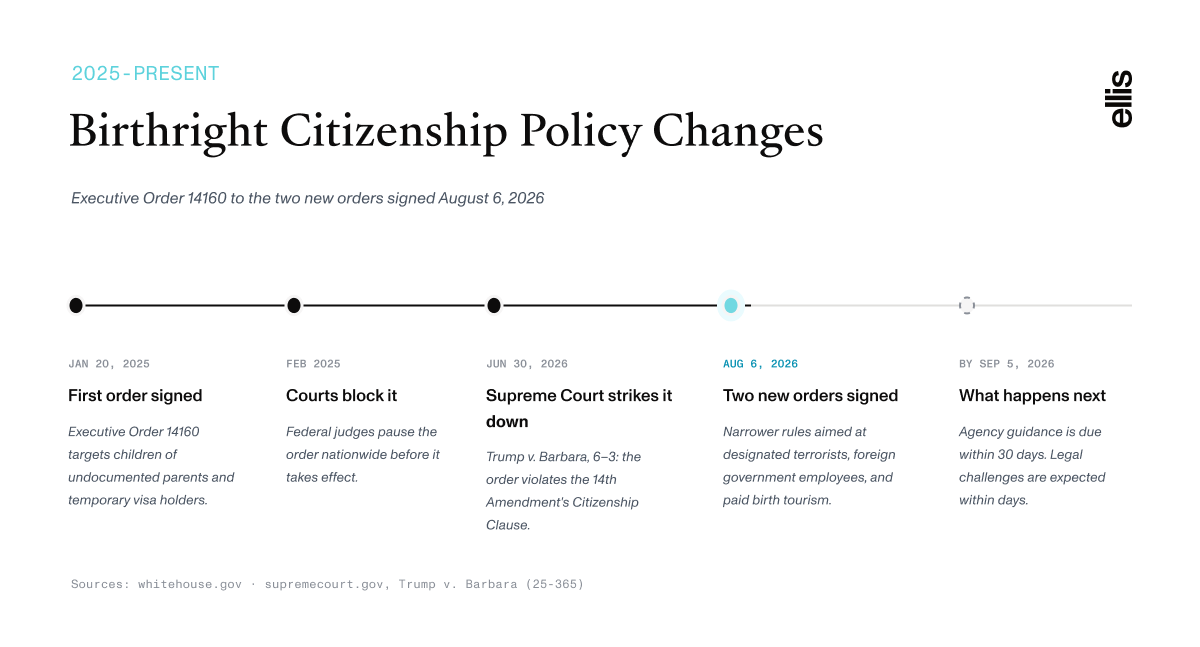
Legal challenges are expected within days. The ACLU responded to the signing by saying no executive order can change the meaning of the Constitution, and the groups that beat Executive Order 14160 in court are expected to sue again. Courts blocked the 2025 order before it ever took effect, and the same pattern is likely here while judges decide whether the new groups really are historical exceptions the 14th Amendment allows.
Three things will decide how this plays out:
- The lawsuits, and whether a court issues a nationwide injunction, a ruling that pauses the orders everywhere, before agencies act.
- The agency guidance due within 30 days from State, DOJ, DHS, and the Social Security Administration, which will show how the government plans to apply the rules when a birth is registered.
- How embassies and consulates handle B visas, which can tighten quickly because the 2020 rule is already on the books.
The order does not say whether it applies to children who were already born, and that question will likely be settled in court.
How Ellis can help
If your family or your employees have questions about a child's citizenship, a pregnant traveler's visa, or how these orders affect a pending case, it can be worth having an attorney look at your specific situation. Ellis pairs you with an experienced immigration attorney and tracks your case from first question to final answer. Schedule a free consult →
This article is for informational purposes only and is not legal advice.