


An O-1 visa agent is a U.S. person or company that files one O-1 petition covering work for several employers. The agent route mostly fits artists, entertainers, and athletes with short engagements. Founders and other O-1A applicants usually do better with a petition from their own company, one main employer, or separate petitions from each employer.
Key Takeaways
- O-1 beneficiaries cannot self-petition, so an employer, a company the worker owns, or a U.S. agent has to file Form I-129 on the worker's behalf.
- The agent route was built for workers who book many short engagements, which is why it mostly fits artists, entertainers, and athletes.
- O-1A holders on an agent petition generally need an amended petition to add an employer, while artists and entertainers can add new engagements without one.
- Most founders and O-1A applicants get a cleaner path by having their own company file, or by having each employer file its own petition.
What is an O-1 visa agent?
An O-1 visa agent is a U.S. person or company that is duly authorized to file an O-1 petition with U.S. Citizenship and Immigration Services (USCIS) on behalf of a foreign worker, called the beneficiary, and one or more employers. The petition is Form I-129.
An O-1 visa is designed for individuals with extraordinary ability in various fields. The O-1A covers science, education, business, or athletics, and it's the category many founders and researchers use. The O-1B covers the arts, film, and TV.
O-1 beneficiaries cannot self-petition. Under the O-1 rules, only a U.S. employer, a U.S. agent, or a foreign employer working through a U.S. agent can file. A U.S. agent can act as:
- The actual employer, meaning a bona fide employer that hires, pays, and supervises the worker
- A representative of multiple employers who each use the beneficiary's services
- A U.S. stand-in for a foreign employer with no U.S. office. This is the only way such a company can bring over an O-1 nonimmigrant worker, and the agent agrees to accept service of legal papers under the employer sanctions provisions of U.S. immigration law.
USCIS does not maintain a list of officially approved O-1 agents, and an O-1 visa agent cannot guarantee approval of the visa. O-1 visa applicants must demonstrate extraordinary ability in their field no matter who files.
Who is the agent route built for?
The agent route was built for people whose work comes as a string of short bookings. USCIS rules allow agent petitions for workers who are traditionally self-employed or who use agents to arrange short-term employment with numerous employers.
That fits artists, performers, and entertainers almost exactly. A musician might play 20 venues on one tour, and an actor might book a film, a series, and a stage run in the same year. Those industries already run on agents and managers.
O-1B: Extraordinary talent in the arts, film, and TV
O-1B covers artists, performers, and people who work in film and TV. The standard is "distinction" in the arts and extraordinary achievement in film and TV, shown through a demonstrated record of extraordinary talent such as lead roles, reviews, awards, and commercial success.
Artists also get a flexibility no one else gets. A petitioner for an artist or entertainer can add new performances or engagements during the validity period without filing an amended petition, as long as the new work calls for O-1 level talent.
O-1A: Extraordinary ability in science, education, business, or athletics
Athletics is the one O-1A field where agents are common, since athletes and coaches tend to work event by event. Outside sports, O-1A work usually means one ongoing role: a founder runs one company, and a researcher works in one lab. The agent route fits event-based work, and most O-1A careers are built on ongoing roles.
Why is the agent model usually a poor fit for founders and O-1A applicants?
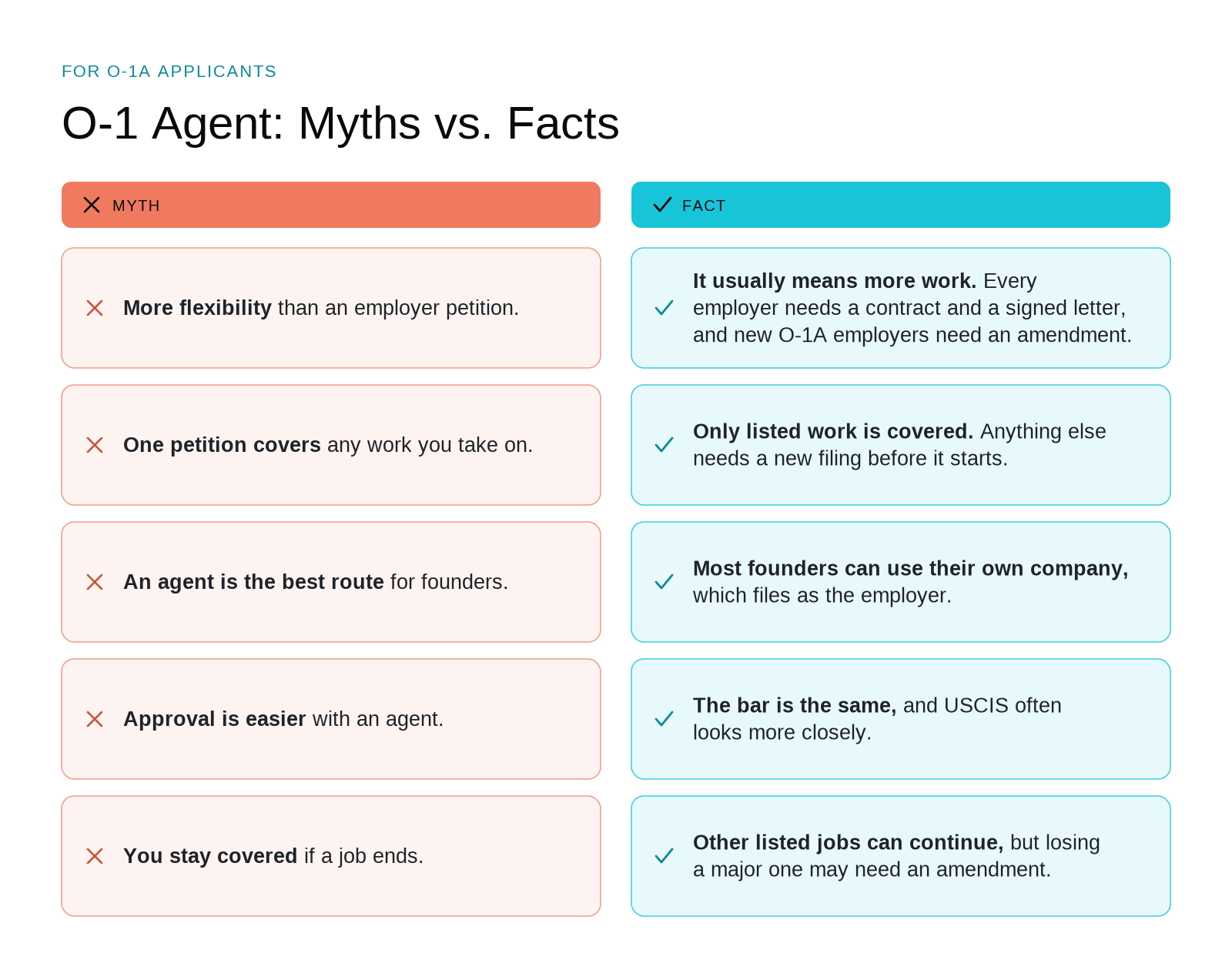
The agent model gets marketed as the most flexible O-1 for founders and tech workers. The common pitch says O-1 visa agents allow work with multiple employers, help monetize multiple income streams legally, and give freelancers a way to consolidate multiple work engagements under one petition. Some also say agent-sponsored O-1 visas provide stability during job transitions. For most O-1A applicants, the trade-offs outweigh the benefits.
Here's how that looks in reality:
- New employers mean new filings. The add-as-you-go rule covers artists only, so each new O-1A employer generally means an amended petition before the work starts.
- Every job has to exist on day one. O-1 applicants must have contracts or agreements validated at the time of filing their petition. Unsigned advisory roles or work still being negotiated count as speculative employment.
- Ongoing roles don't fit an itinerary. O-1 agent petitions require a detailed itinerary of engagements. That works for a tour, not a three-year leadership role at a startup.
- More paperwork, closer review. Agent petitions require more documentation than employer-filed petitions. USCIS may also scrutinize the employment relationship more closely, and agent petitions can lead to more Requests for Evidence.
An agent petition allows for work across multiple projects, but only the projects listed in the approved petition. It is not a freelance visa.
What are better alternatives to agent petitions for O-1A applicants?
Most O-1A applicants who consider an agent have better options available: their own company filing, a separate petition from each employer, a single employer petition, or an EB-1A or EB-2 NIW green card. The right one depends on how their work is set up.
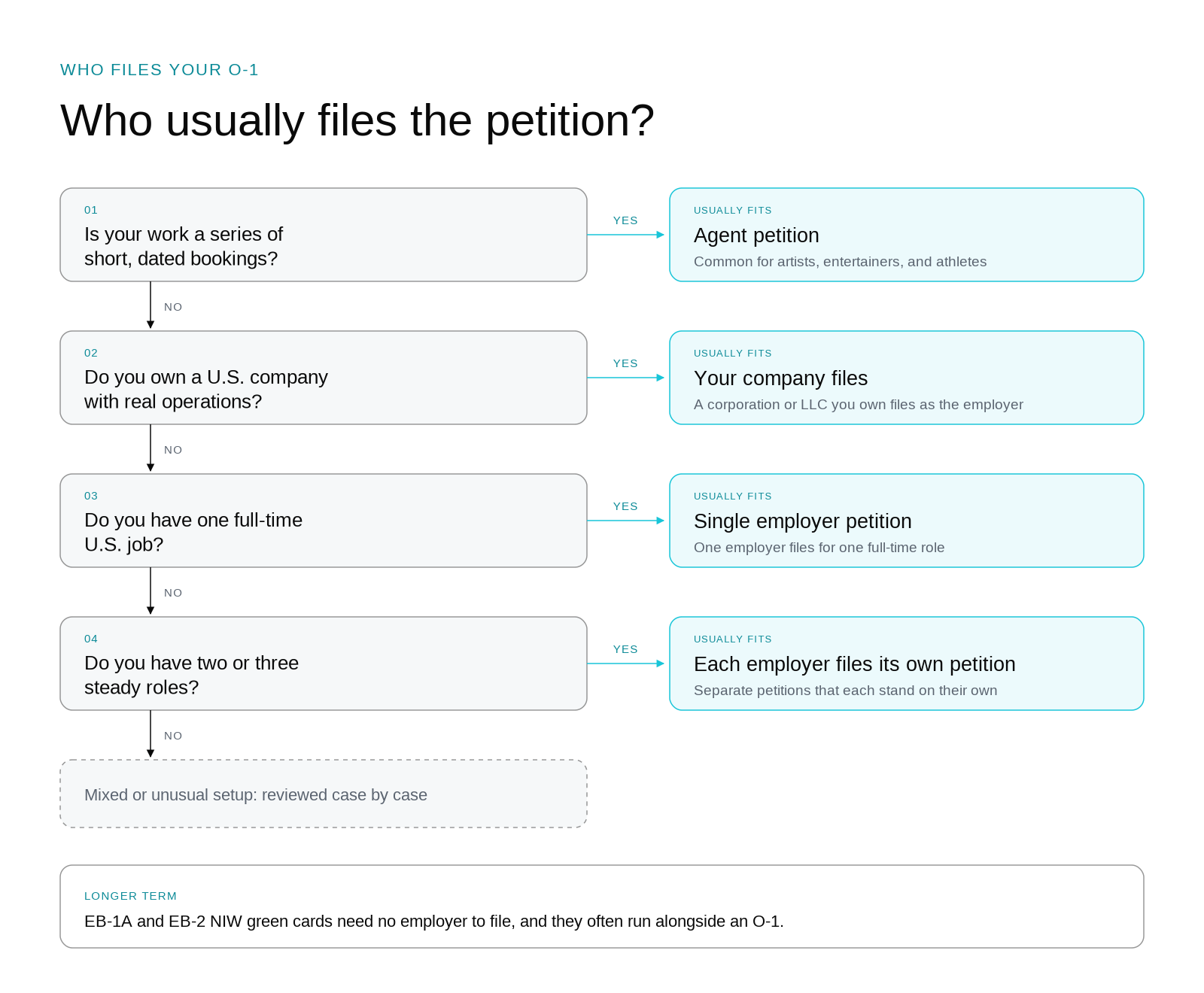
Who it fits | Who files | Main trade-off | |
|---|---|---|---|
Your own company files | Founders running their own startup | A corporation or LLC the worker owns | The company needs real U.S. operations |
Each employer files its own petition | People with two or three steady roles | Each employer, on its own Form I-129 | More filings, but each one stands alone |
Single employer petition | People with one full-time U.S. job | The employer | Work is tied to that one employer |
Green card self-petition | People planning to stay long term | The worker | Longer timeline, so it usually runs alongside an O-1 |
Your own company files the petition
A company you own can file your O-1 petition. In January 2025, USCIS updated its Policy Manual to say that a separate legal entity owned by the beneficiary, such as a corporation or LLC, may file. A Delaware C-corp with real operations is a common setup.
This is an employer petition, not an agent petition. USCIS generally looks for real U.S. business activity, such as customers, contracts, funding, or product progress, and may look more closely at the working relationship when the worker owns the company.
Each employer files its own petition
When someone works for multiple companies at the same time, USCIS rules generally have each employer file a separate petition, unless an established agent files instead. Each petition stands on its own, so losing one job doesn't affect the petitions from other employers. For a consultant with steady consulting projects at two or three companies, this is often more stable than one agent petition.
A single employer petition for one full-time role
When one U.S. employer offers a full-time role, a standard employer petition is usually simpler and draws less scrutiny. O-1 employer-sponsored visas tie work authorization to one employer, which matters little for someone with one main job. The direct employer route stays the most common way to file.
A green card self-petition for the longer term
The EB-1A and EB-2 NIW green cards let a person file for themselves, with no employer or agent. They take longer, so they usually run alongside an O-1, and the EB-1A uses a standard similar to the O-1A.
Do the eligibility criteria change with an agent?
No. The same eligibility criteria apply no matter who files. O-1A applicants need sustained national or international acclaim, shown through a major, internationally recognized award or at least three specific achievements from a USCIS list:
- National or international prizes for excellence in the field
- Membership in associations that require outstanding achievements
- Articles about them in major trade publications or major media
- Judging the work of others
- Original contributions of major significance
- Scholarly articles in professional journals or other major media
- A critical role at distinguished organizations
- A high salary compared to others in the field
These O-1 visa examples show how the criteria play out across different fields.
What does the application process look like for an agent petitioner?
The application process follows the standard O-1 path, with extra steps to prove the agent's authority. An O-1 visa agent serves as a liaison with immigration authorities throughout the application process, and agents are responsible for managing contracts between O-1 applicants and their employers or clients.
- Put the agency relationship in writing. An agent must be a U.S. citizen, permanent resident, or U.S. company in good standing. A written agreement sets out the scope, duties, and fee arrangements of the agency relationship, and an immigration attorney usually reviews it. Clarity on fee structures and responsibilities is essential when selecting an O-1 visa agent.
- Collect contracts and authorization from every employer. The required documentation includes an oral or written agreement for every job, and a signed contractual agreement is the clearest proof. For an oral agreement, a written summary of its terms works. With multiple contracts, each one shows the role, pay, any particular wage structure, and the start and end dates. Each employer also signs a letter confirming the agent is the entity authorized to file for it.
- Build a complete itinerary. An itinerary must list all engagements with dates and employers, plus each work location when the work happens at more than one location. Vague itineraries are a common reason for RFEs.
- Gather proof of extraordinary ability. O-1 petitions must include proof of extraordinary ability and usually an advisory opinion from a peer group, labor organization, labor union, or management organization. O-1 visa agents help gather and organize supporting documents and can facilitate consultations to obtain necessary advisory opinions.
- File Form I-129. Filing Form I-129 is the last step, and the agent signs as petitioner. There are no annual caps for O-1 visa applications, unlike the H-1B lottery. Regular processing times can run many months, and premium processing gets a decision within 15 calendar days under current USCIS rules. If USCIS sends an RFE, the petitioner has to respond by the deadline with more supporting documentation.
After approval, the worker books a visa interview at a U.S. consulate to get the nonimmigrant visa, unless they are changing status inside the U.S.
What happens when your work changes on an agent petition?
On an O-1A agent petition, material changes in employment, such as a new employer or a big shift in duties, generally require an amended petition. The amended form has to be filed before the new work starts. O-1B artists are the exception covered above.
O-1 status lasts up to 3 years at first, then extends in one-year steps. The validity period matches the listed jobs, and the validity period begins on the date on the I-797 approval notice.
If a job ends early, the other listed jobs can usually continue, but losing a major job can count as a material change. If the petitioner withdraws the petition or goes out of business, USCIS automatically revokes the approval. USCIS rules may allow a grace period of up to 60 days, or until the worker's I-94 ends, whichever comes first.
O-1 visa agents help coordinate work arrangements to maintain USCIS compliance, and agents must maintain compliance with U.S. immigration laws throughout the visa lifecycle. Still, the final responsibility falls on both the employer and the worker, and work outside the approved petition puts the worker's visa status at risk.
How Ellis can help
Ellis attorneys look at how the work is set up and recommend the structure that fits, whether that's a founder-owned company, separate employer petitions, or an agent petition. Then they build the O-1 petition, and the Ellis platform tracks filings, RFEs, and extensions in one place. Ellis acts as immigration counsel on these cases and does not serve as the agent itself. For a case-specific review, schedule a free consultation.
This article is for general informational purposes only. It is not legal advice.