

Form I-9 compliance requires employers to verify each new employee's identity and employment authorization, complete the required sections on time, and retain the completed form for the required period. Employees generally complete Section 1 by their first day of work, and employers complete Section 2 by the third business day. In March 2026, ICE reclassified several common Form I-9 errors as substantive violations that carry monetary penalties.
Most U.S. employers must verify that every new employee is authorized to work in the United States. That process is called employment eligibility verification, and Form I-9 is the record of it.
Key Takeaways
- I-9 mistakes can lead to fines. In 2026, some errors that were previously treated as correctable are now considered significant violations.
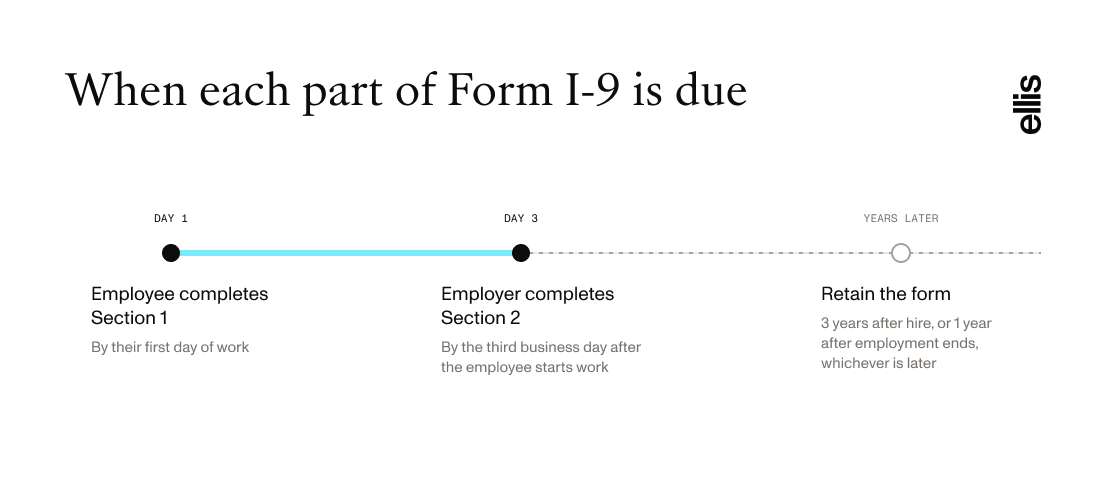
- There are a few important deadlines. Employees must complete Section 1 by their first day, and employers should also complete Section 2 within three business days.
- Employees choose their documents. Employers review the acceptable documents employees choose to provide.
- I-9 records have specific retention requirements. Employers generally keep each form for three years after hire or one year after employment ends, whichever is later.
Need help managing I-9 compliance? Ellis combines immigration attorney guidance with technology to keep documents, deadlines, tasks, and immigration workflows organized in one place.
What Is Form I-9?
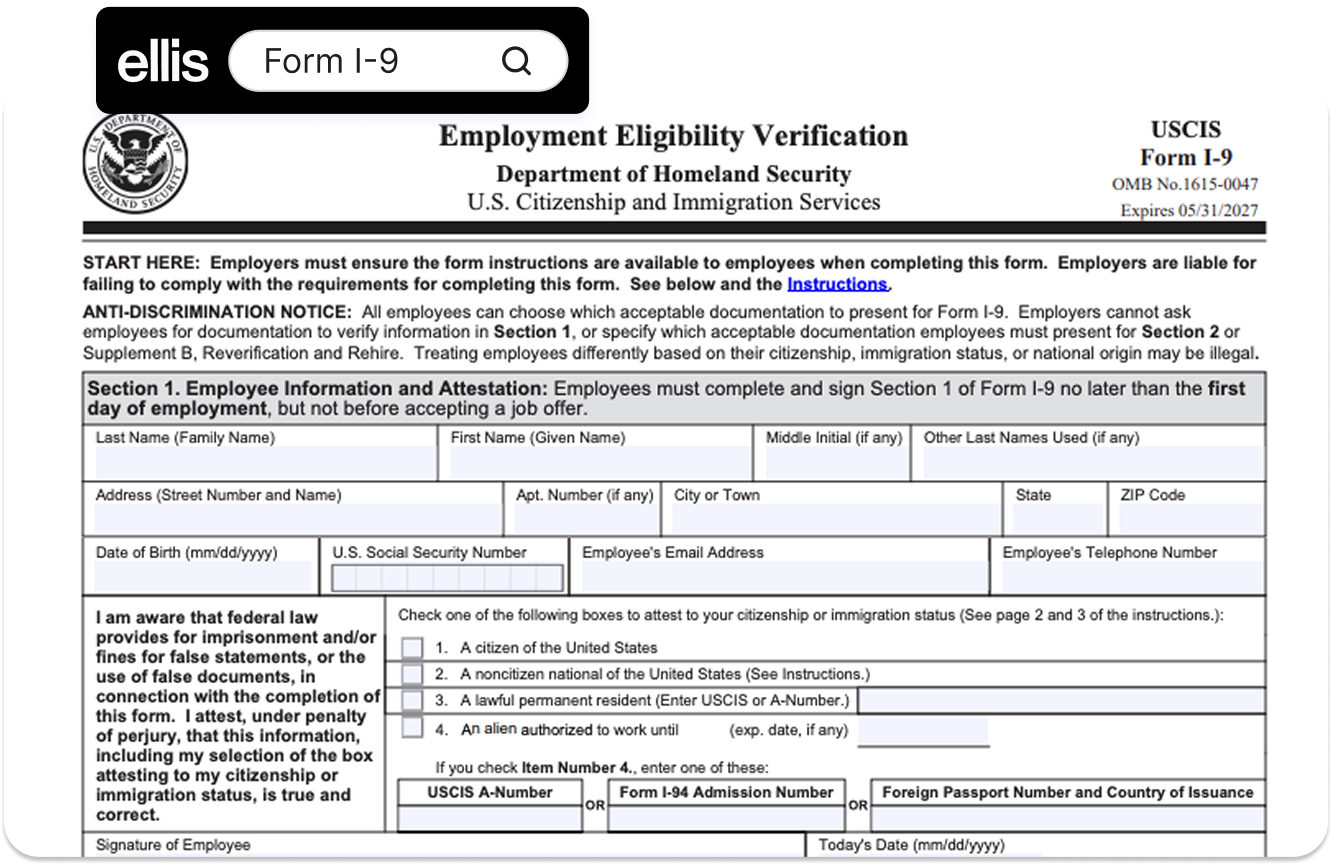
Form I-9, Employment Eligibility Verification, is the federal form used to document an employee's identity and authorization to work in the United States. It is administered by U.S. Citizenship and Immigration Services (USCIS), part of the Department of Homeland Security, and grew out of the Immigration Reform and Control Act.
The employee attests to their citizenship status or immigration status, then provides documents so the employer can verify who they are and that they can work. The employee does not have to be a U.S. citizen. A person may establish employment authorization in several ways, depending on their status and the DHS-issued documents they hold.
What Is Form I-9 Compliance?
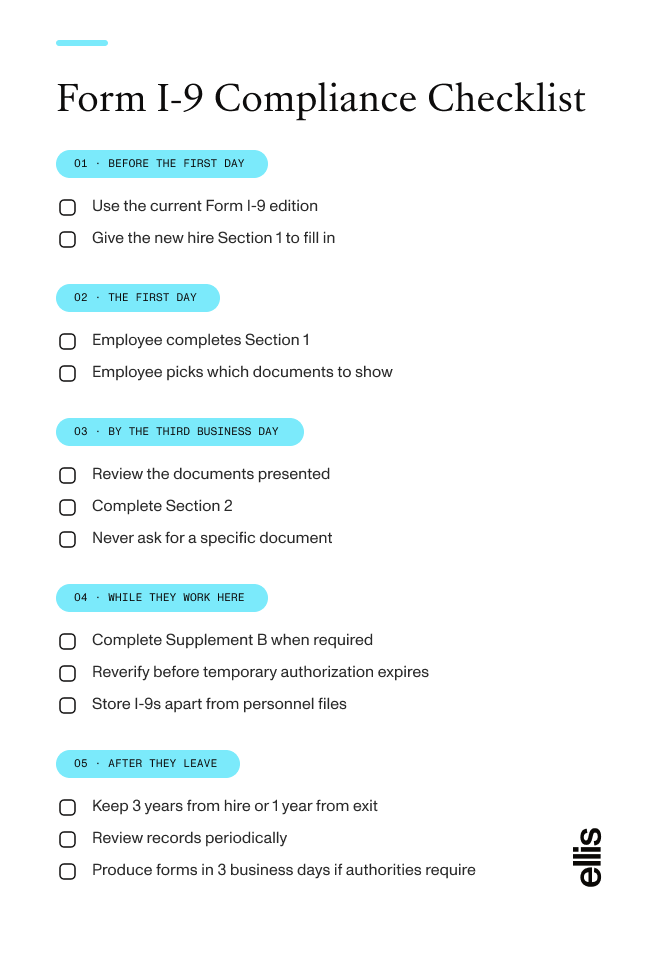
Form I-9 compliance means using the current form, giving the employee the chance to complete Section 1, completing Section 2 on time, reviewing whatever acceptable documents the employee presents, recording the information accurately, correcting errors properly, storing the form securely, and keeping it for the required period.
It is an ongoing process. It starts when an employee is hired and continues for years after they leave, because the retention clock runs past the last day of work.
What Changed for I-9 Compliance in 2026?
Two changes matter for employers in 2026:
- I-9 errors carry monetary penalties. In March 2026, ICE changed its guidance and reclassified certain errors as substantive violations, including missing an employee’s legal name or date of birth, incomplete document information, a missing Alien Registration Number when required, an undated Section 1, and incomplete employer representative information. Keeping copies of employee documents does not make an incomplete Form I-9 compliant.
- Employers should use the current Form I-9 edition. The current edition is dated 01/20/25 and expires 05/31/2027. Properly completed forms from a previous edition generally do not need to be redone simply because that edition has expired.
Form I-9 Compliance Checklist
Who Needs to Complete Form I-9?
Employers generally must complete Form I-9 for every employee hired in the United States, full-time and part-time alike.
Form I-9 generally does not apply to bona fide independent contractors. An employer should not use a contractor classification to avoid the requirement, since the answer depends on the actual relationship, not the label. If the person is an employee, the obligation applies even when the role or work arrangement is unusual.
Some federal contractors must participate in E-Verify under their contract terms. That obligation sits on top of the basic Form I-9 requirement, so a company holding federal contracts should check what its specific contracts require for employment eligibility verification.
Who Completes Form I-9?
The employee completes Section 1 by their first day of work, giving their name, address, date of birth, Social Security number where applicable, and citizenship or immigration status. They also choose which documents to present.
The employer completes Section 2 within three business days of the first day of work, after reviewing those documents. Collecting copies is not enough. The completed form needs the required information, signatures, and dates.
What Documents Are Acceptable for Form I-9?
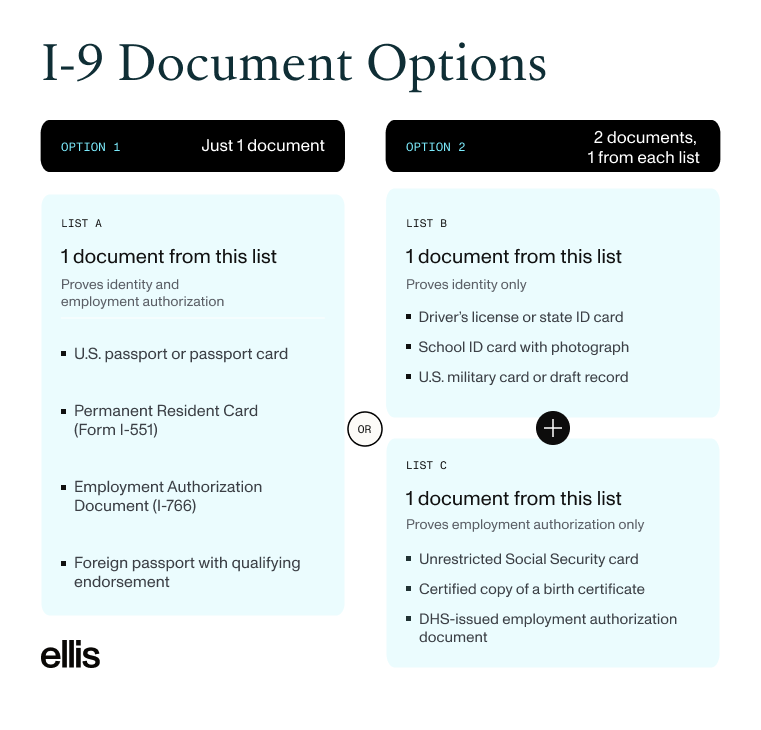
Employees present documents from the Lists of Acceptable Documents, which fall into three categories:
- List A establishes both identity and employment authorization. A U.S. passport, a Permanent Resident Card, and a qualifying Employment Authorization Document (EAD) all belong here.
- List B establishes identity only. A driver's license is the common example.
- List C establishes employment authorization only, such as an unrestricted Social Security card.
An employee provides either one List A document, or one List B document plus one List C document. A Green Card or an EAD is enough on its own. A driver's license never is.
Can an Employer Require Specific Documents?
No. The employee chooses which acceptable documents to present, and the employer reviews what is offered. An employer cannot tell a new hire to provide a Permanent Resident Card when another acceptable combination would do.
This applies no matter what the employee attested to in Section 1. Asking for extra or specific documents because of someone's citizenship or immigration status can create document abuse and discrimination concerns. The same rules apply to every employee.
What About Expired Documents?
An expiration date does not automatically mean a document should be rejected. The rules depend on what the document establishes, so expired documents that prove identity are handled differently from those that prove temporary employment authorization. Follow the rule for the specific document rather than setting a blanket policy.
Form I-9 Deadlines
Requirement | Deadline |
|---|---|
Employee completes Section 1 | By the first day of work |
Employer completes Section 2 | By the third business day after the first day of work |
Employer completes Supplement B | When required for reverification or rehire |
Form I-9 retention | 3 years after hire or 1 year after termination, whichever is later |
Forms I-9 produced for ICE inspection | At least 3 business days after a Notice of Inspection |
Two of these are three-business-day deadlines and they are unrelated. One runs from the employee's first day of work. The other runs from an ICE Notice of Inspection.
How Long Must Employers Keep Form I-9?
Employers keep each Form I-9 for the later of three years after the hire date or one year after employment ends. That means calculating the date per employee rather than clearing out every former employee's file on the same schedule.
Take an employee hired January 1, 2026 who leaves June 1, 2028. Three years from hire is January 1, 2029. One year from the last day is June 1, 2029. The later date wins, so the form is kept through June 1, 2029.
Should I-9s Be Stored With Personnel Files?
They do not have to be, and USCIS recommends keeping them separate. Separate storage protects sensitive information and lets an employer respond to an inspection without handing over unrelated personnel records. For employers with many current and former employees, one central system also makes hire dates, expiration dates, corrections, and retention dates easier to track.
What Happens During an I-9 Inspection?
Immigration and Customs Enforcement can inspect an employer's I-9 records. The inspection begins with a Notice of Inspection, and employers generally have at least three business days to produce the requested forms.
ICE reviews the forms for missing or incomplete sections, incorrect information, missing signatures, late completion, substantive violations, and evidence of knowingly hiring or continuing to employ unauthorized workers. Employers may also need to provide related documents depending on what ICE requests.
What Are the Penalties for I-9 Violations?
Non-compliance can result in civil penalties and, in some circumstances, criminal charges. Current 2026 ranges:
Violation | Penalty range |
|---|---|
Substantive paperwork violation | $288 to $2,861 per Form I-9 |
Knowing hire or continued employment of an unauthorized worker, first offense | $716 to $5,724 per worker |
Second offense | $5,724 to $14,308 per worker |
Third or subsequent offense | $8,586 to $28,619 per worker |
These amounts are adjusted annually for inflation, and the exact figure depends on the violation and the enforcement factors that apply. Note that the $28,619 ceiling is not a paperwork penalty. It is the top of the third-offense range for knowingly employing an unauthorized worker.
What Are Substantive Violations?
A substantive violation is an error or omission that can carry a monetary penalty, as opposed to a technical error an employer is given the chance to fix. It can involve required information in Section 1 or 2, document details, signatures, or dates.
The line moved in March 2026. Errors employers used to treat as correctable, including missing information, missing signatures, incorrect dates, using the wrong form edition, and completing a section late, can now draw a penalty instead of a request to fix the form.
Does E-Verify Replace Form I-9?
No. Form I-9 documents identity and employment authorization. E-Verify is an electronic system that participating employers use to check that information against Department of Homeland Security and Social Security Administration records. Employers enrolled in E-Verify still complete Form I-9, and they take on additional requirements, including when an employee must supply a Social Security number in Section 1.
What Is Remote I-9 Verification?
Eligible employers may use a DHS-authorized alternative procedure to examine documents remotely instead of in person. It has specific requirements, including a live video interaction with the employee and the required document-review steps.
Asking a new hire to email a photo of their documents does not satisfy the procedure. Employers using remote verification, especially those with remote and hybrid teams, should confirm their process meets the current DHS requirements.
What Is Supplement B?
Supplement B, Reverification and Rehire, documents reverification or rehire information. Reverification may be required when an employee's temporary employment authorization expires and they need to establish continued work authorization.
Not every document triggers it. Employers generally do not reverify U.S. passports or Permanent Resident Cards just because they expire, so check the specific document before reverifying.
Common Form I-9 Compliance Mistakes
Most I-9 problems come from a step being missed, not from a hard legal question.
- Missing the Section 2 deadline. It is the third business day after the employee starts work.
- Asking for a specific document. The employee chooses.
- Writing your own expiration date rules. Follow the rule for the document in hand.
- Using an outdated form. Check the edition date before every new hire.
- Forgetting former employees. The retention clock runs past the last day of work.
- Correcting forms informally. Use the proper correction process and preserve the record of it.
How Ellis Helps Employers Manage Compliance
Ellis keeps your program's immigration compliance organized in one place, with attorney guidance when needed.Want a simpler way to manage immigration compliance? Get in touch.